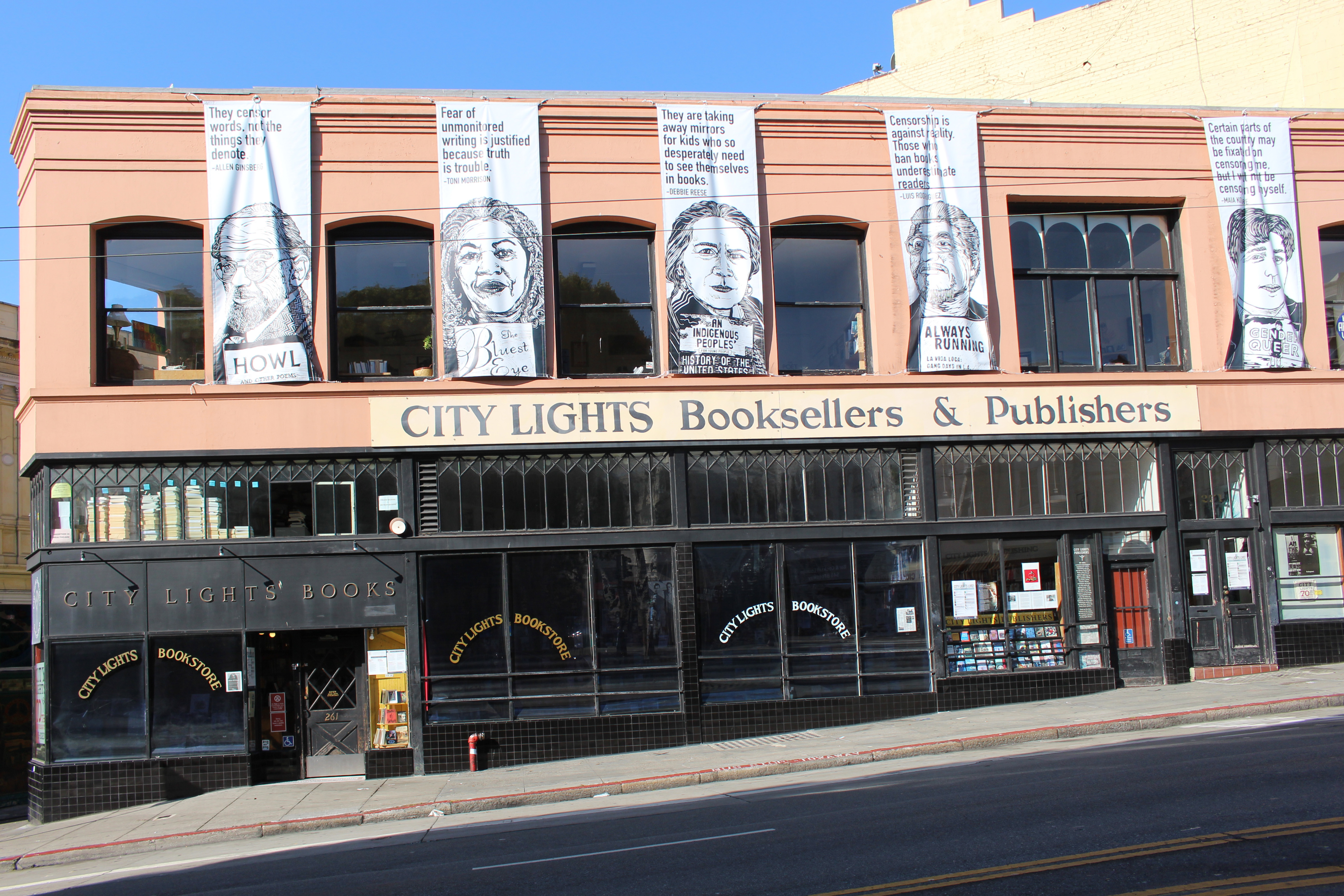
City Lights Bookstore
In 1957, Lawrence Ferlinghetti was arrested for publishing obscenity. The book in question was Allen Ginsberg's Howl and Other Poems, printed by Ferlinghetti's small publishing house, City Lights Books, and sold from his bookstore at 261 Columbus Avenue in San Francisco's North Beach neighborhood. The obscenity trial became a landmark First Amendment case that Ferlinghetti won, establishing the legal protection of literary expression in America. The store, the press, and the poem together created a nexus of literary and cultural revolution that turned a small bookshop into one of the most important literary institutions in American history.
The Pocket Bookshop
Ferlinghetti and Peter D. Martin founded City Lights in 1953 as the first all-paperback bookstore in the country. The name came from the Charlie Chaplin film. The concept was democratic: make literature accessible and affordable, stocking the kind of world literature, poetry, and progressive political writing that larger bookstores ignored. The store's three-story layout, with its narrow aisles and hand-lettered staff recommendations, created an atmosphere that was half bookshop and half literary salon. Ferlinghetti soon bought out Martin's share and began the publishing arm, City Lights Books, launching the Pocket Poets Series that would change American literature.
Howl and the Trial
City Lights Books published Howl and Other Poems in 1956 as number four in the Pocket Poets Series. U.S. Customs seized copies of the book at the border, and San Francisco police arrested Ferlinghetti and the store's manager, Shigeyoshi Murao. The ensuing trial, People v. Ferlinghetti, attracted national attention and the support of the ACLU. Judge Clayton Horn ruled that Howl had redeeming social importance and was not obscene. The verdict established a precedent that protected publishers of controversial literary works. It also made City Lights famous, transforming a small North Beach bookstore into a symbol of intellectual freedom.
The Beat Cathedral
City Lights became the unofficial headquarters of the Beat literary movement. Jack Kerouac, Gregory Corso, Gary Snyder, Michael McClure, and Ginsberg himself congregated at the store and at the neighboring Vesuvio Cafe. The bookstore published many of their works and provided a physical gathering place for a literary community that was geographically scattered but spiritually centered on North Beach. Ferlinghetti, who died in 2021 at 101, maintained the store's independence through decades of rising rents and changing neighborhoods. City Lights survives as both a working bookstore and a literary shrine, its shelves still stocked with the world literature, poetry, and progressive politics that Ferlinghetti believed every reader deserved access to.
From the Air
City Lights Bookstore is at 37.80N, -122.41W, on Columbus Avenue in San Francisco's North Beach neighborhood, near the intersection with Broadway. The distinctive triangular building is in the heart of the Italian-American neighborhood, near the Transamerica Pyramid and Coit Tower. Nearest airports: KSFO 12nm south, KOAK 8nm east.