City Museum: The Wildest Building in America
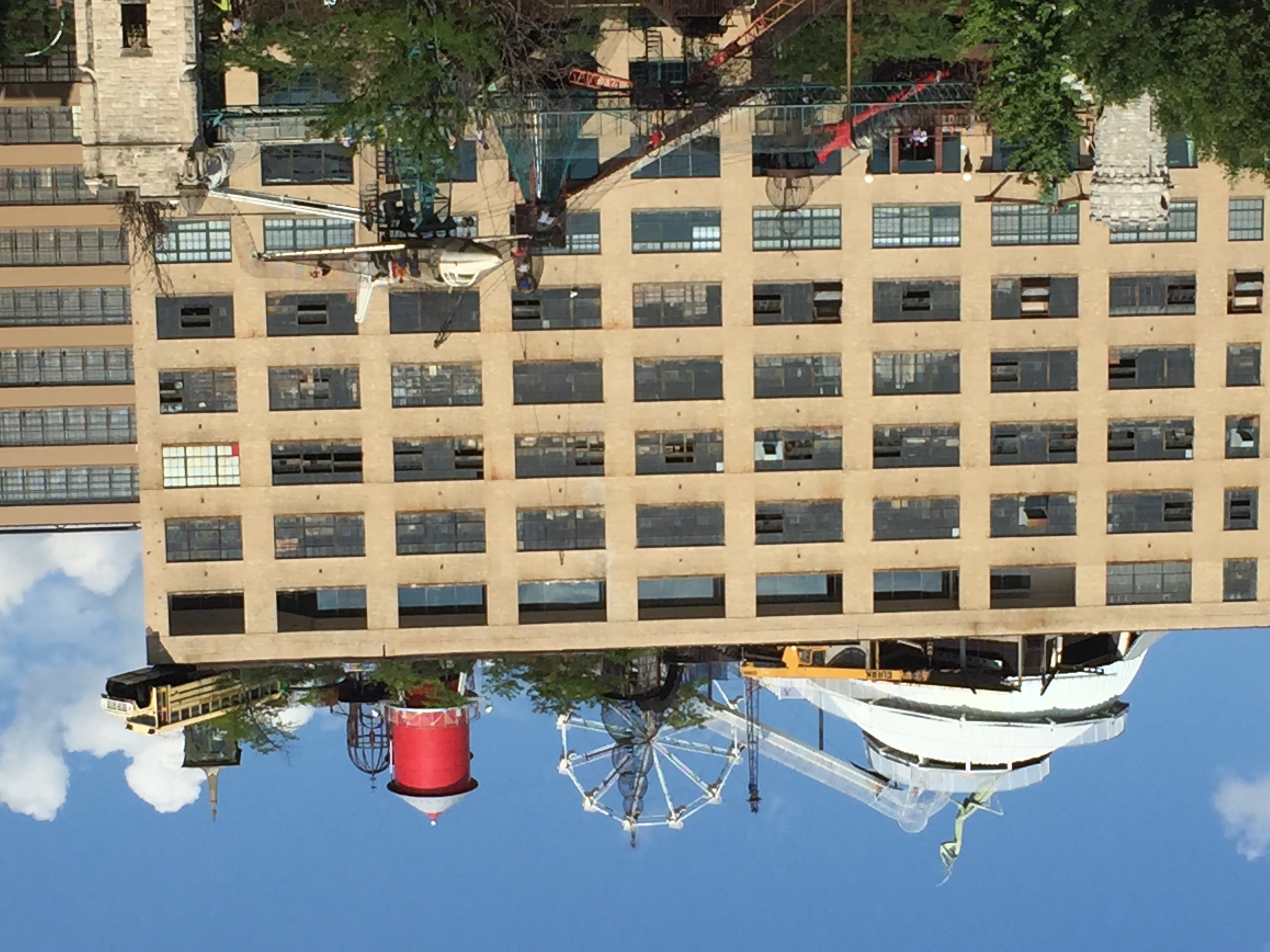
There is a school bus hanging off the roof. Two fighter jet fuselages are suspended in midair above the entrance. A 24-foot metal praying mantis crouches atop a dome salvaged from the St. Louis Science Center. Inside, visitors crawl through tunnels made from old refrigerating coils, slide down ten-story spiral chutes that once moved shoes through a factory, and walk through the belly of a life-size bowhead whale sculpture. This is the City Museum in St. Louis, and it is not really a museum at all. It is the fever dream of sculptor Bob Cassilly, who bought a vacant International Shoe Company factory in 1993 and spent the rest of his life turning it into something no other city on earth possesses.
Bob Cassilly's Obsession
Artist Bob Cassilly and his then-wife Gail purchased the mostly vacant International Shoe building in 1993. Construction began immediately and was shrouded in secrecy until New Year's Eve 1996, when visitors were first allowed inside to glimpse the work in progress. The museum opened to the public on October 25, 1997, anchored by an iconic life-size whale sculpture in the lobby. Within two years, it drew 300,000 visitors annually. By 2010, that number exceeded 700,000. Cassilly was artist, welder, visionary, and construction foreman rolled into one, working alongside his crew to hand-sculpt the elaborate Enchanted Caves that wind through the center of the building from the first floor to the tenth. He remained the museum's artistic director until his death in 2011.
Ten Floors of Impossible
The first floor sets the tone: a life-size bowhead whale you can walk through, tunnels running across the ceiling hidden behind aircraft Kevlar cut to resemble icicles, and a tree house that spans three stories. The floor itself is covered with what is described as the largest continuous mosaic in the United States. Below the first floor, the Underground Whaleway tunnel leads to the Original Caves. Above, the Enchanted Caves, opened in 2003, are an elaborate system of tunnels hand-sculpted by Cassilly and his crew. The Shoe Shafts, spiral slides built from the factory's original shoe distribution chutes, include a ten-story slide from the roof to the cave entrance. The second floor houses the Vault Room, an 1870s bank vault with two 3,000-pound doors and about 1,000 safety deposit boxes, plus the Shoelace Factory, where machines from the 1890s produce custom laces.
Circus, Pencil, and Ferris Wheel
The third floor hosts the Everyday Circus, a working circus school that performs daily. Nearby, the museum displays the world's largest pencil, more than 76 feet long, weighing 21,500 pounds with 4,000 pounds of graphite and a 250-pound rubber eraser, created by Ashrita Furman and donated in 2009. Beatnik Bob's features the self-proclaimed World's Largest Underwear and a collection of vintage pinball and video games. On the roof, a small old-fashioned Ferris wheel installed in 2006 offers views of downtown St. Louis, while a school bus extends past the edge of the building, its driver's door openable by visitors brave enough to walk inside. The 24-foot praying mantis sculpture stands guard atop a salvaged dome, accessible by metal ladders.
MonstroCity and the Cabin Inn
The outdoor installation called MonstroCity greets visitors before they enter the building. Two Sabreliner 40 aircraft fuselages hang suspended high in the air alongside a fire engine, a castle turret, four-foot-wide Slinkies you can crawl through, and climbing structures that lead to slides. Beneath MonstroCity sits the Cabin Inn, an early-19th-century log cabin originally owned by the son of Daniel Boone. The Hezel family held it for more than a century before it became a bar and entertainment venue within the museum complex. The juxtaposition is pure City Museum: a frontier-era log cabin sitting beneath suspended jet planes, all welded together into something that makes no sense and perfect sense simultaneously.
Legacy of the Oddball Mind
The City Museum has been named one of the great public spaces by the Project for Public Spaces and was ranked among the best immersive art experiences in the country by USA Today readers in 2025. After Cassilly's death in 2011, ownership passed through David Jump of American Milling to Premier Parks, a water and amusement park company, in 2019. The transition from a singular artist's vision to corporate ownership raised questions about the museum's future, but the building itself resists homogenization. It is too strange, too specific, too deeply the product of one man's relentless creative drive. Housed in the Washington Avenue Loft District of downtown St. Louis, the City Museum remains what it has always been: proof that an abandoned shoe factory and a welder with unlimited imagination can produce something no committee would ever design.
From the Air
Located at 38.63N, 90.20W in the Washington Avenue Loft District of downtown St. Louis, Missouri. From altitude, the museum occupies a large industrial building identifiable by the MonstroCity installation visible on the exterior, including suspended aircraft fuselages and the rooftop Ferris wheel. The Gateway Arch and Mississippi River are approximately half a mile east. Nearest major airport is St. Louis Lambert International (KSTL). The building is within the dense downtown grid.