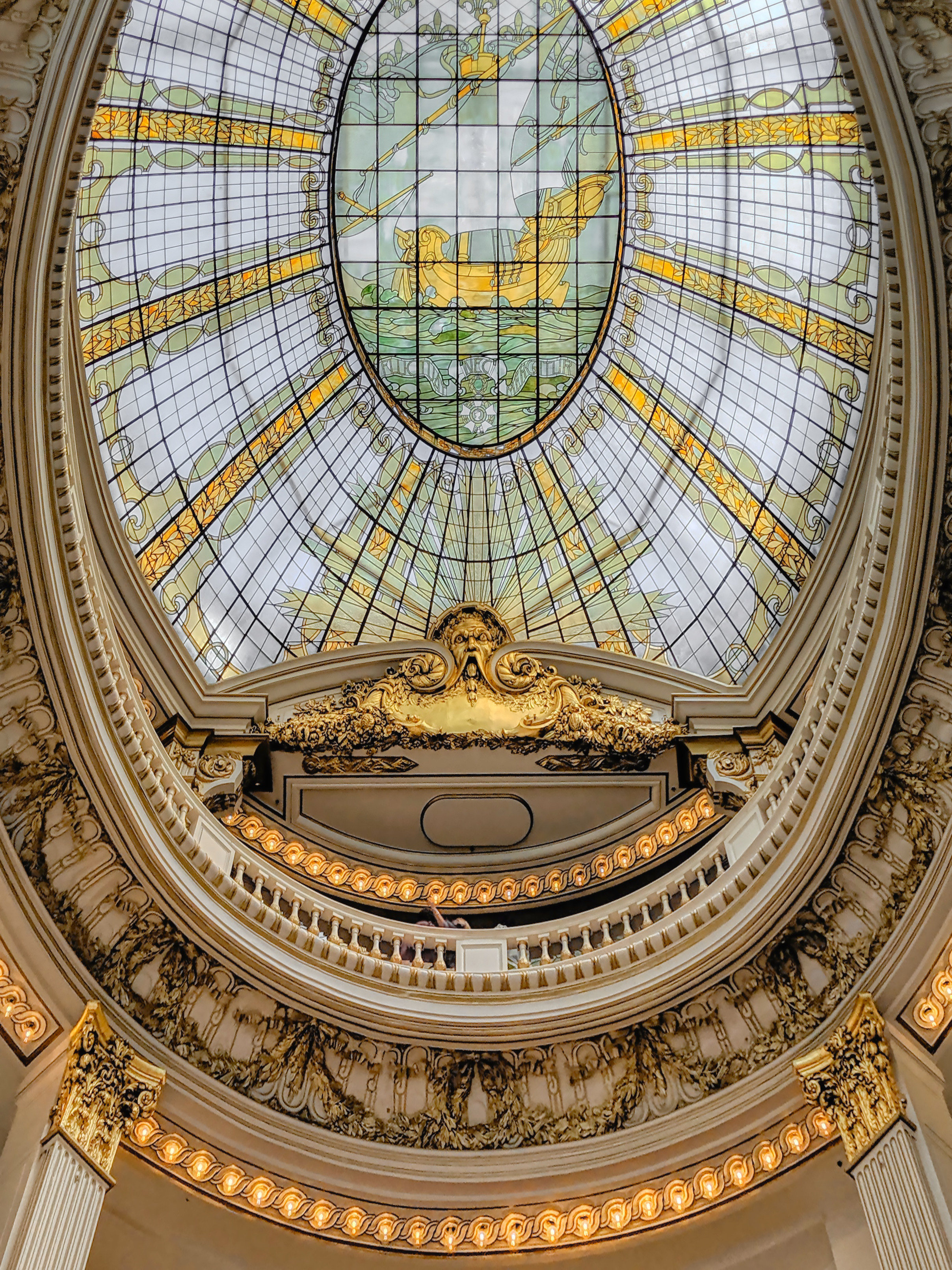
City of Paris Dry Goods Co.
In May 1850, a French ship named Ville de Paris -- City of Paris -- sailed through the Golden Gate carrying dry goods from France. Emile Verdier had chartered the vessel to sell merchandise to the gold-hungry men of San Francisco, and the ship's name became the store's name. For 122 years, the City of Paris Dry Goods Company stood diagonally opposite Union Square, one of San Francisco's great department stores, a piece of the Gold Rush era that persisted into the age of suburban malls. When it finally closed in 1972 -- not bankrupt, but no longer profitable -- the building's fate ignited one of the city's bitterest preservation battles.
Arrival by Sea
The Verdier brothers, Felix and Emile, founded the store in the chaotic commerce of Gold Rush San Francisco. Emile arrived with a shipload of goods from France, set up shop near the waterfront, and discovered that miners who had struck it rich would pay extravagant prices for European finery. The store grew from a waterfront trading post into a proper department store, moving to its landmark location opposite Union Square. The City of Paris remained under Verdier family ownership and management for its entire existence -- a family business that spanned the Gold Rush, the 1906 earthquake, two world wars, and the rise and fall of downtown retail.
The Rotunda and the Dome
The store's architectural centerpiece was a soaring rotunda topped by a stained-glass dome that filled the interior with colored light. Shoppers entering the City of Paris looked up into a space that felt more like a cathedral than a department store -- a deliberate evocation of the grands magasins of Paris that the Verdier family had left behind. The dome became the store's identity, the image that San Franciscans carried in their memory long after the merchandise was forgotten. When demolition threatened in the late 1970s, it was the dome that preservationists fought hardest to save.
The Preservation Fight
After Liberty House of Hawaii purchased and briefly operated the building, it changed hands again and demolition was proposed to make way for a new Neiman Marcus store. Preservation advocates argued that the building was irreplaceable -- a physical link to Gold Rush-era commerce and a masterpiece of early 20th-century retail architecture. They lost the larger battle: the building was demolished in 1980. But they won a concession that has proved remarkably enduring. The original rotunda and stained-glass dome were preserved and incorporated into Philip Johnson's new Neiman Marcus design, floating inside a modern structure like a jewel in a setting it never chose.
A Dome in Exile
Today, the City of Paris dome rises inside the Neiman Marcus store at 150 Stockton Street, visible to anyone who looks up from the cosmetics counter. It is a strange survival -- an architectural orphan living inside the building that replaced its home. The dome's presence acknowledges what San Francisco lost and what it managed to salvage. The store that began with a French ship in 1850 exists now only as a ceiling, casting the same colored light it always did, over shoppers who may not know the name City of Paris but who still pause, instinctively, to look up.
From the Air
Located at 37.7874°N, 122.4065°W at the corner of Stockton and Geary Streets, diagonally opposite Union Square in downtown San Francisco. The current Neiman Marcus building contains the preserved City of Paris dome. Best viewed at 2,000-3,000 feet AGL. Nearest airports: KSFO (11 nm south), KOAK (10 nm east). Union Square is identifiable as the open plaza in the dense downtown grid.