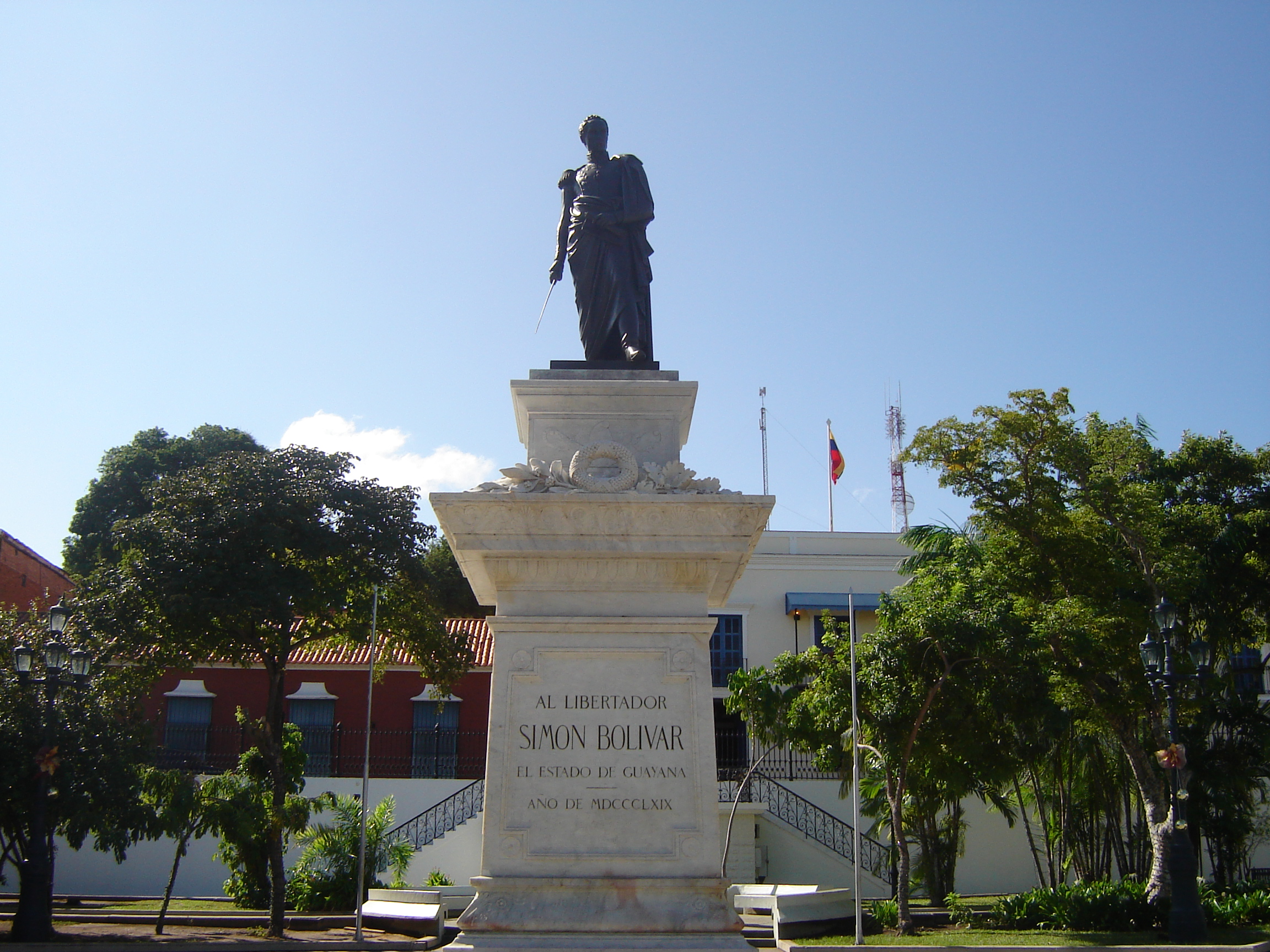
Ciudad Bolivar
Every cocktail with a dash of Angostura bitters carries a trace of this city's history. In the 1820s, a German surgeon in Simon Bolivar's army developed the recipe here, when the city was still called Angostura -- 'the narrows' -- for the point where the Orinoco River squeezes between rocky banks before continuing its long journey to the Atlantic. The bitters left for Trinidad long ago, but the city kept its revolutionary name: Ciudad Bolivar, renamed in 1846 for the liberator who made it his provisional capital.
Capital of a Revolution
The city's strategic position on the Orinoco made it a prize worth fighting for. Founded as a Spanish settlement in 1764 under the unwieldy name San Tomas de la Nueva Guayana de la Angostura, it controlled river traffic into Venezuela's vast southern interior. In July 1817, Bolivar's forces captured Angostura and gained control of the Orinoco, turning the city into the provisional capital of the republic. The Congress of Angostura convened here on February 15, 1819 -- a gathering that would lead to the creation of Gran Colombia, the short-lived nation uniting Venezuela, Colombia, Ecuador, and Panama. Bolivar delivered his famous Angostura Address in the city's congress hall, laying out his vision for South American governance. The colonial buildings where these debates took place still stand in the historic district, their facades faded but intact.
Gateway to the Tepuys
Today Ciudad Bolivar serves as the jumping-off point for expeditions into the Gran Sabana and Canaima National Park. The Jose Tomas de Heres Airport, located in the center of the city, handles flights to Canaima village and the remote airstrips scattered across the tepuy country to the south. Outside the terminal sits an unlikely artifact: the restored Flamingo monoplane of Jimmie Angel, the American bush pilot who first spotted Angel Falls from the air in 1933 and crash-landed atop Auyan-tepui four years later. His plane spent 33 years on the summit before a helicopter retrieved it. Now it rests at sea level, pointed at the sky it once navigated, a monument to the kind of reckless ambition that the Venezuelan interior has always inspired.
Where the Orinoco Draws the City's Shape
The Angostura Bridge, a suspension span completed in 1967, connects Ciudad Bolivar to the rest of Venezuela across the Orinoco. For most of the city's history, the river was crossed by ferry, and the narrows that gave Angostura its name made this one of the few practical crossing points for hundreds of kilometers. The city grew along the southern bank, its colonial core hugging the waterfront where warehouses once stored goods moving between the coast and the interior. A freeway now links Ciudad Bolivar to Ciudad Guayana, the industrial center downstream, but the old city retains a pace and architecture that its larger neighbor has largely abandoned.
A City of Unexpected Artists
Ciudad Bolivar has produced a remarkable concentration of musicians and artists for a provincial capital. The kinetic artist Jesus Rafael Soto, born here in 1923, became one of the most important Venezuelan artists of the twentieth century, and the museum bearing his name -- designed by architect Carlos Raul Villanueva -- houses 350 works of modern and kinetic art. Guitarist and composer Antonio Lauro, considered one of the foremost South American composers for the guitar, was born here in 1917. Cheo Hurtado, a virtuoso of the cuatro, and Ivan Perez Rossi, founder of the folk group Serenata Guayanesa, also call this city home. Even the local cuisine carries a creative streak: cassava bread, cashew desserts, and the spicy Catara sauce made from cassava juice, which locals claim is an aphrodisiac.
The Narrows Hold
Ciudad Bolivar occupies a peculiar position in Venezuela's geography -- too far south for the coastal economy, too far north for the wilderness, straddling the line between settled country and the vast, sparsely populated interior of Bolivar State, the largest state in Venezuela. The economy runs on agriculture, cattle, and increasingly on tourism. Fencer Ruben Limardo, who won Olympic gold in London in 2012, and baseball player Victor Martinez both came from here, adding sports to the city's list of exports. But the city's deepest identity remains tied to the river and the narrowing that first made this spot worth defending. The Orinoco still squeezes through, as it has for millennia, indifferent to the revolutions and renamings that have happened along its banks.
From the Air
Located at 8.10N, 63.55W on the south bank of the Orinoco River. The city is identifiable by the Angostura Bridge spanning the Orinoco at its narrowest point. The Jose Tomas de Heres Airport (SVCB) is located in the center of the city. Look for the colonial historic district along the waterfront and the distinctive river narrows. From here, the Gran Sabana and tepuy country lie approximately 300 nm to the south-southeast. Best viewing altitude: 2,000-4,000 feet AGL. The Orinoco is a major visual reference for navigation throughout the region.