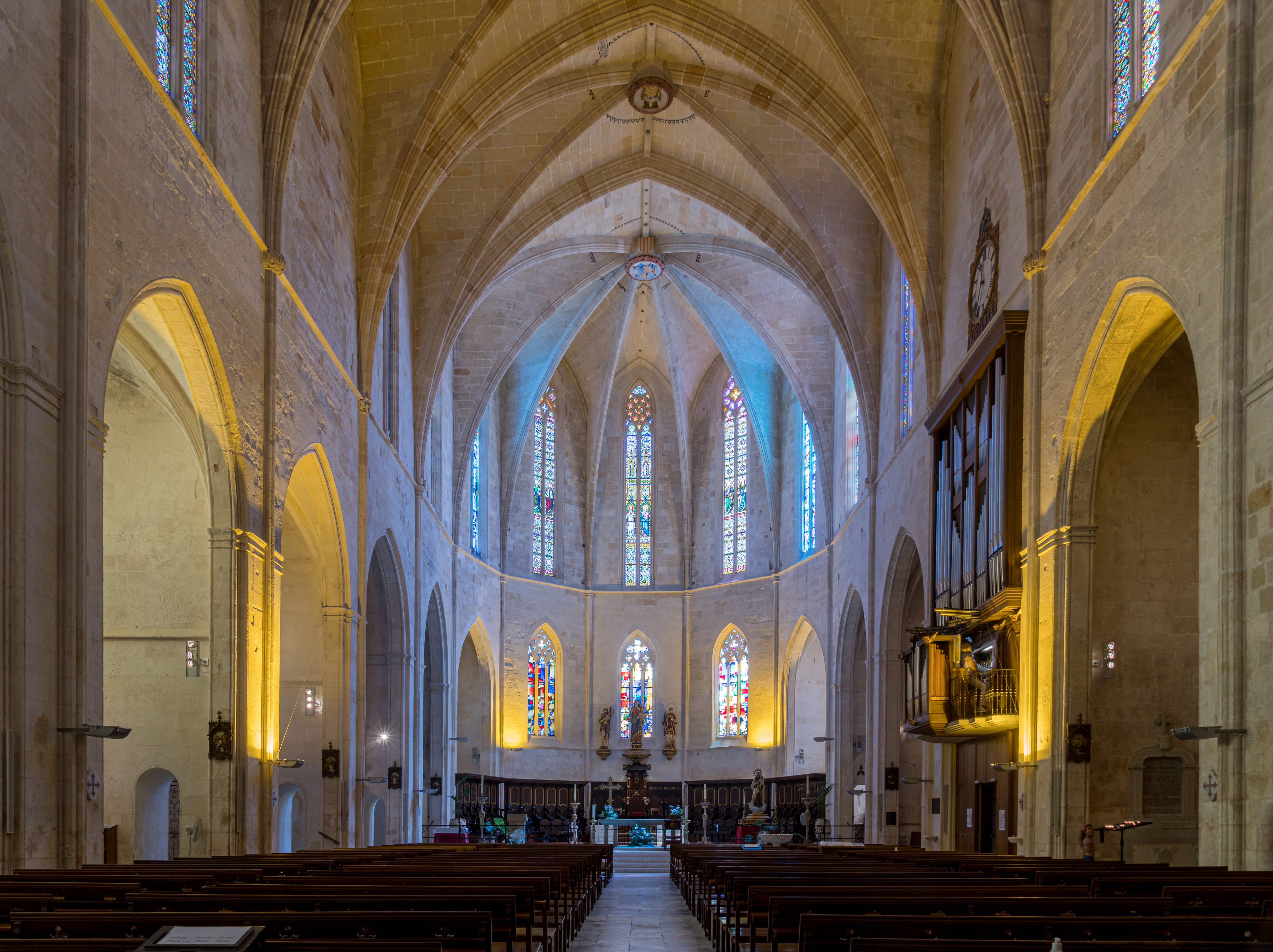
Ciutadella de Menorca Cathedral
They called the side door the Porta de la Llum -- the Portal of the Light. Step through it into the Cathedral-Basilica of Saint Mary in Ciutadella de Menorca and you enter a space shaped by seven centuries of destruction and devotion, a single wide nave flanked by twelve chapels that has been gutted and rebuilt so many times it has become less a building than a statement of persistence. What stands today is not the original. It is not even the second version. It is the latest answer to a question Menorca keeps asking: what survives?
From Minaret to Bell Tower
When King Alfonso III of Aragon conquered Menorca in 1287, his soldiers found a mosque at the heart of Ciutadella. Alfonso ordered a church built on its foundations, and construction began in 1300. Over the next sixty-two years, masons raised a structure in the Catalan Gothic style -- a tradition that favored width over height, creating broad naves that felt more like gathering halls than the soaring vertical cathedrals of northern France. The result was distinctive: a single expansive nave flanked by six chapels on each side, oriented with a five-sided apse facing east toward Jerusalem. The stone carried the warmth of the Menorcan limestone, golden in afternoon light, cool to the touch even in summer.
The Ottoman Reckoning
In 1558, the Ottoman admiral Piali Pasha brought devastation to Ciutadella. His forces sacked the city and desecrated the cathedral, leaving the interior gutted and the population traumatized. When the vaults of the apse collapsed in 1626, the damage might have been reason enough to start over in a newer style. Instead, the repairs were carried out in the original Gothic manner, a deliberate act of architectural memory. The Menorcans chose continuity over fashion, rebuilding what had been rather than reimagining what might be. That decision preserved the cathedral's medieval character through centuries when Baroque grandeur was reshaping churches across Spain.
Layers of Style, Layers of Power
In 1795, Menorca's ancient bishopric -- which traced its origins to the 5th century -- was restored, and the parish church of Ciutadella became a cathedral. Bishop Juano rebuilt the main facade in 1813, choosing the neoclassical style then in vogue. The result is a striking architectural collision: a clean-lined classical entrance opening into the shadowy depths of a Gothic interior. At the back of the apse, under an image of the Virgin, sits the episcopal throne carved from Roman marble blessed by Pope Pius XII -- a physical link between this island church and St. Peter's Basilica in Rome. In 1953, the same pope elevated the cathedral to the rank of minor basilica, a rare honor acknowledging both its historical significance and its congregation's endurance.
Fire and Restoration
The Spanish Civil War brought a second devastation. In the first days of the conflict in 1936, the cathedral was sacked and desecrated again. Altarpieces were destroyed, chapels stripped, sacred objects scattered or lost. Bishop Bartolome Pascual oversaw the restoration between 1939 and 1941, reshaping the interior into its current form. During this work, the choir was moved from the nave to the apse, opening up the broad central space. The great altar -- a marble monolith beneath a canopy reaching fifteen meters high -- anchors the interior today. Nearby, the Baroque chapel of the Angelus, dating from the early 17th century, survived both catastrophes with its exquisitely carved columns intact, a pocket of ornamental calm amid the rebuilt severity.
A Living Stone
In 1987, marking the seventh centennial of Alfonso III's conquest, a new restoration and development plan began, treating the cathedral not as a relic to be frozen in time but as a living building still finding its form. Walk through the Porta de la Llum today and you see traces of every century layered into the walls: the Gothic bones of the 14th-century nave, the Baroque flourishes of the 17th-century chapel, the neoclassical facade of the 19th century, and the careful reconstructions of the 20th. No single era owns this space. It belongs, instead, to the accumulated weight of return -- of a community that has been knocked down, gutted, and rebuilt, and whose cathedral tells exactly that story in stone.
From the Air
Located at 40.00N, 3.84E on the western coast of Menorca in the Balearic Islands. The cathedral is visible from low altitude within the old town of Ciutadella. Nearest airport is Menorca Airport (LEMH), approximately 40 km to the east. Approach from the west over the Mediterranean for the best view of the town's historic waterfront and the cathedral's neoclassical facade rising above the rooftops.