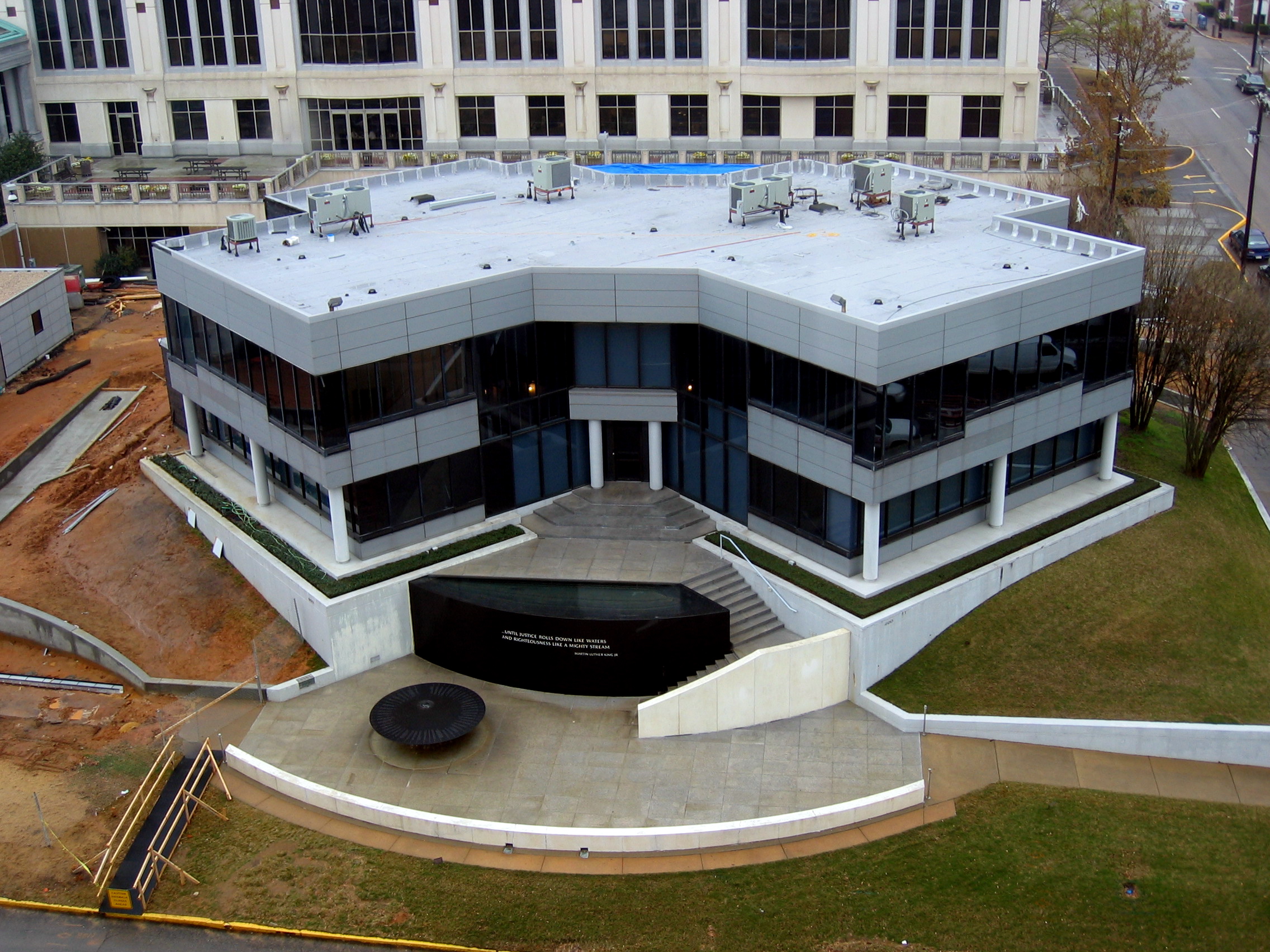
Civil Rights Memorial
Water moves across the names. It rises from the center of a circular black granite table and flows outward, a thin, even sheet that visitors reach through to trace the engraved letters with their fingertips. Forty names are inscribed there, arranged along a timeline of the civil rights movement from 1955 to 1968, each one a person killed for the cause of racial justice. Behind the table, water slides down a curved granite wall bearing the words Martin Luther King Jr. paraphrased from the Book of Amos: "...until justice rolls down like waters and righteousness like a mighty stream." Maya Lin designed this memorial in Montgomery, Alabama, the same artist who created the Vietnam Veterans Memorial in Washington, D.C. It was dedicated in 1989 and sits at 400 Washington Avenue, sponsored by the Southern Poverty Law Center, just blocks from where the movement's key moments unfolded.
The Architect of Memory
Maya Lin was 21 years old when her design for the Vietnam Veterans Memorial was selected in 1981, a decision that launched one of the most significant careers in American memorial architecture. When the Southern Poverty Law Center commissioned her to create the Civil Rights Memorial, Lin drew inspiration directly from King's speech imagery. She conceived a design where water itself would do the remembering, its constant flow across the names creating a living, tactile connection between visitors and the dead. The circular table functions like a sundial, its timeline radiating outward as water smooths granite into something that invites touch. Lin understood that grief needs a physical gesture, and designed a memorial where reaching through water to feel a name becomes an act of recognition.
The Forty
The timeline spans from 1954, when the Supreme Court's Brown v. Board of Education ruling made legalized segregation a target, to 1968 and the assassination of King himself. The names include some that became national news: Emmett Till, the 14-year-old murdered in Mississippi in 1955. Medgar Evers, the NAACP field secretary shot in his driveway in 1963. James Chaney, Andrew Goodman, and Michael Schwerner, three civil rights workers murdered in Mississippi during Freedom Summer in 1964. Viola Liuzzo, a Detroit housewife shot after the Selma to Montgomery march in 1965. Jimmie Lee Jackson, whose death in Marion, Alabama directly prompted those Selma marches. And Addie Mae Collins, Denise McNair, Carole Robertson, and Cynthia Wesley, four girls killed in the 16th Street Baptist Church bombing in Birmingham in 1963. Others are less widely known but no less dead, no less mourned.
The Forgotten Seventy-Four
Inside the Civil Rights Memorial Center, a separate display identifies 74 additional names. These are people believed to have been killed by racially motivated violence between 1952 and 1968, but whose cases lacked sufficient documentation when the memorial was built. They are called "The Forgotten," though that name serves as accusation as much as description. Their stories often went uninvestigated; local law enforcement frequently had no interest in solving the murders of Black citizens. The Memorial Center preserves their names as an acknowledgment that the 41 inscribed on granite represent a fraction of the actual toll, and that the full cost of racial terror during those years remains uncounted.
A Few Blocks from Everything
The memorial's placement in downtown Montgomery is deliberate in ways that compound with each step. Walk a few blocks and you reach the Dexter Avenue King Memorial Baptist Church, where King pastored from 1954 to 1960 and organized the Montgomery Bus Boycott. Continue up Dexter Avenue to the Alabama State Capitol, where Jefferson Davis became Confederate president and where the Selma to Montgomery marchers arrived in 1965. Nearby stand the corner where Claudette Colvin boarded a bus in March 1955 and refused to give up her seat, nine months before Rosa Parks did the same. The Rosa Parks Library and Museum preserves that story. The Alabama Department of Archives and History anchors the historical record. Montgomery compressed a century of American racial history into a walkable radius, and Lin's memorial sits near its center, water flowing.
From the Air
Located at 32.376°N, 86.303°W in downtown Montgomery, Alabama, at 400 Washington Avenue near the Southern Poverty Law Center headquarters. The memorial plaza is not individually visible from altitude, but sits within the dense downtown grid between the Alabama State Capitol dome (visible landmark on Goat Hill) and the Alabama River. Nearest airport: Montgomery Regional Airport (KMGM, ~9 nm southwest). Best experienced on the ground, but the concentration of civil rights landmarks in this area is remarkable from any perspective.