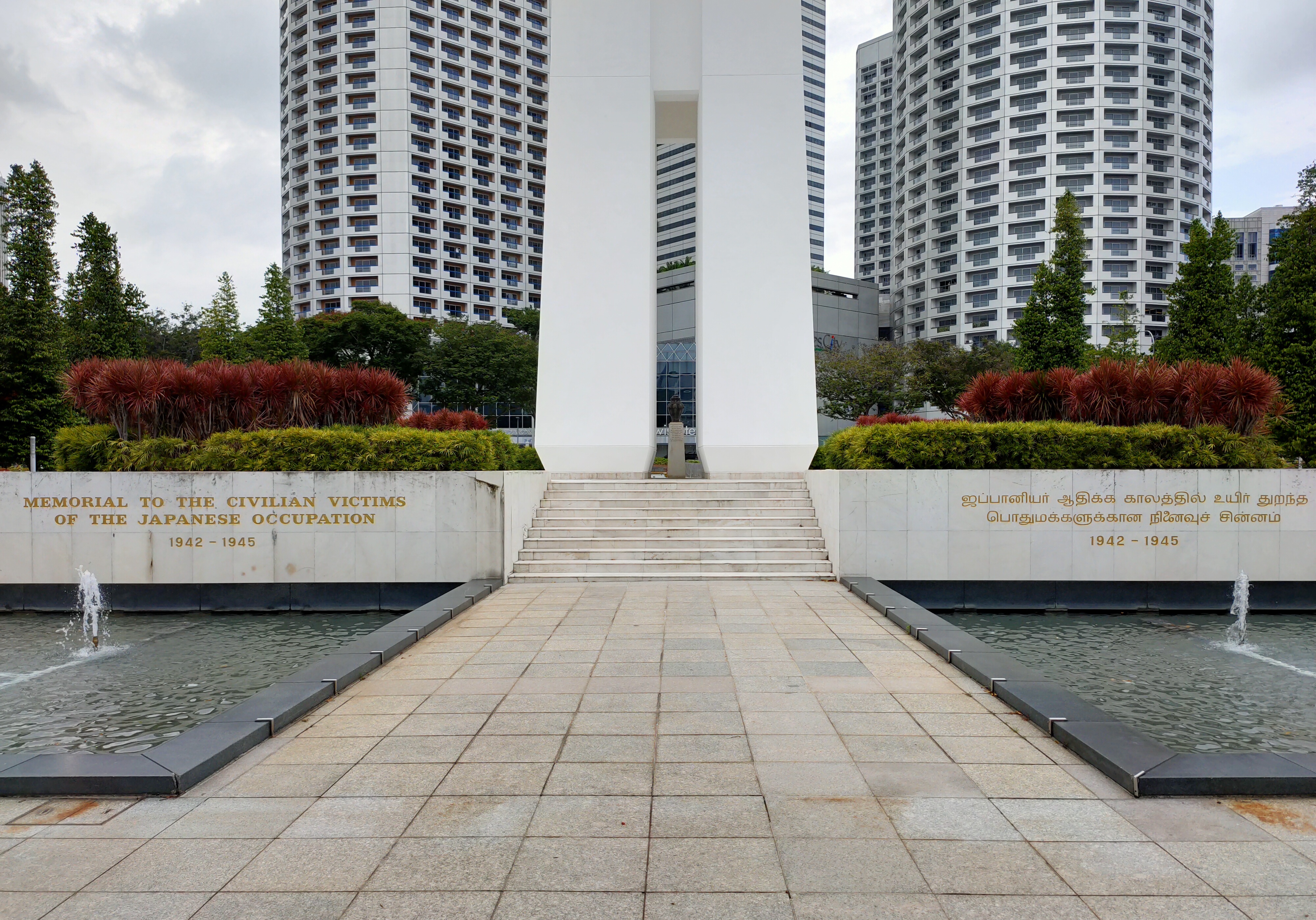
Civilian War Memorial
Singaporeans call them the four chopsticks. The nickname carries the easy irreverence of a city that has learned to live beside its grief, but the four white pillars standing 70 meters tall at Beach Road are anything but casual. They mark the spot where 606 urns of human remains were interred in 1966 -- remains unearthed from mass graves across the island four years earlier, belonging to civilians who never came home during the Japanese occupation of 1942 to 1945. That the memorial stands in War Memorial Park, surrounded by the glass towers and rushing traffic of Singapore's Central Business District, is itself a statement: the city built its future around its dead, not over them.
The Bones Beneath the City
In February 1962, construction workers in Siglap struck bone. Then more bones appeared in Changi, Bukit Timah, and other sites across the island -- the remains of civilians killed during Operation Sook Ching, the systematic massacre that the Japanese military police, the Kempeitai, carried out after the fall of Singapore in February 1942. Chinese men between the ages of 18 and 50 had been ordered to report for screening. Those deemed anti-Japanese -- a designation applied with arbitrary brutality -- were taken to beaches and jungle clearings and shot. Japan reported 6,000 dead. Official estimates place the toll between 25,000 and 50,000. The Singapore Chinese Chamber of Commerce and Industry took responsibility for gathering the scattered remains, but the sheer scale of the recovery made clear that no single community's memorial would suffice.
Four Pillars, One Nation
On 13 March 1963, Prime Minister Lee Kuan Yew set aside the Beach Road plot for a memorial to all civilian victims of the occupation. The project began as a Chinese community initiative, but contributions poured in from across Singapore's ethnic spectrum -- Malay, Indian, Eurasian -- and the fund committee expanded to match. Architect Leong Swee Lim of Swan & Maclaren won the open design competition with a concept as direct as a fist: four identical pillars, each representing one of Singapore's four major ethnic communities, rising together from a shared base. The design became one of Leong's most celebrated works. At a ceremony on 1 November 1966, 606 urns containing the commingled remains of thousands of unknown civilians were interred on either side of the memorial podium. The bones of Chinese, Malay, Indian, and Eurasian dead lay together, indistinguishable -- unified in death as the living memorial above urged the living to be.
A Day the City Remembers
The memorial was completed in January 1967 at a cost of roughly S$500,000, and Lee Kuan Yew unveiled it on 15 February -- the anniversary of the British surrender of Singapore to the Japanese in 1942. That date now carries double weight. Every year on 15 February, designated Total Defence Day, a memorial service is held at the site. Wreaths are laid, and the names of the dead -- those few that are known -- are spoken aloud against the background hum of city traffic. The annual ceremony is not large or dramatic by design. It is steady, year after year, the way memory must be if it is to last.
Standing Among the Towers
The memorial sits on parkland near the Padang and City Hall, close to Esplanade MRT station. From most vantage points across Singapore's central business district skyline, the four pale columns are visible -- slender, almost fragile-looking against the mass of commercial high-rises, yet impossible to miss once you know what they are. On 15 August 2013, the National Heritage Board gazetted the Civilian War Memorial as Singapore's 65th National Monument. The designation was deliberate in its timing: it fell on the anniversary of Japan's surrender in 1945. From above, the four pillars converge into what looks like a cross -- an optical illusion created by viewing them from the center of the podium upward. From the ground, though, they stand apart, four individuals sharing the same foundation. That is the image the memorial's creators intended, and the one Singapore has chosen to carry forward.
From the Air
Located at 1.293N, 103.855E in central Singapore, within War Memorial Park along Beach Road. The four 70-meter white pillars are visible from moderate altitude against the CBD skyline. Near the Padang, Esplanade, and Marina Bay. Singapore Changi Airport (WSSS) is approximately 16 km to the east. Best viewed at 1,500-3,000 ft in clear conditions.