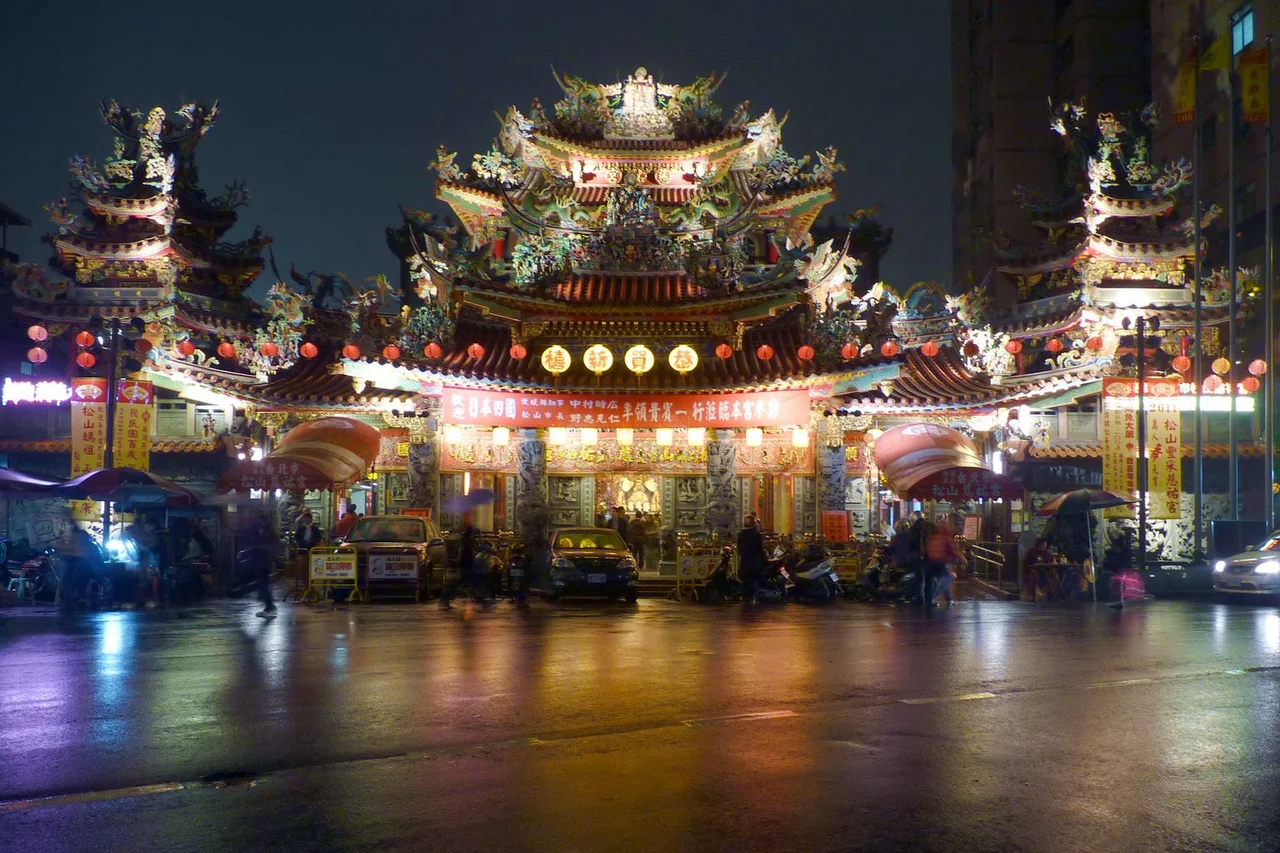

Ciyou Temple
The founding story of Ciyou Temple is not about a wealthy patron or an imperial decree. It begins, according to tradition, with a wandering monk who encountered a small group of devoted believers and recognized something worth building. Together, the monk and those early devotees spent ten years collecting donations — ten years of faith expressed in small coins and larger aspirations — before they finally had enough to raise a temple to Mazu, the sea goddess who watches over sailors, fishermen, and those whose lives depend on water. That origin story still shapes the character of the place: Ciyou Temple, in Taipei's Songshan District, belongs to its community in the way that a monument built from popular contribution always does.
The Goddess Who Watches Over Water
Mazu — sometimes written Matsu — is one of the most widely venerated deities in the Chinese religious world, and Taiwan has more Mazu temples per capita than perhaps any other place on earth. She is the protector of sailors and fisherfolk, a deified woman from Fujian Province whose legend holds that she could calm storms and guide ships to safety. At Ciyou Temple, her statue occupies the place of honor on the main altar of an impressive main hall, six stories above street level. The temple's roof ridge carries figures formed from cochin pottery — the distinctive glazed ceramic tradition known for its vivid colors — including phoenixes and figures drawn from historical tales. Carved and painted beams run overhead, and the entire structure declares that what happens inside is important.
A Pantheon of Everyday Concerns
Mazu presides at the center, but Ciyou Temple is not a single-deity shrine. The temple houses an extensive pantheon of Taoist and folk deities, each associated with a specific domain of human life: safety, fertility, education, prosperity. The City God and the Earth God both have their places here, receiving prayers from city residents navigating jobs, exams, newborn children, and aging parents. This multiplicity is characteristic of Taiwanese folk religion, which tends toward inclusion rather than exclusivity — a worshipper might come for Mazu but also stop to offer incense at the shrine of the God of Literature before an important examination. The temple functions less as a single sacred space and more as a complete spiritual resource for the neighborhood.
Fire, Reconstruction, and Continuity
In 1981, fire destroyed the original main structure of Ciyou Temple. The loss was significant — a building that had stood since the 18th century, that had accumulated the specific wear and patina of generations of worshippers, was gone. The community rebuilt within two years. What stands today is the result of that reconstruction: a six-story square structure with the main hall at its heart, rebuilt to serve the same purposes as the temple that came before. The fire and reconstruction story is not unusual in Taiwan's temple history. Sacred sites burn, flood, and sometimes fall to the demands of urban development, and communities rebuild them because the relationship between worshippers and their deities does not end with the loss of a building.
The Birthday Procession
Once each year, on the 23rd day of the third lunar month — Mazu's birthday — Ciyou Temple comes fully alive in a way that transforms the surrounding streets. Worshippers arrive to pray and present ceremonial offerings. The statue of Mazu is placed in an elaborately decorated palanquin and carried through the neighborhood in procession, accompanied by well-decorated floats and battle-array troupes who perform ritual movements meant to escort and protect the goddess. The procession draws participants who have been preparing for months. Incense smoke thickens the air. Drum rhythms carry for blocks. For visitors unfamiliar with the tradition, the spectacle can feel overwhelming — joyful, loud, dense with meaning, and organized according to protocols invisible to the uninitiated but precise to those who know them. The Raohe Street Night Market, one of Taipei's most famous, sits right next to the temple grounds, ensuring that the celebration spills freely between the sacred and the delicious.
From the Air
Ciyou Temple sits at 25.0511°N, 121.578°E in Songshan District, approximately 1 nautical mile north-northeast of Taipei Songshan Airport (RCSS). The six-story temple structure is identifiable from low altitude; its square roofline and prominent location near the Raohe Street Night Market distinguish it from the surrounding mid-rise residential and commercial blocks. From the pattern altitude of 1,500 feet on approach to runway 10 at RCSS, the temple falls within the southern edge of the instrument approach corridor. Taipei Taoyuan International Airport (RCTP) lies approximately 24 nautical miles to the west-southwest. Best viewed from the northeast, where the rooftop ceramic figures catch the afternoon light.
Nearby Stories
- Dapu Incident 9.3 km away
- Shuanglianpi Wetland 18 km away
- Toufen 41 km away
- North Jiangsu Main Irrigation Canal 980 km away
- General Cliff Rock Paintings 1050 km away
- Sinking of MV Sewol 1061 km away
- Yellow Sea 1111 km away
- Twin Forts of Romblon 1358 km away