The Clapham Junction Rail Crash: A Wire Left Loose
The fault was a single wire. It had been disconnected from a relay during routine re-signalling work but never cut back, never insulated, never tied out of the way. It dangled loose in a signal box near Clapham Junction, unnoticed for weeks, until on the morning of 12 December 1988 it shifted position and created a false electrical feed. A signal that should have shown red displayed green. A crowded commuter train plowed into the back of a stationary train, and both were sideswiped by an empty train coming the other direction. Thirty-five people died. The technician who left the wire loose had been working seven days a week for thirteen consecutive weeks.
The Morning Commute
The 07:18 from Basingstoke to London Waterloo was a crowded twelve-car train carrying commuters from Hampshire and Dorset. As it approached Clapham Junction, the driver saw a signal ahead change from green to red. Unable to stop in time, he halted at the next signal and reported the problem by lineside telephone. The signalman told him nothing was wrong. Shortly after 08:10, the 06:14 from Bournemouth to Waterloo, equally crowded, approached the same stretch of track at speed. The faulty signal showed green -- proceed -- when it should have been showing red. The Bournemouth train slammed into the rear of the stationary Basingstoke train. The impact drove the wreckage across the adjacent track, where it was struck by an empty train heading in the opposite direction.
In the Cutting
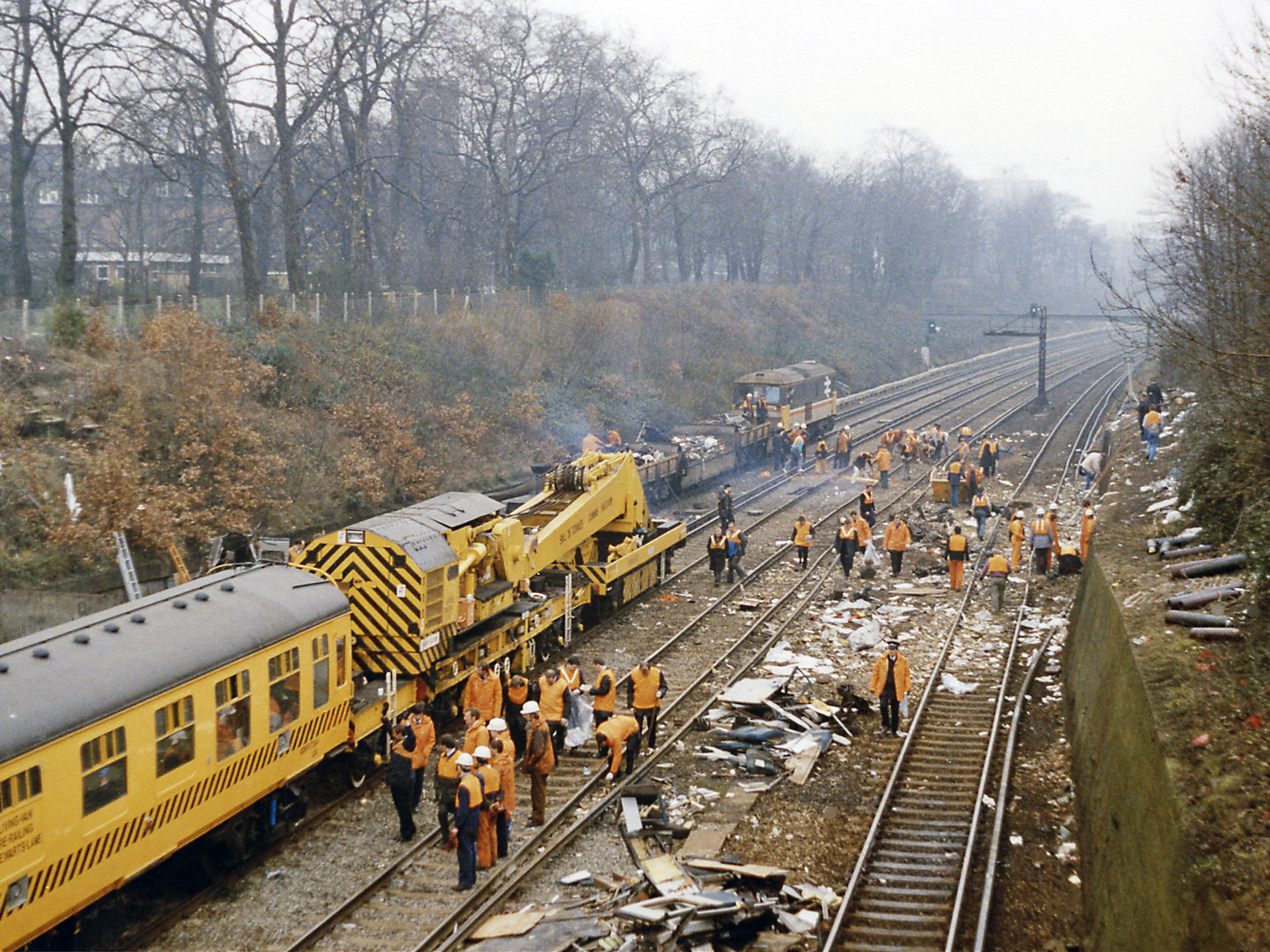
The crash site was in a deep railway cutting, bounded by metal fences at the top and a wall at the bottom of a wooded slope. Rescue was agonizingly difficult. Emergency crews struggled to reach the wreckage, lowering equipment down the embankment. Pupils and teachers from the adjacent Emanuel School were among the first on the scene, climbing through the fence to help the injured. Prime Minister Margaret Thatcher later commended them for their courage. Twenty-two of the thirty-five dead were from Dorset and the New Forest, including the Bournemouth train's driver, John Rolls, from Bournemouth. Another 69 were seriously injured and 415 sustained lesser injuries. The last casualty was taken to hospital at 1:04 PM. The last body was removed at 3:45 PM.
Thirteen Weeks Without a Day Off
The independent inquiry, chaired by Anthony Hidden QC, exposed a systemic failure of safety culture within British Rail. The signalling technician who had left the wire loose had not been told his working practices were wrong. His work had never been checked by an independent inspector, as rules required. A simple wire count -- which would have revealed that an old wire had not been removed -- was never performed. The re-signalling project had been understaffed from the start, and workers felt pressured to complete the work on schedule. The technician had been working voluntary weekend overtime, seven days a week, for thirteen straight weeks. Hidden's report contained ninety-three recommendations, including mandatory independent inspection of all safety-critical signalling work, refresher courses for technicians every five years, and limits on overtime for workers in safety-critical roles.
Lessons Fading
British Rail was fined 250,000 pounds for breaches of the Health and Safety at Work Act, but no individual was prosecuted for manslaughter. The collision became one of the events cited by the Law Commission as justification for new corporate manslaughter legislation, eventually resulting in the Corporate Manslaughter and Corporate Homicide Act 2007. A memorial stands at the top of the cutting above the railway on Spencer Park in Battersea. But the most sobering aspect of Clapham's legacy is how quickly the lessons faded. In 2017, a Rail Accident Investigation Branch report revealed that redundant points had been left in an unsafe condition at a junction -- circumstances strikingly similar to those at Clapham. A year later, a report into a collision at London Waterloo noted that 'some of the lessons from the 1988 Clapham Junction accident are fading from the railway industry's collective memory.'
From the Air
Clapham Junction (51.46N, 0.18W) is in southwest London, one of Britain's busiest railway junctions. The complex web of rail lines is clearly visible from the air. The crash occurred in a cutting south of the station. Nearby airports: Battersea Heliport 2nm north, London Heathrow (EGLL) 12nm west. Best viewed from 2,000-3,000ft with the railway corridor visible.