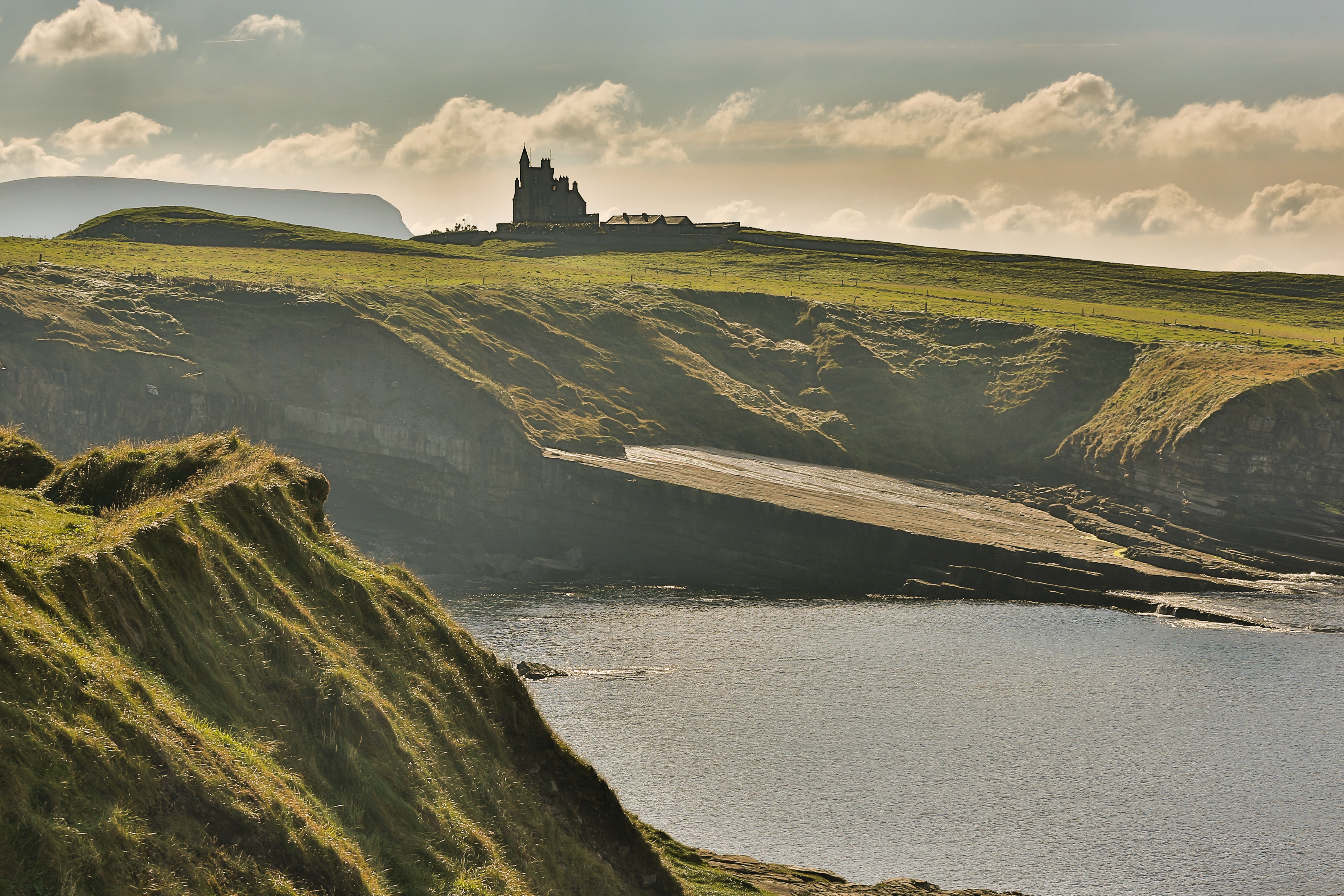
Classiebawn Castle
The castle sits on the Mullaghmore Peninsula like a sentinel, its conical turret and yellow-brown sandstone walls catching the Atlantic light. Classiebawn is beautiful and remote, but it is not a place anyone can visit without thinking of what happened in the waters just offshore. On 27 August 1979, Lord Mountbatten -- the last Viceroy of India, a war hero, and uncle to Prince Philip -- was killed when the Provisional IRA detonated a bomb hidden aboard his fishing boat, Shadow V. Two of his family members and a local teenager also died. The castle, the peninsula, the quiet harbor: all became part of one of the most devastating acts of violence in the Troubles.
Confiscation and Construction
The land beneath Classiebawn carries its own layered history of dispossession. It once belonged to the O'Connor Sligo family, but was confiscated by the English Parliament after the Irish Rebellion of 1641 to compensate those who had suppressed it. Around 10,000 acres were granted to Sir John Temple, Master of the Rolls in Ireland, in the 1600s. The property eventually passed to Henry John Temple, 3rd Viscount Palmerston -- the statesman who served twice as British prime minister. Palmerston commissioned the current castle and the harbor at Mullaghmore. Designed in the Baronial style by Dublin architect James Rawson Carroll, the building was constructed from sandstone brought by sea from County Donegal. Palmerston died in 1865 before it was finished; his stepson William Cowper-Temple completed the house in 1874.
A Summer Retreat
Ownership passed through a line of English aristocrats. When William Cowper-Temple died childless in 1888, the estate went to his nephew Evelyn Ashley, son of the 7th Earl of Shaftesbury. Ashley's son Wilfrid inherited next, and he spent summers at Classiebawn with his daughters -- including Edwina, who married Lord Louis Mountbatten and became Countess Mountbatten of Burma. After Edwina's death in 1960, Mountbatten continued to spend his summers at the castle, drawn to the wild coast and the quiet of northwest Ireland. He became a familiar figure in the village of Mullaghmore, setting out regularly on his boat to fish and pull lobster pots.
The Bombing
On that August morning in 1979, Mountbatten, then 79 years old, took his family out on Shadow V from the Mullaghmore harbor. The IRA had planted a radio-controlled bomb on the boat the night before. The explosion killed Mountbatten, his 14-year-old grandson Nicholas Knatchbull, the Dowager Baroness Brabourne, and a 15-year-old local boy, Paul Maxwell, who had been helping on the boat. Others in the party were seriously injured. The assassination sent shock waves through Britain and Ireland. It happened on the same day that the IRA killed eighteen British soldiers in an ambush at Warrenpoint in Northern Ireland -- the British Army's worst single loss of life during the Troubles. The violence of that day underscored the depths of the conflict and its human cost.
Reconciliation and Solitude
In 1991, businessman Hugh Tunney from County Tyrone acquired Classiebawn and its surrounding 3,000 acres. The castle today is privately owned and not open to the public. In 2015, Prince Charles visited Mullaghmore -- a gesture widely seen as an act of reconciliation. He met survivors and family members of those affected by the bombing, and laid a wreath near the harbor. The visit acknowledged the pain on all sides. The castle still stands on its headland, overlooking the Atlantic waters where so much was lost. It is a place where the beauty of the Irish coast and the weight of modern history exist in the same frame, inseparable.
From the Air
Located at 54.46°N, 8.47°W on the Mullaghmore Peninsula in County Sligo. The castle is visible from moderate altitude, sitting prominently on the headland above the harbor. Nearest airport: Sligo Airport (EISG), approximately 25 km to the south. Donegal Airport (EIDL) is roughly 65 km to the north. The Atlantic coastline and Benbulben mountain provide visual reference points.