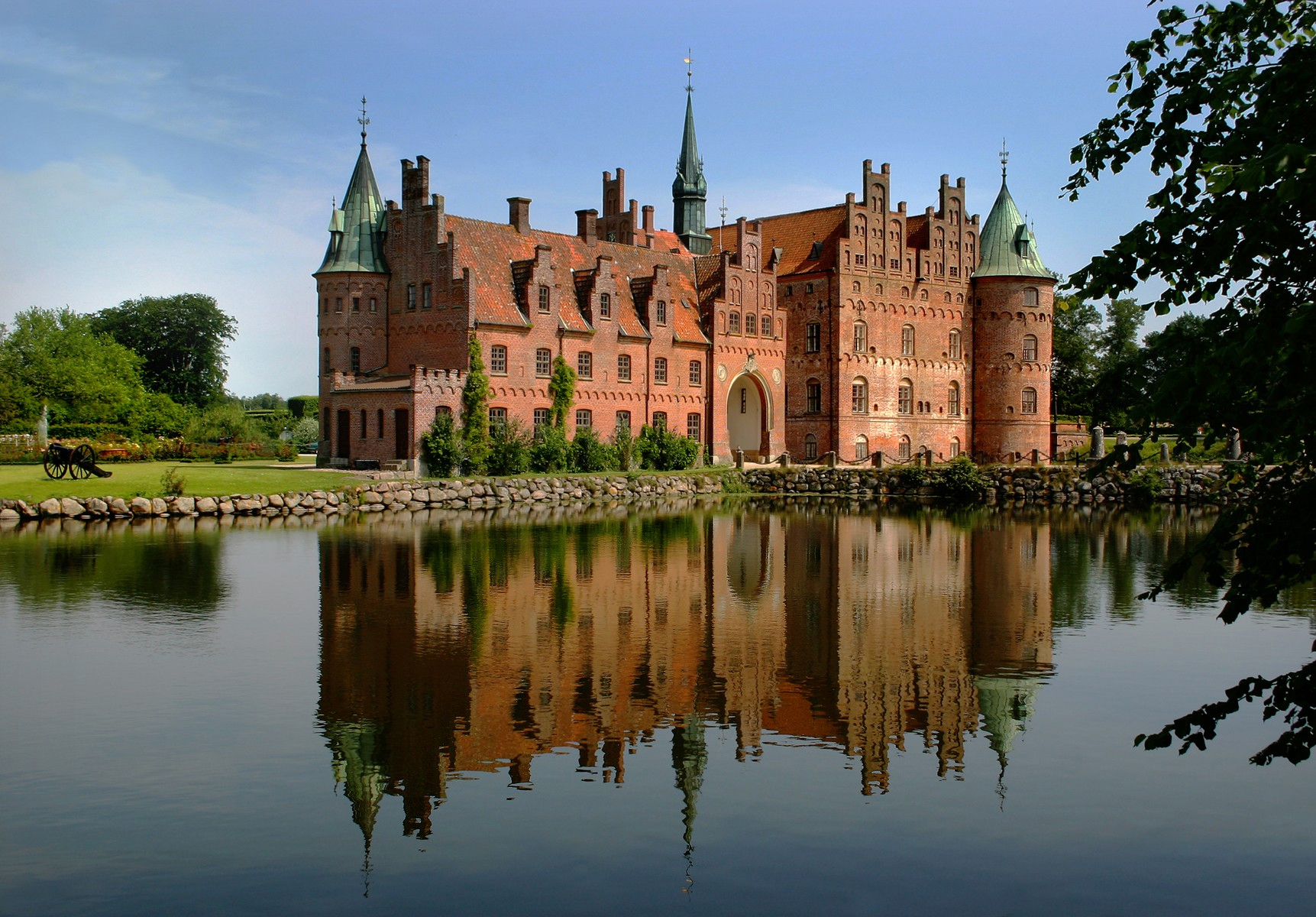
Clausholm Castle
The king came for the girl, not the castle. But it is the castle that remembers. In the 1710s, Frederick IV of Denmark became infatuated with Anna Sophie Reventlow, the daughter of Clausholm's owner, Grand Chancellor Conrad von Reventlow. The king abducted her. He married her. She became queen of Denmark in 1721. And when Frederick died in 1730, Anna Sophie returned to Clausholm with her court, spending her remaining years in the same rooms where she had grown up before a royal obsession changed her life. The castle she came back to was already one of Denmark's finest Baroque buildings. Her presence made it legendary.
Rebellion and Ruin
Clausholm's origins reach back to the 12th century, though the first documented mention appears in the 14th century, when its owner, Lage Ovesen, was one of the leaders of the Jute uprising against King Valdemar Atterdag. In those years, the castle was a four-winged structure surrounded by a moat, a typical Danish medieval stronghold. But centuries of conflict and neglect took their toll. By the 1690s, when Grand Chancellor Conrad von Reventlow acquired the property, Clausholm was in such a sorry state that he made a radical decision: tear it down entirely and build something new. What rose in its place was a two-storey, three-winged Baroque manor designed by the Danish architect Ernst Brandenburger with assistance from the renowned Swedish architect Nicodemus Tessin the Younger.
A Floor for the Chancellor, a Floor for the King
Reventlow designed Clausholm with a hierarchy built into its architecture. The Grand Chancellor lived on the ground floor. The second floor, with higher ceilings and more elaborate decorations, was reserved for royal visitors. It was an arrangement that spoke to the relationship between crown and nobility in late-17th-century Denmark: close enough to entertain, deferential enough to keep one's head. Both the castle and its surrounding park rank among Denmark's earliest and finest examples of Baroque design. In the chapel, decorated later by Anna Sophie herself, stands one of Denmark's oldest pipe organs, built around 1700 by the Botzen brothers of Copenhagen. The instrument has survived three centuries of Danish winters, a testament to the quality of its craftsmanship and the chapel's careful stewardship.
The Sleeping Castle
After Anna Sophie's time, Clausholm entered a long quiet period. Without running water or electricity, the castle was inhabited only during summer months, its rooms otherwise left to the cold and the dark. This neglect, paradoxically, became its greatest gift. Because no one modernized Clausholm, no one destroyed what the 1690s and 1730s had created. The Baroque interiors remained practically untouched for over two centuries. In 1964, Henrik and Ruth Berner acquired the castle and began the delicate work of modernizing its infrastructure without compromising its historical fabric. Restoration continued for years, with great care taken to preserve rather than renovate. In 1994, Queen Margrethe II awarded Clausholm the Europa Nostra Prize for outstanding heritage work, a recognition that the Berners had succeeded in the difficult art of bringing a sleeping castle back to life without waking it into something it was not.
Baroque Gardens and Baking Shows
The large Baroque park surrounding Clausholm, with its fountains and avenues, was designed in the 18th century and fell into disrepair along with the castle itself. In 2009, with support from the Realdania Foundation, the park was thoroughly renovated, restoring the formal geometry that Baroque landscape design demands. The 900-hectare estate encompasses several subsidiary properties, including Schildenseje and Sophie-Amaliegaard. Located 12 kilometers southeast of Randers in eastern Jutland, Clausholm now serves double duty as a heritage site and a television backdrop: it is used as the setting for Den Store Bagedyst, Denmark's popular baking competition broadcast on DR1. The juxtaposition suits the castle well. A place built to impress kings now impresses viewers with pastry, and Anna Sophie's chapel organ still plays in a building that has outlasted every ambition except the one to simply endure.
From the Air
Located at 56.38N, 10.17E in eastern Jutland, Denmark, approximately 12 km southeast of Randers. The castle appears as a three-winged Baroque structure with formal gardens, surrounded by the flat agricultural landscape of eastern Jutland. Nearest airport is Aarhus Airport (EKAH), approximately 30 km to the south. Best viewed at 2,000-4,000 feet to appreciate the symmetry of the Baroque park layout, with its fountains, avenues, and the relationship between the castle wings.