Clava Cairns
On the shortest day of the year, the setting sun sends its light down the passage of the southwestern cairn at Balnuaran of Clava and into the burial chamber. This is not an accident. The builders of these Bronze Age tombs, working roughly 4,000 years ago in a river valley east of what is now Inverness, oriented their entrances to the southwest with a precision that speaks of careful astronomical observation. They also graded their kerb stones by size and colour, placing the largest and reddest to the southwest and the smallest and whitest to the northeast. The Clava cairns are not merely graves. They are instruments calibrated to the turning of the year.
Two Types, One Design
About 50 Clava-type cairns are scattered across the Inverness and Moray Firth area, but the three at Balnuaran of Clava are the type site that gives the tradition its name. They lie close together in a line running northeast to southwest. The tombs at either end are passage graves: corbelled chambers linked to the outside by short passages, originally covered with a mound of stones. Between them stands a ring cairn of the second sub-type, which encloses an apparently unroofed area with no formal entrance. How the dead were placed inside, or how the living were meant to relate to them after burial, remains unclear. Each cairn is surrounded by a stone circle, creating concentric rings of structure -- chamber, mound, kerb, and standing stones -- that impose an order on death that feels simultaneously practical and ritual.
Stones Chosen for Colour
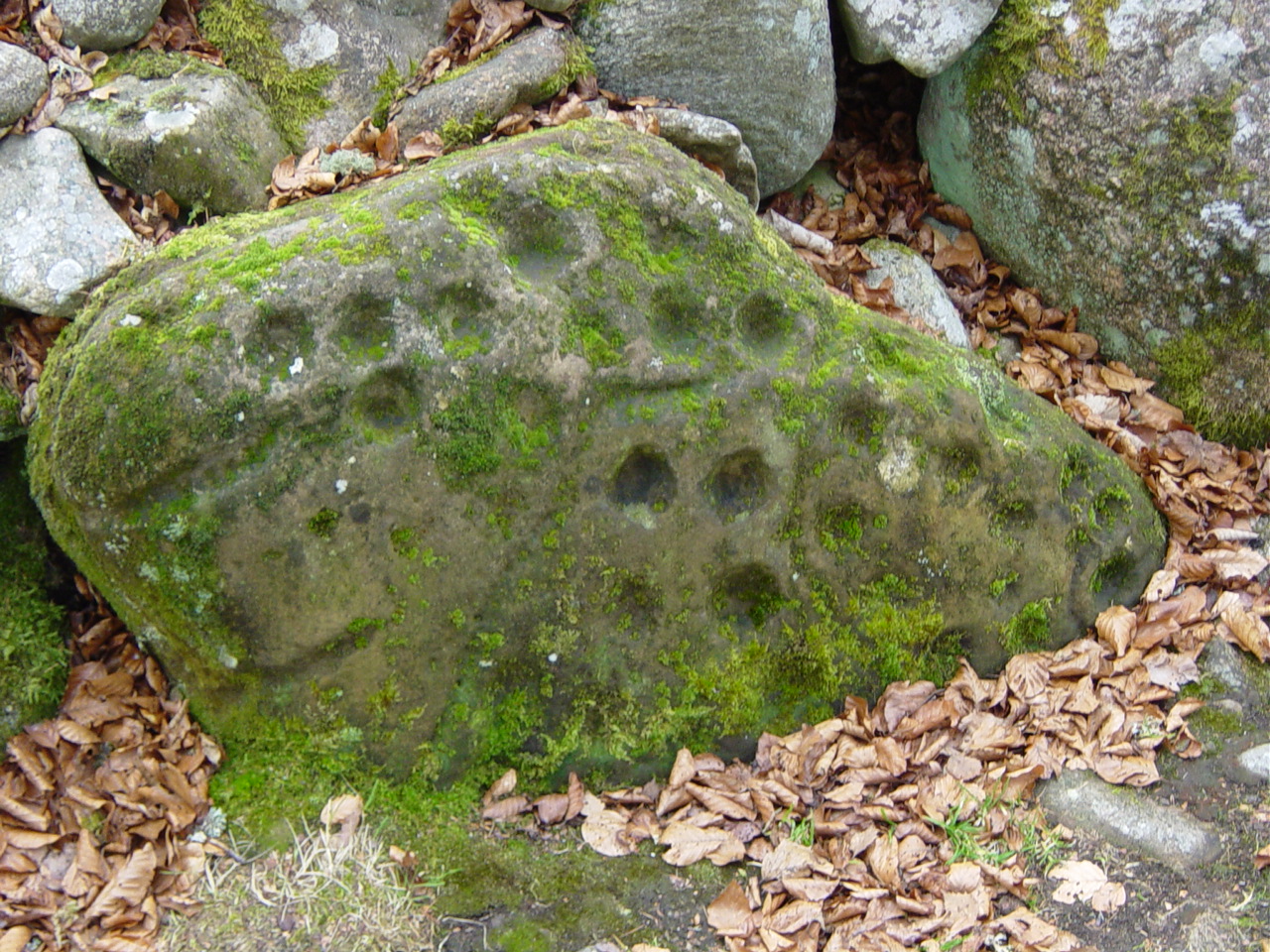
The attention to colour and material at Balnuaran is remarkable. The kerb stones that ring each cairn are graded not just by size but by colour, transitioning from red-toned stones at the southwest to white-toned stones at the northeast. Cup and ring marks -- carved spirals and concentric circles -- appear on stones that were decorated before being incorporated into the structures, suggesting the carvings were part of the design rather than later additions. The central ring cairn has a feature unique among Clava-type tombs: stone causeways or "rays" radiate outward from the platform around the kerb to three of the standing stones, connecting the inner burial structure to its outer circle in a way that no other known example replicates. Archaeologists interpret all these elements as evidence of a complex design executed as a single operation, not a gradual accumulation of features.
The Dead and the Light
When Clava-type tombs have been found to contain burial remains, only one or two bodies appear to have been interred in each. This is a departure from earlier Neolithic communal tombs, where generations of dead were placed together and graves were reopened to receive new burials. The sealed ring cairns, with no passage to the interior, suggest that the Bronze Age builders at Clava intended no return visits to the dead. The deceased was placed inside, the structure was closed, and the relationship between the living and the dead was maintained not through physical access but through the architecture itself -- through the alignment of passages to the midwinter sunset, through the graduated colours of the stones, through the standing stones that watched over the cairn like sentinels. These were tombs designed to be seen from the outside, not entered.
Layers of History
Balnuaran of Clava sits in a landscape thick with later history. The Culloden Viaduct, Scotland's longest masonry railway viaduct, passes just to the east. Culloden Moor, where the last Jacobite rising was destroyed in 1746, lies barely a mile to the west. The cairns themselves were old when the Picts carved their symbol stones, old when the Romans marched north, old when the first Celtic-speaking peoples arrived in Scotland. They have endured because stone endures, and because the low river valley of the Nairn, sheltered by higher ground, has never been the kind of terrain that invites large-scale development. The cairns stand today much as they were found, surrounded by trees and grass, with the stones still graded by colour from red to white, still pointing toward the place on the horizon where the midwinter sun goes down.
From the Air
Located at 57.47N, 4.07W in the Nairn river valley, approximately 5nm east of Inverness. The cairns are in a wooded area adjacent to agricultural land. The Culloden Viaduct (29 arches) is visible just to the east, and Culloden battlefield is 1nm to the west. Nearest airport: Inverness (EGPE) 6nm west.