Clean Sky
In May 2017, on an open-air test rig near Istres in southern France, Safran fired up an engine the aviation industry had largely given up on. It was an open rotor — a contra-rotating propfan that exposes its blades to the airstream instead of hiding them inside a cowling. The promise: 30% less fuel burned and 30% less carbon dioxide compared with the CFM56 turbofans that power thousands of single-aisle airliners. The catch, as anyone who has stood near an unducted propeller knows, is noise. The Safran demonstrator was eight years and €65 million in the making, funded by a program most travelers have never heard of: Clean Sky, the European Union's public-private bet on greener flight.
Why Public Money for Private Engines
Aviation has long timelines. It takes 20 to 30 years for a new idea to make the journey from drawing board to certified, in-service aircraft, and the development costs can break companies that move too aggressively. Civil aviation also produces roughly 3% of global man-made carbon emissions, and that share grows as demand for air travel grows. Private industry on its own has every reason to be conservative. So in 2008 the European Commission and the European aeronautics industry — Airbus, Safran, Rolls-Royce, Thales, Dassault, Leonardo, Liebherr, Fraunhofer, and dozens more — pooled €1.6 billion into a joint undertaking and gave themselves a target: a 50% cut in carbon dioxide, an 80% cut in nitrogen oxides, and a 50% noise reduction by 2020, the goals defined by the Advisory Council for Aeronautics Research in Europe. Half the money came from EU research funds, half from the industry partners themselves. Clean Sky was the result.
BLADE: The Smooth-Skin Wing
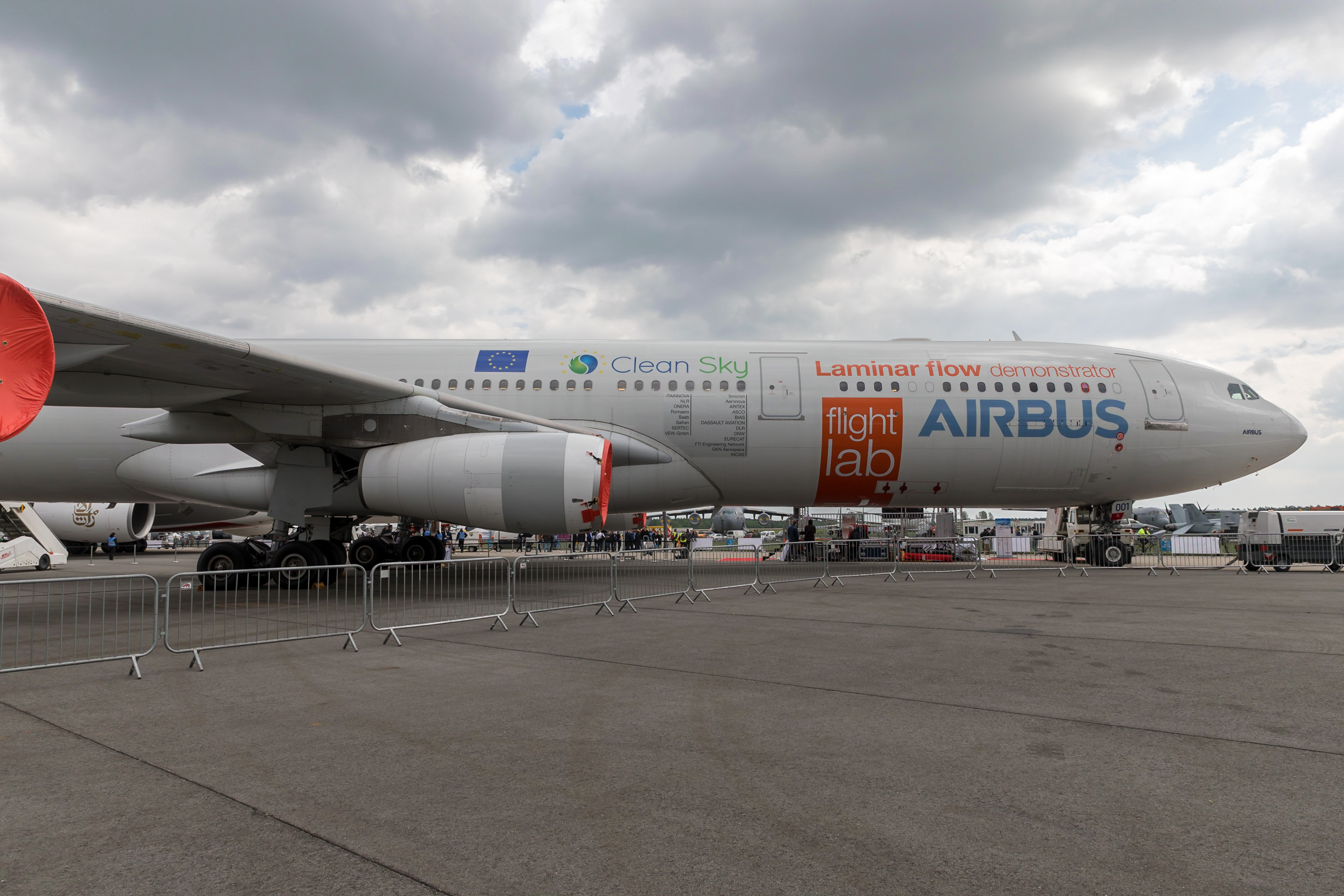
If you fly an Airbus A340-300 with the registration F-WWAI today, you are flying the most precisely measured wing in commercial aviation history. The Breakthrough Laminar Aircraft Demonstrator in Europe — BLADE — replaced the outer sections of the A340's wings with experimental laminar-flow wing panels in September 2017. The aim was to get the airflow over a real wing, at real cruise speeds, to stay smooth and unbroken for as far back along the chord as possible. Laminar flow produces far less drag than turbulent flow, and less drag means less fuel. Getting a wing manufactured to the surface tolerances laminar flow requires is brutally hard, and keeping it laminar in the presence of insects, rain, and surface contamination is harder still. The BLADE program does not deliver an airliner-ready answer. It does deliver real-world data that decades of wind-tunnel work could not.
Six Demonstrators, Six Bets
Clean Sky was organized around six Integrated Technology Demonstrators, each co-led by two industry heavyweights. Green Regional Aircraft (Airbus and Alenia) tackled small, low-weight airliners. Smart Fixed Wing Aircraft (Airbus and SAAB) explored wing configurations for large jets and business aircraft. Green Rotorcraft (AgustaWestland and Airbus Helicopters) chased innovative rotor blades and electric architectures to eliminate hydraulic fluids. Sustainable and Green Engines (Rolls-Royce and Safran) drove the open-rotor and lean-burn work. Systems for Green Operations (Liebherr and Thales) handled electrical equipment and greener flight trajectories. Eco-Design (Dassault and Fraunhofer) attacked the lifecycle — materials, manufacturing, recycling. A separate Technology Evaluator measured how much fuel and noise each new technology actually saved. The catalog of resulting hardware is unglamorous and crucial: a titanium fan wheel made by additive manufacturing, a carbon-nanotube ice protection system, a morphing wing flap, a fault-tolerant electromechanical helicopter rotor actuator.
Clean Sky 2 and Beyond
By 2014 the program had spawned a successor, Clean Sky 2, running under the Horizon 2020 framework with tougher targets aligned to the Flightpath 2050 goals: 75% less carbon dioxide, 90% less nitrogen oxides, 65% noise reduction. New work began on high-speed rotorcraft — the Airbus RACER compound helicopter and the Leonardo Next-Generation Civil Tiltrotor — and on hybrid-electric propulsion. ONERA, DLR, TU Delft, and NLR were tasked with evaluating 35 radical configurations to replace the conventional airliner from 2035 onward, all needing to meet A320 requirements: 150 passengers, Mach 0.78 cruise. In 2022 a 1/8.5 scale Airbus A320 model flew as a Clean Sky 2 demonstrator, designed to validate scale-model testing as a bridge between simulation and full-size flight tests.
The Hydrogen Question
On 23 March 2022 the successor to Clean Sky — now renamed Clean Aviation — opened its first call for proposals with €735 million in funding over 36 months. The targets are sharper and more specific than before: hydrogen aircraft, hybrid electric aircraft, short- and medium-range platforms, and the transversal technologies that make any of those real. The reasoning is bluntly arithmetical. To cut 80% of aviation emissions by 2050 — the EU's stated goal — the aircraft must enter service in the early 2030s. Aircraft in service in the 2030s must be demonstrated by 2025–2027. Aircraft demonstrated then must be funded now. The Clean Sky project never had the luxury of waiting for the perfect answer. It funds the imperfect ones early, in the belief that some will graduate to fleets actually flying paying passengers — and that the alternative, more of the same, is no longer survivable for the industry or the planet.
From the Air
The Clean Sky Joint Undertaking is headquartered in Brussels at roughly 50.835°N, 4.355°E, within the central administrative quarter near the Senne and the historic center. The program itself operates across Europe — open-rotor tests at Istres in southern France, BLADE flight tests originally based at Tarbes-Lourdes-Pyrénées (LFBT), wind tunnel work in Austria, hybrid-electric studies at TU Delft and DLR. Brussels Airport (EBBR) lies about 12 km northeast of the headquarters location. The hub city is well served by commercial aviation; clear views over central Brussels and the broader Belgian aerospace cluster are best in continental high-pressure conditions.