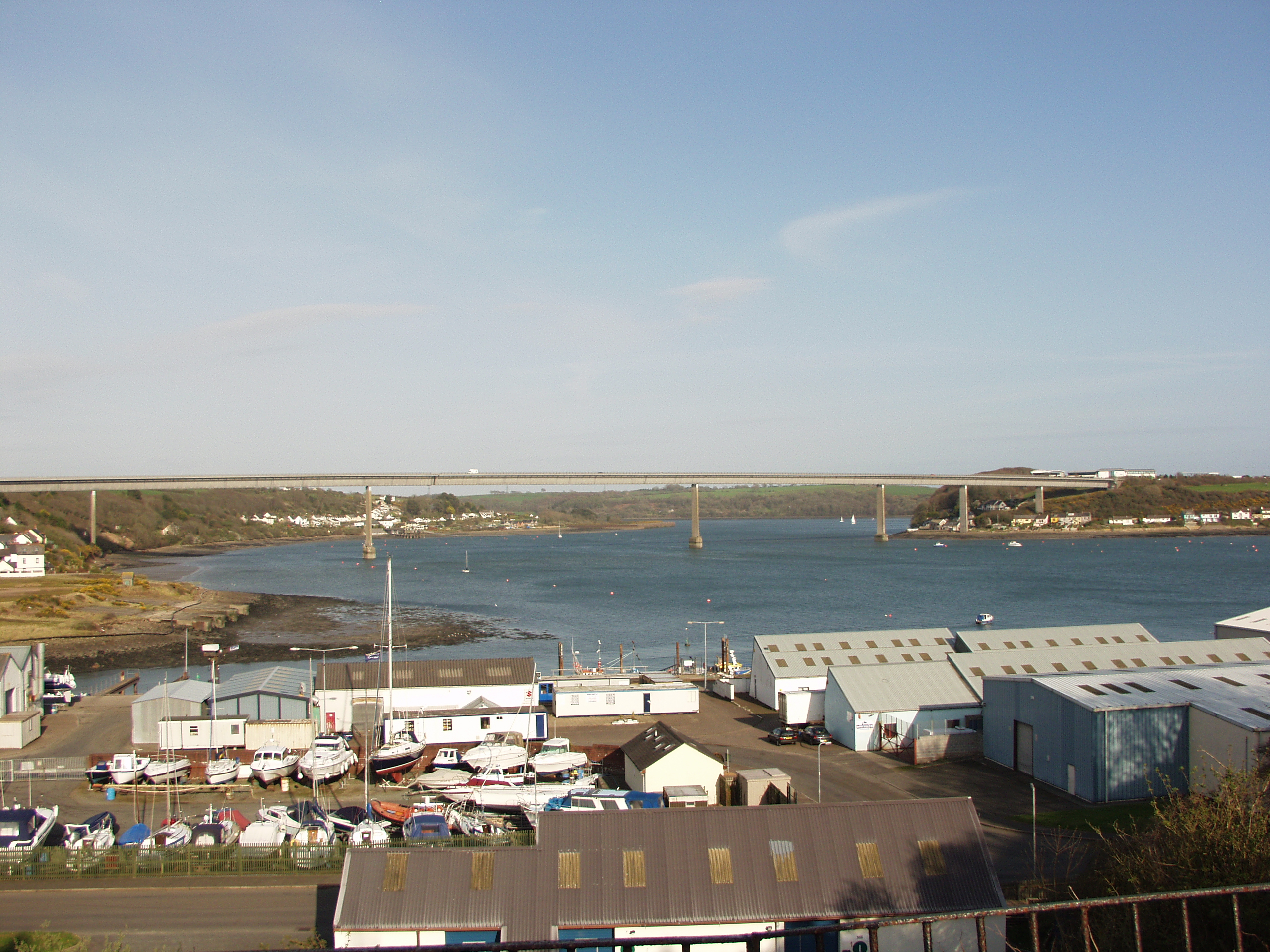
Cleddau Bridge
Hobbs Point in Pembroke Dock and Neyland sit less than a mile apart across the Milford Haven waterway. Before 1975, driving between them required a 28-mile detour. The absurdity of that geography had been partially addressed since 1858 by ferry services -- first steam ferries operated under Admiralty permission, then a County Council service carrying 24 vehicles and 250 pedestrians. But in the 1960s, Pembrokeshire decided on a permanent solution. The Cleddau Bridge would span the river and connect the two towns. What should have been a straightforward piece of infrastructure became instead a story of engineering failure, human cost, and hard-won reform.
The Collapse
The contract was awarded to A.E. Farr Limited in September 1968 for 2.1 million pounds, with completion expected by March 1971. Sir Alexander Gibb & Partners and Freeman Fox and Partners served as joint consulting engineers. On 2 June 1970, a 230-foot cantilever being used to position one of the 150-tonne box girder sections collapsed on the south side of the estuary. Four construction workers died and five were injured. Construction halted immediately and did not resume for over two years, until October 1972. The Merrison Committee of Inquiry into the Design and Erection of Steel Box Girder Bridges investigated and found that the cause was the inadequacy of a pier support diaphragm -- specifically, a diaphragm of half the designed thickness had been used. But the committee considered 'the failure of site organisation between the parties' to be of even greater significance than the specific design flaw.
Rewriting the Rulebook
The Merrison Committee's conclusions went far beyond blame for a single accident. They determined that the only relevant Code of Practice for designing steel bridges in the UK was fundamentally inadequate for structures like the Cleddau Bridge. In response, they implemented Interim Design and Workmanship Rules that laid the groundwork for an entirely new British Standard covering box girder bridge design. The collapse of a section of the Cleddau Bridge remains, as of 2026, the last major bridge disaster in the United Kingdom -- a grim distinction that the reformed standards have helped to maintain. The safety legacy of those four deaths extends to every major steel bridge built in Britain in the half century since. Engineering codes are typically written in the dry language of load calculations and material tolerances, but the Cleddau collapse is a reminder that those numbers represent the difference between a bridge that stands and one that kills the people building it.
The Bridge That Eventually Opened
The final cost of construction reached 11.83 million pounds -- nearly six times the original contract. The 7 million pounds in overruns was attributed to design changes mandated by the Merrison Committee's recommendations. The cost was covered by a 3-million-pound out-of-court settlement between the County Council and the consulting engineers and a 4-million-pound interest-free loan from the government, repayable over 40 years. The bridge opened to traffic on 20 March 1975, originally named the Milford Haven Bridge. In its first year alone, 885,900 crossings were recorded. The ferry Cleddau King, now redundant, was sold and modified by Harland & Wolff in Belfast to serve as a reserve on the Portaferry-Strangford route in Northern Ireland. Tolls were collected for decades, with toll booths and barriers introduced in September 2004 to deal with the persistent problem of drivers passing through without paying. The bridge became toll-free on 28 March 2019.
Wind, Memory, and Stolen Bronze
The Cleddau Bridge remains an exposed crossing. Pembrokeshire County Council closes it to vehicles taller than 1.9 meters, bicycles, and motorcycles when wind speeds exceed 50 miles per hour. At 70 miles per hour, it closes to everyone. These are not theoretical thresholds; the council maintains records of every closure, and the Pembrokeshire coast delivers the kind of weather that tests them regularly. In 1995, on the 25th anniversary of the collapse, a memorial plaque was unveiled to honor the four men who died. In 2017, the plaque was reported stolen. It is a small, ugly footnote to a story that deserves better. The bridge carries the A477 across the Cleddau as if it has always been there, an unremarkable piece of road infrastructure that drivers cross without thinking. But the engineers who designed the replacement standards, and the families of the four men who died building it, know the cost embedded in that unremarkableness.
From the Air
Located at 51.71N, 4.93W spanning the River Cleddau between Neyland and Pembroke Dock in Pembrokeshire, Wales. The bridge crosses the Milford Haven waterway, one of the finest deep-water natural harbours in the world. Nearest airports: Haverfordwest (EGFE), Pembrey/Carmarthen area. Best viewed at 1,500-2,500 feet to appreciate the waterway crossing and the relationship between the two towns the bridge connects.