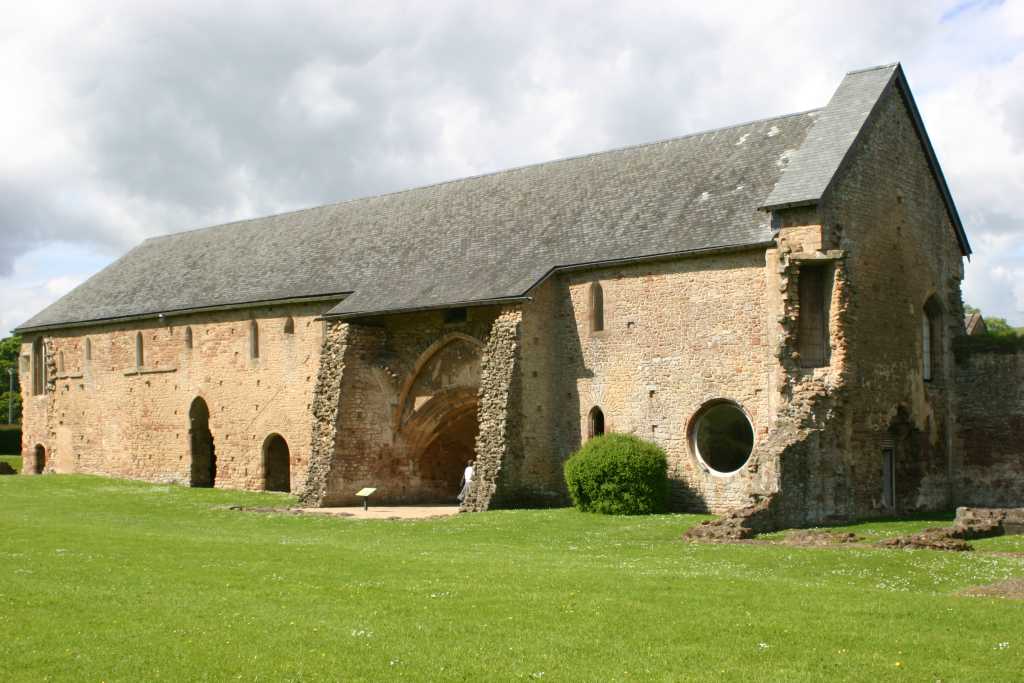
Cleeve Abbey
In 1400, a report reached the English government with an unlikely complaint: the abbot of Cleeve Abbey and three of his monks were leading a gang of 200 bandits, attacking travellers across the Somerset countryside. For a house of the austere Cistercian order -- monks who had taken vows of poverty, silence, and manual labour -- this was a spectacular fall from grace. Yet Cleeve's story is full of such contradictions: an abbey that was chronically poor but built a refectory ceiling carved with angels, that was dissolved by Henry VIII but survived as a farmyard, and that now stands as one of the best-preserved medieval monastic sites in southern England precisely because no one thought it worth demolishing.
Twelve Monks from Lincolnshire
On 25 June 1198, twelve Cistercian monks led by Abbot Ralph arrived at this site beside the Washford River in Somerset, sent from Revesby Abbey in Lincolnshire to establish a new house. Their patron was William de Roumare, Earl of Lincoln. The Cistercians chose locations that were deliberately remote -- far from towns, close to water, suitable for the self-sufficient agricultural life their rule demanded. Cleeve fit the pattern. Over the decades that followed, the monks built their monastery around a cloister: chapter house, refectory, dormitory, and the small west range for storage and lay brothers' quarters. Heraldic tiles in the refectory floor, including the arms of Henry III and Richard, 1st Earl of Cornwall, suggest the building was completed by the end of the thirteenth century, possibly to celebrate the 1272 marriage of Edmund, 2nd Earl of Cornwall, and Margaret de Clare.
Angels in the Rafters
Cleeve was never wealthy, but its monks spent as though they were. In the fourteenth century, elaborate polychrome tiled floors were laid throughout the abbey -- an expensive, high-status product that signalled ambitions well above the community's means. Then, between 1435 and 1487, Abbot David Juyner commissioned a complete redesign of the south range. He demolished the old refectory and built a new one on the first floor, parallel to the cloister. The result was a grand chamber with a wooden vaulted ceiling carved with angels -- a hall that could rival any contemporary secular lord's. Beneath it, Juyner built self-contained apartments, probably for corrodians, pensioners who paid the abbey for board and lodging in their old age. Wall paintings of religious and allegorical subjects decorated the rooms, some of which survive: St Catherine and St Margaret flanking a man on a bridge, attacked by a lion on one side and a dragon on the other, with angels hovering at his head.
Dissolution and the Farmyard Years
In 1536, Henry VIII closed Cleeve during the Dissolution of the Monasteries. The abbey was converted into a country house, then gradually declined into use as farm buildings -- a fate that, ironically, preserved it. The church itself was demolished, but the domestic buildings around the cloister remained roofed and habitable because they served practical agricultural purposes. Hay was stored where monks had slept; cattle sheltered in the refectory. The abbey's sole claim to historical celebrity was John Hooper, a monk with an obscure background who left Cleeve to become a Calvinist, was appointed Bishop of Gloucester, and was eventually burned at the stake for heresy under Queen Mary I. In 1870, George Luttrell of nearby Dunster Castle acquired the site. The farm was removed, archaeological excavations began, and the abbey became a tourist attraction, partly to generate traffic for the West Somerset Railway.
A Shilling for the Ghosts
Among Cleeve's more colourful figures was Cleeva Clapp, a local farmer's daughter named after the abbey, who served as a guide in the late nineteenth and early twentieth centuries. For a shilling a head, she would describe her nightly 'communings' with the ghosts of the monks -- a performance that probably owed more to showmanship than the supernatural, but that captured something real about the atmosphere of the place. The roofed rooms, the surviving vaults, the painted chamber with its faded medieval figures -- Cleeve has a presence that empty ruins lack. The abbey passed to the Crown in 1950-51 to pay death duties on the Luttrell estate, and English Heritage took over in 1984. Today visitors enter through the same gatehouse the monks used, walk the same cloister, and stand beneath the same angel-carved ceiling that Abbot Juyner built to prove that a poor monastery could dream as grandly as a rich one.
From the Air
Located at 51.156N, 3.364W near the village of Washford in west Somerset, beside the Washford River. The abbey complex with its intact roofed buildings is visible from low altitude. Exeter Airport (EGTE) is approximately 25 nm south-southwest. Dunkery Beacon on Exmoor is visible to the northwest. Best viewed at 1,000-1,500 ft from the south.