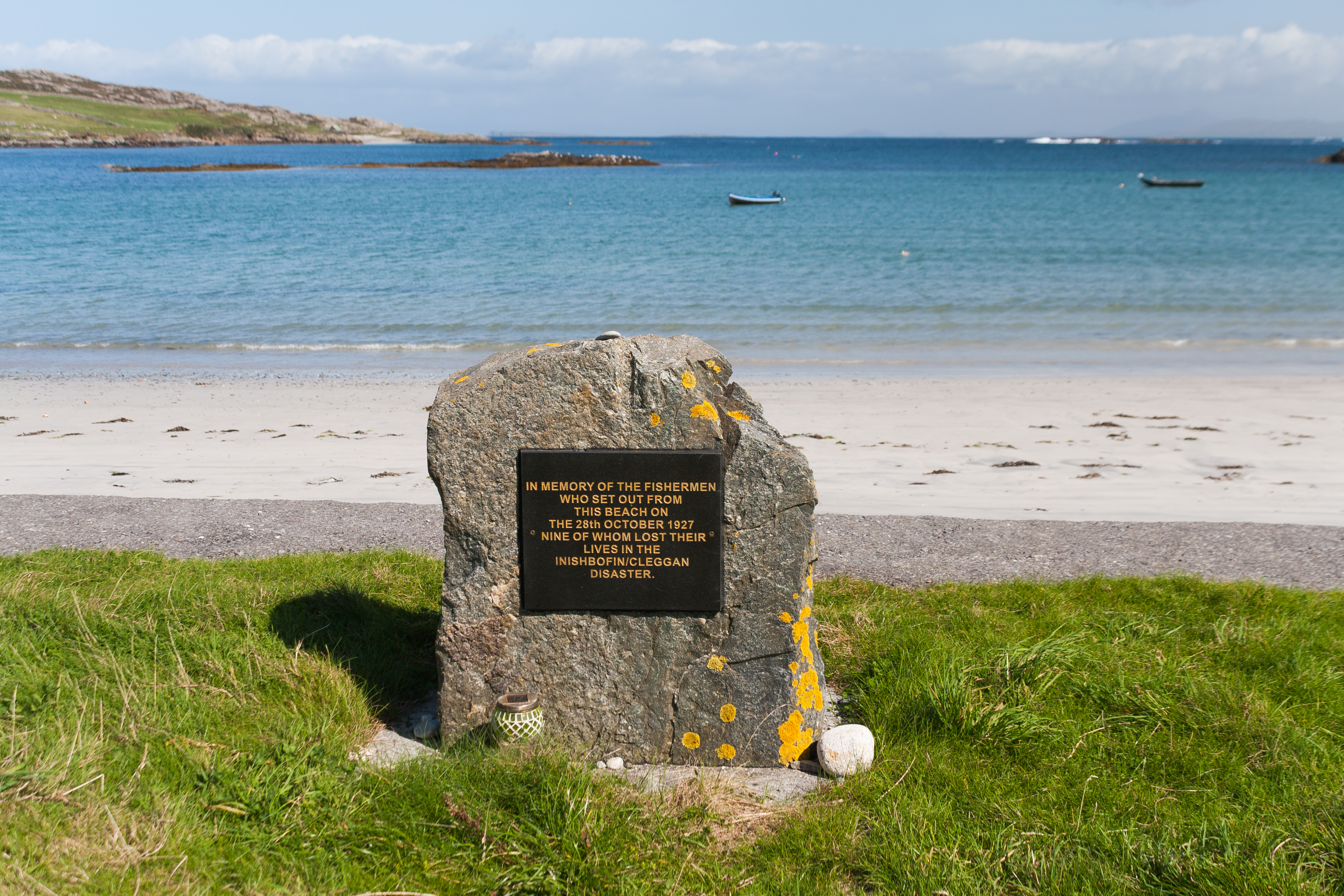
Cleggan Bay Disaster
On the morning of 27 October 1927, the mackerel were running off Cleggan Bay. Dozens of small boats put out from villages along the Connemara coast -- from Cleggan, from the island of Inishbofin, from communities in County Mayo. By nightfall, forty-five men were dead, taken by a gale that rose without warning from the Atlantic. One village, Rossadilisk, lost sixteen of its fishermen in a single evening. It would never recover.
The Day the Sea Turned
There was no weather warning. The technology that might have saved these men -- reliable maritime forecasting, radio communication to small boats -- did not exist in the remote west of Ireland in 1927. The fishermen set out in currachs and small wooden boats, following the mackerel shoals into open water as they had done for generations. When the gale struck, it came fast and hard. The Atlantic off Connemara offers no shelter; the coastline is a maze of rocks and headlands, and in heavy seas even experienced sailors could be overwhelmed. Boats capsized, were swamped, or were driven onto rocks. Some men drowned within sight of shore. Others were lost in the darkness as the storm raged through the night.
Three Communities Shattered
The dead came from three areas, and the arithmetic of loss tells its own story. Sixteen men from Rossadilisk, a tiny fishing village near Cleggan. Nine from Inishbofin, the island visible on clear days across the sound. Twenty from various communities in County Mayo. In places this small, where fishing was the only industry, the death of every working-age man meant not just grief but economic annihilation. Rossadilisk's losses were so catastrophic that the village was effectively abandoned. The houses emptied. The families who survived had no means of support and no reason to stay. Within a few years, the village was a collection of roofless walls -- a fate common enough in Ireland's west, but rarely so sudden in its cause.
A Wider Reckoning
News of the disaster spread across the Atlantic and beyond. Fundraising efforts were organized in the United Kingdom, the United States, and Australia, channeling money to the devastated families. The tragedy exposed the precariousness of life in the west of Ireland -- communities dependent on dangerous work, with no safety net when catastrophe struck. The poet Richard Murphy would later write about the disaster, drawing on the oral histories that kept the memory alive in Connemara. TG4, the Irish-language television station, produced a documentary exploring the events and their aftermath. In Cleggan itself, the disaster is marked and remembered, a wound that never fully closed.
The Empty Shore
Fly over Cleggan Bay today and the coastline looks serene -- the Atlantic stretching westward toward America, Inishbofin sitting low on the horizon, the green and brown patchwork of Connemara's bogs running down to rocky shores. The beauty conceals a landscape shaped by loss. Rossadilisk is a ruin, its stone walls slowly returning to the earth. Along the coast, the harbors are quieter than they once were; the fishing industry that sustained these communities for centuries has contracted to a fraction of its former self. The disaster of 1927 accelerated a decline that poverty and emigration had already begun. What the gale destroyed in a single night, time has been slow to rebuild.
From the Air
Located at 53.59°N, 10.17°W on the Connemara coast of County Galway. Cleggan Bay is visible from moderate altitude as a small inlet along the rugged western Irish coastline. Inishbofin island lies approximately 8 km offshore to the northwest. Nearest airports: Galway Airport (EICM), approximately 80 km southeast; Connemara Regional Airport (NNR), approximately 25 km south. The coastline is heavily indented with numerous small bays and rocky headlands.