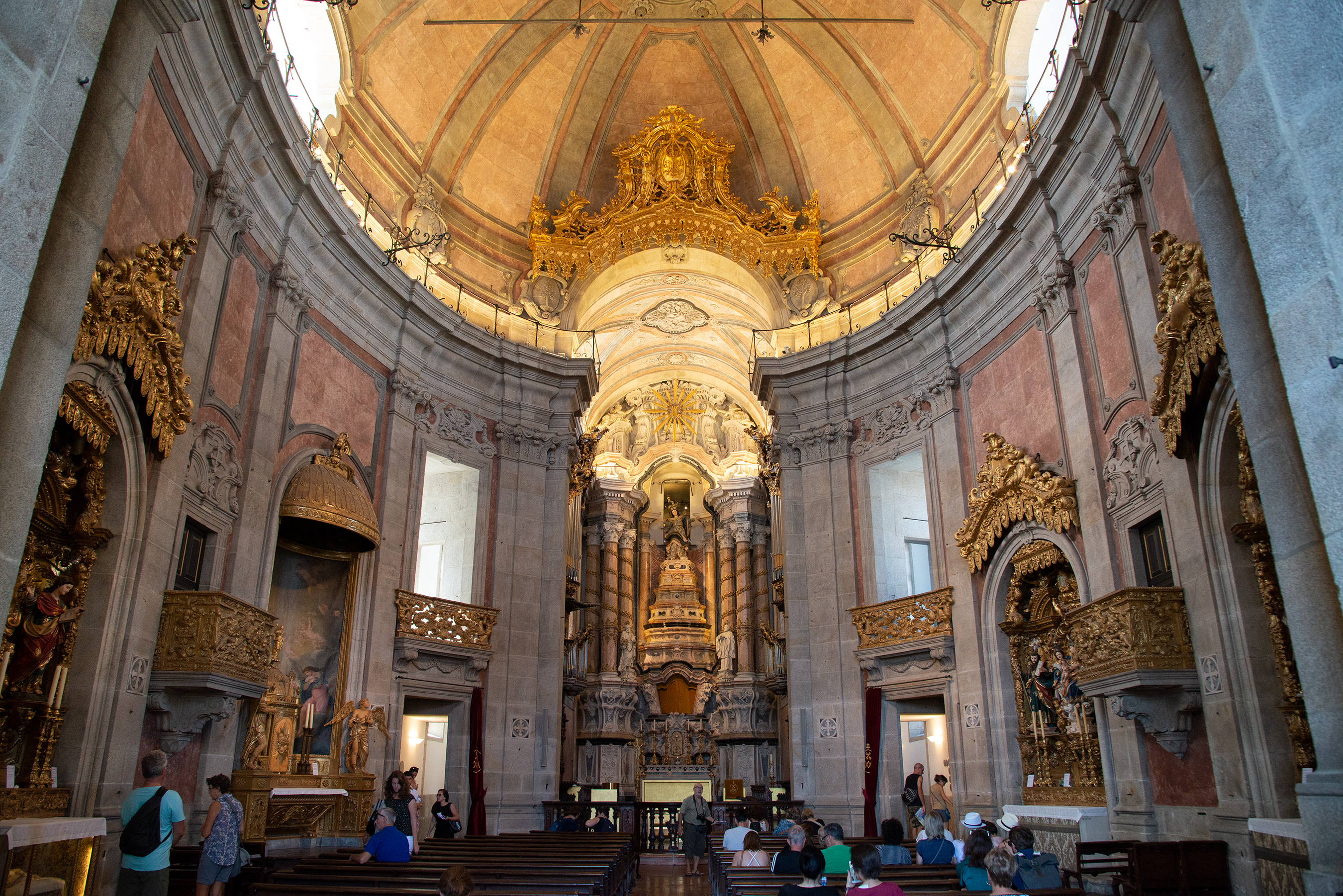
Clerigos Church
Nicolau Nasoni arrived in Porto from Italy and proceeded to reshape the city. He designed churches, palaces, and cathedral additions across northern Portugal, but his masterwork was the Igreja dos Clerigos -- the Church of the Clergymen -- whose tower rises 75.6 meters above Porto's granite rooftops. When Nasoni died, he asked for one thing: to be buried in the crypt of his greatest creation. The Brotherhood of the Clerigos granted his wish. Somewhere beneath the church he designed, the architect rests in an unmarked spot, his exact location unknown even to the institution that honored him.
An Italian Vision in Portuguese Stone
The Brotherhood of the Clerigos commissioned Nasoni in the 1730s to build a church worthy of their ambitions. Construction began in 1732 and the church was finished in 1750, but the bell tower and the monumental divided stairway at the entrance took another thirteen years, completed in 1763. What Nasoni delivered was unlike anything Portugal had seen. The church adopted an elliptical floor plan -- one of the first Baroque churches in Portugal to do so -- breaking from the rectangular tradition. The main facade bursts with Baroque ornamentation: garlands, shells, an indented broken pediment drawn from early 17th-century Roman models. A central frieze above the windows displays symbols of worship and an incense boat, signaling the building's purpose to anyone approaching from the street.
240 Steps to the Top of the City
The Torre dos Clerigos, built between 1754 and 1763 at the rear of the church, became Porto's defining landmark. Its design was inspired by Tuscan campaniles, filtered through Roman Baroque decoration, and it dominates the cityscape with a visibility that made it useful to navigators on the Douro River below. Climbing the tower requires ascending 240 steps through six floors, each level narrowing as the walls taper upward. From the top, the view unfolds across Porto's terracotta roofscape, the Douro winding toward the Atlantic, and the Port wine lodges of Vila Nova de Gaia on the opposite bank. For centuries, the tower served as a reference point for ships entering the river mouth. In June 2015, the Clerigos Brotherhood opened the tower and church to nighttime visitors for the first time in 250 years.
Nasoni's Porto
The Clerigos Church was not Nasoni's only mark on Porto. He designed the Misericordia Church, the Archbishop's Palace, and the lateral loggia of Porto Cathedral. But the Clerigos remains his signature, the building where ambition and skill aligned most completely. Inside, the altarpiece of the main chapel, crafted from polychromed marble by Manuel dos Santos Porto, anchors a space that rewards the eye from every angle. The elliptical nave creates sightlines that shift as you move, a deliberate theatrical effect that Nasoni, who was also a painter, understood intimately. He joined the Clerigos Brotherhood late in life, becoming part of the institution he had served, and his burial in the church's crypt sealed the bond between creator and creation.
The Tower That Became a City's Symbol
Porto is a city of hills, bridges, and narrow streets that tumble down to the river. In such a landscape, vertical landmarks matter. The Torre dos Clerigos has served that role for over 260 years -- a fixed point around which the city orients itself. It appears on postcards, tourism campaigns, and in the peripheral vision of anyone walking Porto's steep lanes. The church below it continues to function as a place of worship, its Baroque interior a counterpoint to the stripped-granite austerity of much of the city's architecture. Together, church and tower embody something essential about Porto: a city that has always looked outward, from the Douro to the Atlantic to the wider world, and that built its landmarks tall enough to be seen from the water.
From the Air
Located at 41.15N, 8.61W in the heart of Porto, Portugal. The Torre dos Clerigos at 75.6 meters is the tallest structure in Porto's historic center and clearly visible from altitude. Nearest airport is LPPR (Francisco Sa Carneiro Airport, ~11 km northwest). The tower stands on elevated ground above the Douro River, with the Dom Luis I Bridge and Ribeira waterfront visible nearby. The church is surrounded by the dense historic core of Porto, a UNESCO World Heritage Site.