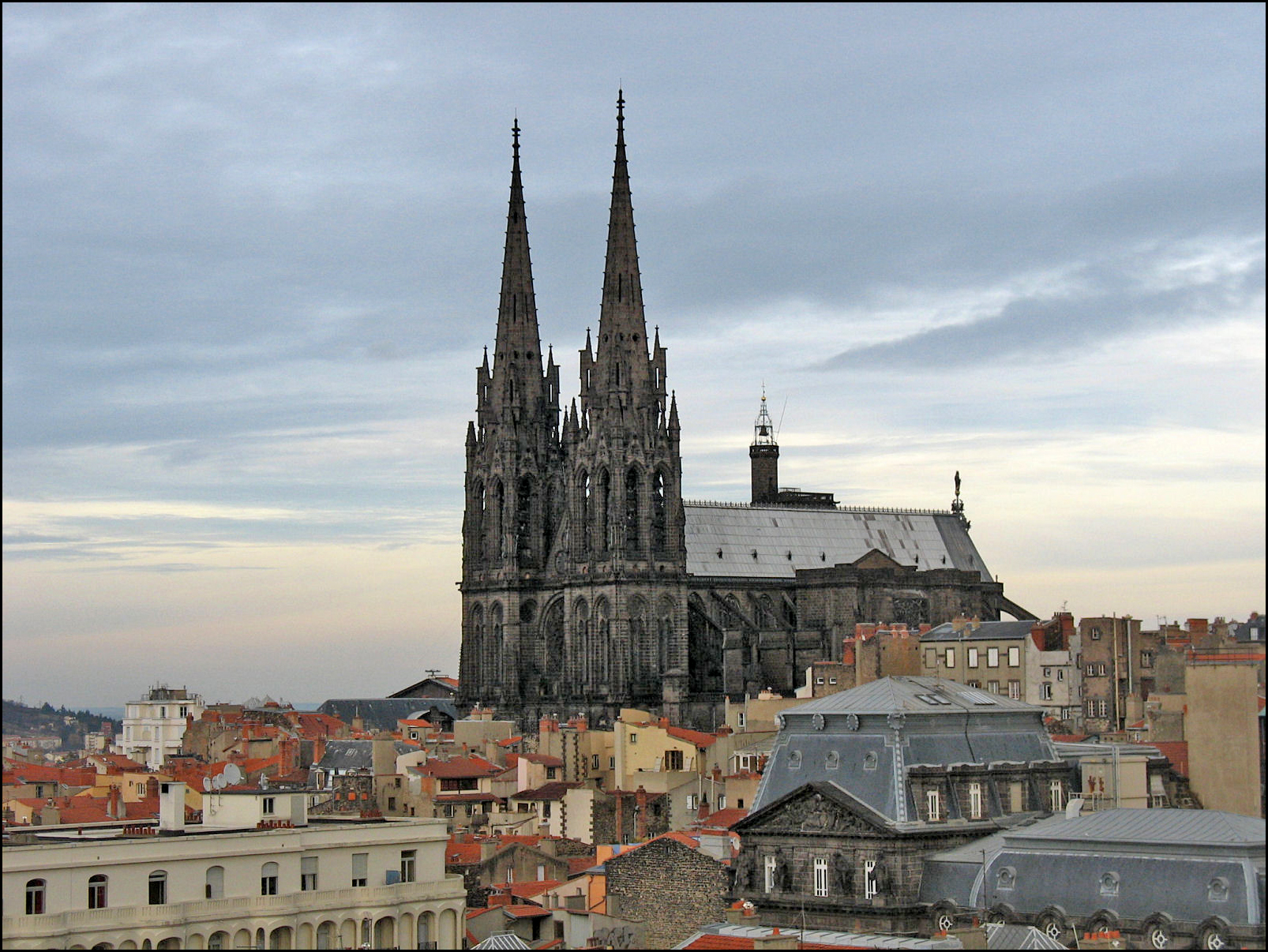
Clermont-Ferrand Cathedral
Most cathedrals glow. Clermont-Ferrand's absorbs light. Built entirely from pierre de Volvic — a dark volcanic trachyandesite quarried from the surrounding lava fields — this Gothic cathedral stands as a shadowed counterpoint to every pale limestone church in France. Its twin spires reach 96.1 meters, visible from across the city and the surrounding volcanic landscape, but their impact comes not from height alone. It is the color that arrests: a deep, almost geological darkness that makes the building look as though it erupted from the earth rather than being placed upon it.
Five Cathedrals Deep
The current building is at least the fourth church on this site. In the 5th century, Bishop Namatius built the first cathedral, dedicating it to Saints Vitalis and Agricola with relics brought from Bologna. Gregory of Tours recorded it as 43 meters long with 70 marble columns. Pepin the Short destroyed it in 760 and then, regretting the act, funded its reconstruction between 764 and 768. The Normans destroyed this second structure in 915. Bishop Stephen II built a third, Romanesque cathedral consecrated in 946 that likely served as a model for churches across the Auvergne. Its crypt survives beneath the present building, holding a 4th-century white marble sarcophagus.
The Bishop Who Visited Paris
In 1248, Bishop Hugues de la Tour visited Sainte-Chapelle in Paris and returned to Clermont-Ferrand with an ambition: a new cathedral in the prestigious Northern Gothic style that would assert his authority over a city recently restored to episcopal rather than aristocratic control. He hired Jean Deschamps, who had already worked on the cathedrals at Narbonne and Limoges. Inspired by Beauvais and Amiens, Deschamps devised original plans where the ribs penetrate directly under the arches and elliptical choir pillars allow apsidal window light to flood the sanctuary. The volcanic stone, stronger than limestone, permitted unusually delicate pillars. Louis IX attended the choir to marry his son — the future Philip III — to Isabella of Aragon, and financed stained glass windows from the same workshop that supplied Sainte-Chapelle.
Wars, Revolution, and a Watchman's Tower
Construction continued across generations. Pierre Deschamps succeeded his father around 1287, pushing the work beyond the transept crossing by 1325. Pierre de Cébazat finished three spans of the nave before the Hundred Years' War halted progress in 1355. Two great rose windows were installed in the 14th century — one predominantly blue, one predominantly orange — each fitting into a square 8.5 meters wide. During the French Revolution, revolutionaries planned to tear the cathedral down, but a Benedictine monk named Verdier-Latour persuaded them it would serve excellently as a gathering place for the people. The rood screen, choir stalls, altar, and statues were stripped, and three of four transept towers were razed. Only the Tour de la Bayette survived, its 17th-century bell still striking the hours — too useful as a watchtower to demolish.
Completion at Last
The cathedral stood unfinished for five centuries. It was not until 1866 that completion began, following plans by Viollet-le-Duc and executed by his pupil Anatole de Baudot. In 1884, the western facade with its soaring spires and the final span of the nave were completed, built with full respect for medieval construction methods. Only the cleaner cutting of the more modern stone reveals the difference. A small detail: the entire building was painted with lines to imitate masonry joints. The access steps on the rue des Gras were built at the start of the 20th century, and to make room for them, the birthplace of Blaise Pascal was destroyed — a trade-off that still provokes debate. At 92 meters long and 28.7 meters to the crossing vault, the cathedral remains the dark geological heart of a city built on volcanic ground.
From the Air
Located at 45.78°N, 3.09°E in central Clermont-Ferrand. The black cathedral with its 96.1m twin spires is a highly distinctive visual landmark from the air, contrasting sharply with the lighter-colored buildings surrounding it. Clermont-Ferrand Auvergne Airport (LFLC) is the nearest field. The cathedral sits on the city's high ground and is visible from considerable distance. Recommend viewing at 3,000-5,000 ft AGL.