Cleveland Museum of Art: For the Benefit of All People, Forever
The bomb went off on March 24, 1970, shattering the lower half of Auguste Rodin's The Thinker where it sat atop the museum's grand staircase. The Weather Underground claimed responsibility. Art conservators debated restoration, but the Cleveland Museum of Art made a remarkable choice: leave the damage. This was the last bronze casting of The Thinker made during Rodin's lifetime, and the blast had made it unique among the more than twenty original large castings. A plaque at the base notes the 1970 damage. The Thinker still sits there, scarred and contemplative, a fitting symbol for a museum that has weathered more than a century of upheaval while keeping its doors open and its admission free.
For the Benefit of All People
The Cleveland Museum of Art exists because three Cleveland industrialists - Hinman Hurlbut, John Huntington, and Horace Kelley - left trust endowments specifically for a public art museum. The neoclassical building, constructed from white Georgian marble in the Beaux-Arts style, opened on June 6, 1916, on the southern edge of Wade Park. The park itself takes its name from philanthropist Jeptha H. Wade, who donated part of his wooded estate to the city in 1881. His grandson, Jeptha H. Wade II, proclaimed the museum's mission at its opening: "for the benefit of all people, forever." That phrase was not rhetoric. More than a century later, the museum still charges no general admission. With a $920 million endowment - the fourth largest of any American art museum - it never has needed to.
61,000 Works and Counting
The collection spans 6,000 years and 16 departments, from Chinese scroll paintings and Egyptian sculpture to Caravaggio, Picasso, and Warhol. Picasso's Blue Period masterpiece La Vie hangs here. So does Turner's The Burning of the Houses of Lords and Commons and Frederic Edwin Church's Twilight in the Wilderness. The museum is particularly renowned for its Asian art holdings, considered among the finest in the United States, and its Egyptian collection. In 2004, the museum acquired an ancient bronze believed to be an original work by the Greek sculptor Praxiteles - the Apollo Sauroktonos, later reattributed as Apollo the Python-Slayer. The contested provenance sparked years of scholarly investigation; in 2013, laboratory analysis dated the bronze to between 350 and 250 B.C., supporting its attribution as a genuine Praxiteles.
A Building That Never Stopped Growing
The original 1916 building has been expanded four times. The first addition in 1958 doubled the floor space. In 1971, modernist architect Marcel Breuer contributed a brutalist North Wing whose angular, two-toned granite facade stands in sharp contrast with the original neoclassical flourishes. A West Wing followed in 1983. Then came the most ambitious project: between 2001 and 2012, architect Rafael Vinoly demolished the 1958 and 1983 additions and wrapped the entire complex with new east and west wings connected by a soaring glass-roofed atrium. The $350 million expansion - the largest cultural project in Ohio's history - doubled the museum's total size. Movie fans may recognize the atrium: it stood in for S.H.I.E.L.D. headquarters in the 2014 Marvel film Captain America: The Winter Soldier.
Knights, Candles, and Contested Legacies
The Armor Court has occupied its original location since 1916, displaying European arms and armor including a complete set of jousting armor for knight and horse from northern Italy, circa 1575 - man and horse armor together weighing 114 pounds. But the museum has also grappled with darker chapters of collecting. In 2013, it paid heirs of Arthur Feldmann to retain a drawing confiscated by the Nazis before they murdered him in the Holocaust. In 2017, it returned an ancient Roman portrait head stolen from an Italian museum in 1944. In 2023, New York prosecutors seized a Roman bronze sculpture connected to looting at the ancient Turkish town of Bubon. After extensive collaboration with Turkish authorities - including lead isotope analysis and mold comparisons - the museum announced in 2025 that it would repatriate the statue.
Open Access, Open Doors
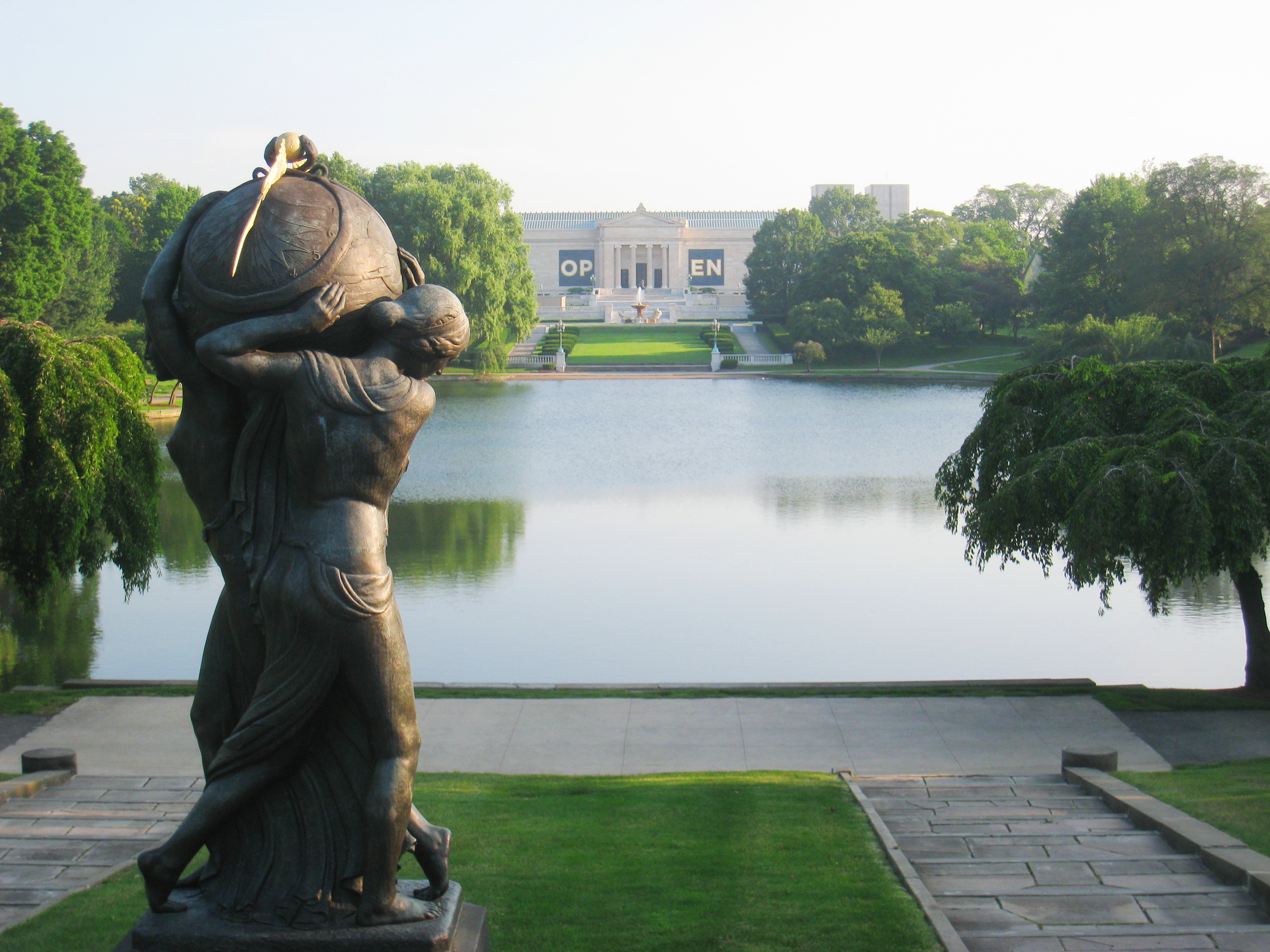
In 2019, the museum waived its rights to roughly 30,000 works in its permanent collection considered to be in the public domain, releasing high-resolution images under a Creative Commons Zero license. The ARTLENS Gallery offers a 40-foot interactive digital wall for browsing the entire collection, alongside digital studios where visitors create their own art. Nearly 770,000 visitors pass through the doors each year - a record set in 2018 - making it one of the most-visited art museums in the world. The Ingalls Library, one of the largest art museum libraries in the country, holds more than 500,000 volumes. Outside, Chester Beach's 1927 Fountain of the Waters still graces Wade Park, and Frank Jirouch's 1928 bronze sundial, Night Passing the Earth to Day, looks across the lagoon toward the museum entrance. The industrialists' vision endures: world-class art, free to all, forever.
From the Air
Located at 41.51N, 81.61W in the University Circle cultural district on Cleveland's east side. From altitude, University Circle appears as a concentration of large institutional buildings amid green space - Wade Park's lagoon is visible as an oval of water adjacent to the museum's white neoclassical facade and glass atrium. The museum is the largest building on the park's southern edge. Nearest airport is Cleveland Hopkins International (KCLE) approximately 12 miles southwest. Burke Lakefront Airport (KBKL) sits on the Lake Erie shore about 4 miles northwest.