Clifton Suspension Bridge
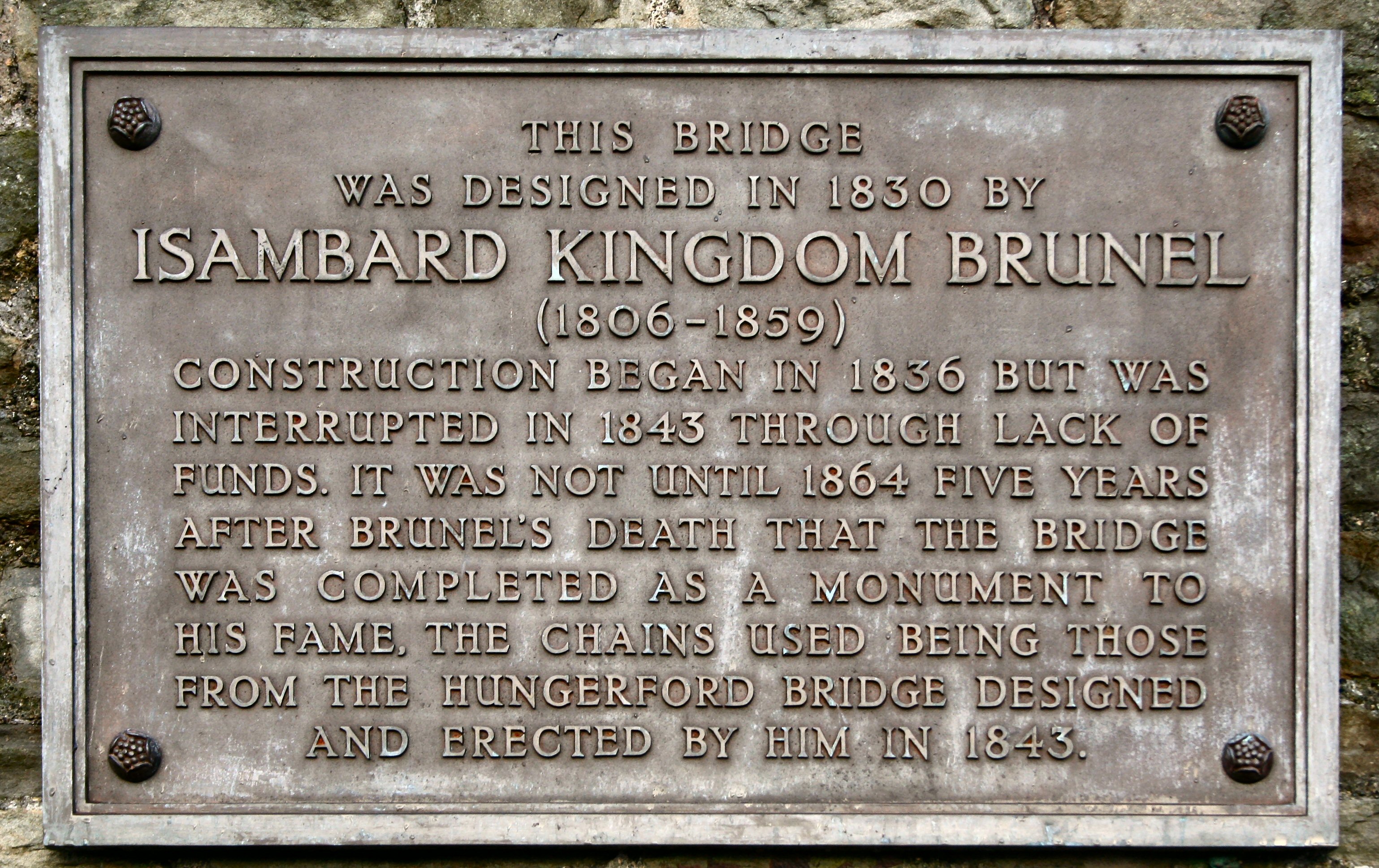
Isambard Kingdom Brunel never saw his bridge completed. He won the design competition in 1831 at the age of twenty-four, but the Bristol Riots interrupted construction that same year, and decades of financial difficulty followed. When Brunel died in 1859, only the two massive towers stood on either side of the Avon Gorge. His fellow engineers, determined to build a memorial worthy of the man, raised funds and completed the bridge in 1864, five years after his death. It spans 702 feet across the gorge, 245 feet above the high-water mark of the River Avon, and it has been collecting tolls every day since it opened.
A Competition and a Riot
The idea of bridging the Avon Gorge dated to 1753, when a Bristol merchant left a bequest for the purpose. Plans progressed slowly through stone bridge proposals and wrought iron designs before a formal competition was announced. Thomas Telford, the grand old man of British engineering, was invited to judge, but rejected all entries and submitted his own design, a move that infuriated the competitors. A second competition in 1831 selected Brunel's design, an elegant suspension bridge with Egyptian-inspired towers. Construction began, but the Reform Bill riots that autumn saw Brunel himself sworn in as a special constable. The social upheaval dried up investment, and work ground to a halt. The towers stood incomplete for over two decades, monuments to ambition thwarted by circumstance.
Finished Without Its Creator
After Brunel's death, the Institution of Civil Engineers launched a memorial fund. The final bridge was not built exactly to Brunel's specifications. William Henry Barlow and John Hawkshaw modified the design, and the chains used to suspend the deck were salvaged from Brunel's own Hungerford suspension bridge over the Thames, which had been demolished in 1860 to make way for a railway bridge to Charing Cross. The bridge opened on 8 December 1864, a functional monument to the engineer who had imagined it thirty-three years earlier. The two towers, though similar in size, are deliberately different in design: the Clifton tower has side cut-outs, while the Leigh tower features more pointed arches atop a 110-foot red sandstone-clad abutment. Roller-mounted saddles at the top of each tower allow the three independent wrought-iron eyebar chains on each side to move as traffic crosses.
Engineering That Breathes
A suspension bridge is not a rigid structure. It flexes, sways, and responds to the loads placed upon it. The Clifton Bridge's deck hangs from 162 vertical wrought-iron rods arranged in 81 matching pairs, and the chains shift across their saddles as vehicles cross. This designed flexibility is what has allowed the bridge to carry traffic for over 160 years, though the loads it bears today, including 11,000 to 12,000 vehicles daily, far exceed anything Brunel anticipated. A charitable trust has managed the bridge since the Clifton Bridge Company's shares were purchased and consolidated, completing the process in 1949. Toll income funds ongoing maintenance, and a visitor centre in the Leigh Woods tower opened in 2015, built within vaults that had been sealed since construction.
The Gorge Below
The setting elevates the engineering. The Avon Gorge itself is a dramatic limestone canyon carved by the River Avon through the Carboniferous limestone of the Mendip Hills, its walls supporting rare plant species found nowhere else in Britain. Standing on the bridge, the drop to the river is vertiginous. The gorge channeled not just the river but trade: Bristol's docks lie downstream, and the bridge connected the wealthy suburb of Clifton to the woodland of Leigh Woods on the Somerset side. From the air, the bridge reads as a thin line of iron and stone stretched between the gorge walls, the river curving beneath it toward the city. It remains a Grade I listed structure and the defining image of Bristol.
From the Air
Located at 51.455N, 2.628W, spanning the Avon Gorge between Clifton (Bristol) and Leigh Woods (North Somerset). The bridge is a striking visual landmark from the air, a thin suspension span across a deep limestone gorge. Nearest airports: EGGD (Bristol, 6 nm southwest), EGBP (Filton, 4 nm north). The Avon Gorge and River Avon provide unmistakable navigation references. Recommended viewing altitude 1,500-3,000 ft for the best perspective on the bridge and gorge relationship.