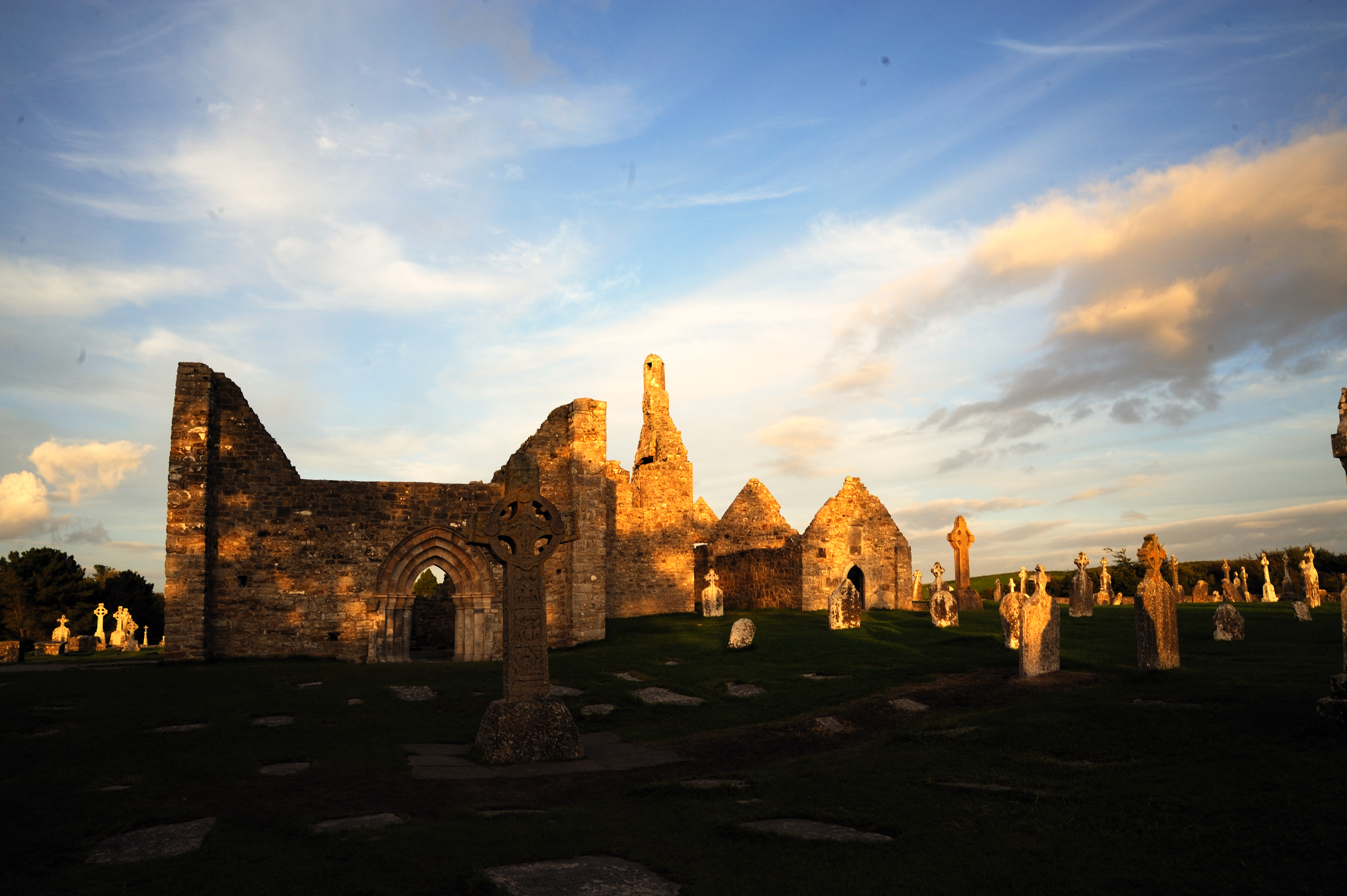
Clonmacnoise
There is almost nothing here. That is the point. Clonmacnoise sits in the boggy midlands of County Offaly with no pub, no hotel, and barely a mobile signal. Tour buses arrive, disgorge their passengers, and whisk them away again. What they leave behind is silence, a scatter of stone churches with grass growing between the walls, and the deep conviction that this emptiness is what makes the place extraordinary. Fifteen hundred years ago, this was one of the most important crossroads in Ireland. Today it is a place where you can hear the wind and imagine the rest.
Where the Roads Cross the River
Geography made Clonmacnoise. The River Shannon, Ireland's longest waterway, provided a north-south highway. Running east-west across the bogland was the Esker Riada, a chain of low sandy ridges left behind by retreating glaciers -- one of the few dry routes through the wet center of the country. Where the Shannon cut through the esker, travelers had to stop. Clonmacnoise (Cluain Mhic Nois, meaning "meadow of the sons of Nos") grew at that intersection. Saint Ciaran founded his monastery here in 544 and died just five years later, reportedly of plague, at the age of 33. The humble wooden buildings he left behind grew into a complex of stone churches, round towers, and high crosses that drew scholars, kings, and pilgrims from across Europe.
Walking the Circuit
Start at the visitor center, where the original high crosses are preserved indoors. The replicas outside mark the positions where the originals stood for centuries. The Cross of the Scriptures, a 4-meter masterpiece from around 900 AD, depicts the arrest of Jesus, the Crucifixion, and the Last Judgement, along with a panel showing King Flann Sinna and Abbot Colman, who commissioned it. O'Rourke's Tower -- named for a 10th-century Connacht king but not finished until 1124 -- was once a 30-meter landmark for arriving pilgrims. Lightning decapitated it in 1135, and the rebuilt stump now stands 19.3 meters tall, still impressive against the flat Shannon landscape. Temple Ciaran, the smallest church at just 2.8 by 3.8 meters, is said to mark the saint's grave. Excavations revealed the Clonmacnoise Crozier but no saintly remains.
Nine Churches and Their Secrets
The cathedral, built from 909 AD by King Flann and Abbot Colman, contains the graves of the last High Kings of Ireland: Turlough O'Connor, buried near the altar in 1156, and his son Rory in 1198. Its Gothic north doorway, known as the Whispering Arch, dates to the mid-15th century. Temple Finghin, a 12th-century Romanesque church, is notable for its round tower built directly into the structure -- an unusual design compared to the free-standing towers elsewhere on site. In 1864, a tourist from Birr named John Glennon walked in and began smashing the church. His motive was never recorded, but the resulting legal case exposed a gap in Irish law: there was no precedent for protecting ancient monuments as shared heritage. Glennon escaped punishment, but the case led to stronger legal protections for historic sites.
The Practical Pilgrim
Getting to Clonmacnoise without a car requires planning. The 850 Local Link bus runs from Athlone to Roscrea with six daily services. Shannonbridge, 7 km southeast, offers a few B&Bs and a marina for those arriving by boat on the navigable Shannon. The visitor center has a small cafe and gift shop, but beyond the compound walls there is nothing -- no restaurant, no pub, no accommodation. Mobile signal is unreliable at best. The site itself is walkable, with wheelchair access along the west side of the compound, though crossing the grass or navigating steps is required to reach some churches. Come prepared to spend a contemplative hour or two, then move on. Athlone has a fine castle and restaurants. Birr has the Leviathan telescope. Tullamore has its distilleries. Clonmacnoise has something those towns cannot offer: the experience of standing where a thousand years of Irish history happened, with nothing to distract you from it.
From the Air
Clonmacnoise is located at 53.324N, 7.991W on the east bank of the River Shannon in County Offaly. From the air, the monastic complex is clearly visible as a cluster of stone ruins and round towers set against flat green fields beside the river. The site is surrounded by bogland and has no significant modern development nearby. Nearest airports: Athlone Aerodrome approximately 15 km north; Birr Airfield (EIBI) about 30 km south. Shannon Airport (EINN) is roughly 100 km southwest. Recommended viewing altitude: 1,500-2,500 ft to appreciate the full extent of the ruins and their river setting.