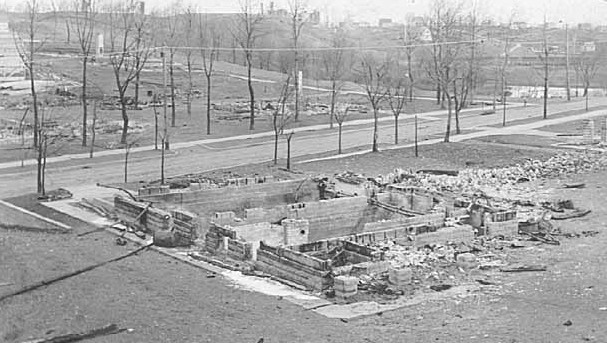
Cloquet Fire
On October 12, 1918, while the world's attention was fixed on the final weeks of the Great War, a different kind of devastation was unfolding in northern Minnesota. Railroad sparks landed on drought-parched timber, and within hours a wall of flame consumed entire towns. The Cloquet Fire killed 453 people in a single day, making it the worst natural disaster in Minnesota history by single-day casualties and the third-deadliest wildfire ever recorded, behind only the 1871 Peshtigo Fire and a 1936 blaze in Russia's Kursha-2. Wartime rumors blamed enemy saboteurs, but the true culprits were far more mundane: dry conditions, high winds, and a landscape stripped bare by decades of industrial logging.
Sparks on Dry Ground
The conditions that created the Cloquet Fire had been building for years. Northern Minnesota's forests had been heavily logged, leaving vast fields of slash and dry timber scattered across western Carlton County. A prolonged drought had turned the landscape into kindling. When sparks from railroad tracks ignited grass and brush, the fire found endless fuel. High winds drove the flames forward at terrifying speed, overwhelming the region's limited firefighting equipment. Cloquet Fire Chief F. J. Longren later confirmed that early rumors of intentional arson by enemy agents were false. The fire was devastatingly ordinary in its origins, a perfect collision of industrial neglect, weather, and geography that turned the towns of Cloquet, Moose Lake, and Kettle River into infernos.
A City Emptied in Hours
Cloquet bore the worst of it. Special police officer Albert Michaud described scenes horrific enough to make the pages of the New York Times. By mid-afternoon, it was clear the town could not be saved. Around 3 p.m., Lieutenant Karl A. Franklin and Captain Henry Tourtelotte of the Fourth Regiment of the Minnesota National Guard were called to the Rice Lake Road area. After conferring with Cloquet's mayor and police chief Robert McKercher, Tourtelotte and nine others raced toward Duluth to assemble reinforcements. Companies were dispatched to fight the fire but torrents of flame drove them back, and they shifted to rescuing survivors instead. By 5:40 p.m., Commanding Officer Roger M. Weaver of the 3rd Battalion had mobilized scores of men in under an hour, dispersing them to hazard sites across the burning region. About 4,700 Cloquet residents fled to Duluth, while others escaped to Superior, Wisconsin. In total, close to 12,000 people from neighboring towns were left homeless.
Sheltered by Strangers
The relief effort was massive and immediate. Hospitals, schools, churches, armories, and private homes in Duluth and surrounding communities opened their doors to thousands of displaced survivors. Doctors were brought in from across the region to treat the injured. The Red Cross constructed over 200 temporary shelters in Cloquet by November 15. Charles Mahnke, the Moose Lake member of the relief commission, told devastated farmers, "We are going to put you back as well off as you were before." The Northwestern Telephone Company restored phone service by Sunday evening. Students in Moose Lake returned to school on January 6, 1919, with Red Cross assistance. The generosity of neighboring communities, many of which had their own losses to mourn, defined the recovery as much as any government program.
Rebuilding from Ash
Cloquet's recovery was slower and more complex than Duluth's, whose economy centered on transportation and mining that the fire had largely spared. In Cloquet, the Northern Lumber Company, the backbone of the local economy, had been destroyed. Citizens gathered on October 20 in Carlton County to plan the path forward. Secondary industries stepped up: the Northwest Paper Company, the Cloquet Tie and Post Company, a toothpick factory, and a box factory all became primary economic drivers. The Northwest Paper Company resumed production just one week after the fire, providing desperately needed jobs. Within five years, Cloquet had industrialized, rebuilt its railroads, and replaced Red Cross shelters with permanent homes. The town that emerged from the ashes was not the same lumber town that had burned. It was something harder, more diversified, and more resilient.
Remembering the 453
A 27-foot monument near Duluth memorializes the 453 lives lost in the Cloquet Fire. In Moose Lake, the Soo Line Depot was converted in 1995 into a railroad and fire museum operated by the Moose Lake Area Historical Society, which annually honors the victims. The museum tells both stories intertwined in the disaster: the railroads that built northern Minnesota and the fire those same railroads helped ignite. The Cloquet Fire sits in a grim lineage of Upper Midwest wildfires, preceded by Wisconsin's Peshtigo Fire of 1871 and Minnesota's own Great Hinckley Fire of 1894. Each disaster was amplified by the same forces: industrial logging that left landscapes vulnerable, and communities that grew faster than their ability to protect themselves from the forests they were consuming.
From the Air
Located at 46.58N, 92.57W in northern Minnesota's Carlton County. The fire devastated a broad area of western Carlton County, centered on Cloquet but extending to Moose Lake and Kettle River. From the air, the St. Louis River corridor is the dominant landscape feature. The region is now reforested, but the pattern of regrowth differs visibly from old-growth areas. Duluth Sky Harbor Airport (KDYT) lies approximately 15 miles to the northeast; Cloquet is accessible from Duluth International Airport (KDLH). Viewing altitude of 3,000-5,000 feet AGL reveals the broad river valleys and rail corridors that shaped both the fire's spread and the region's recovery.