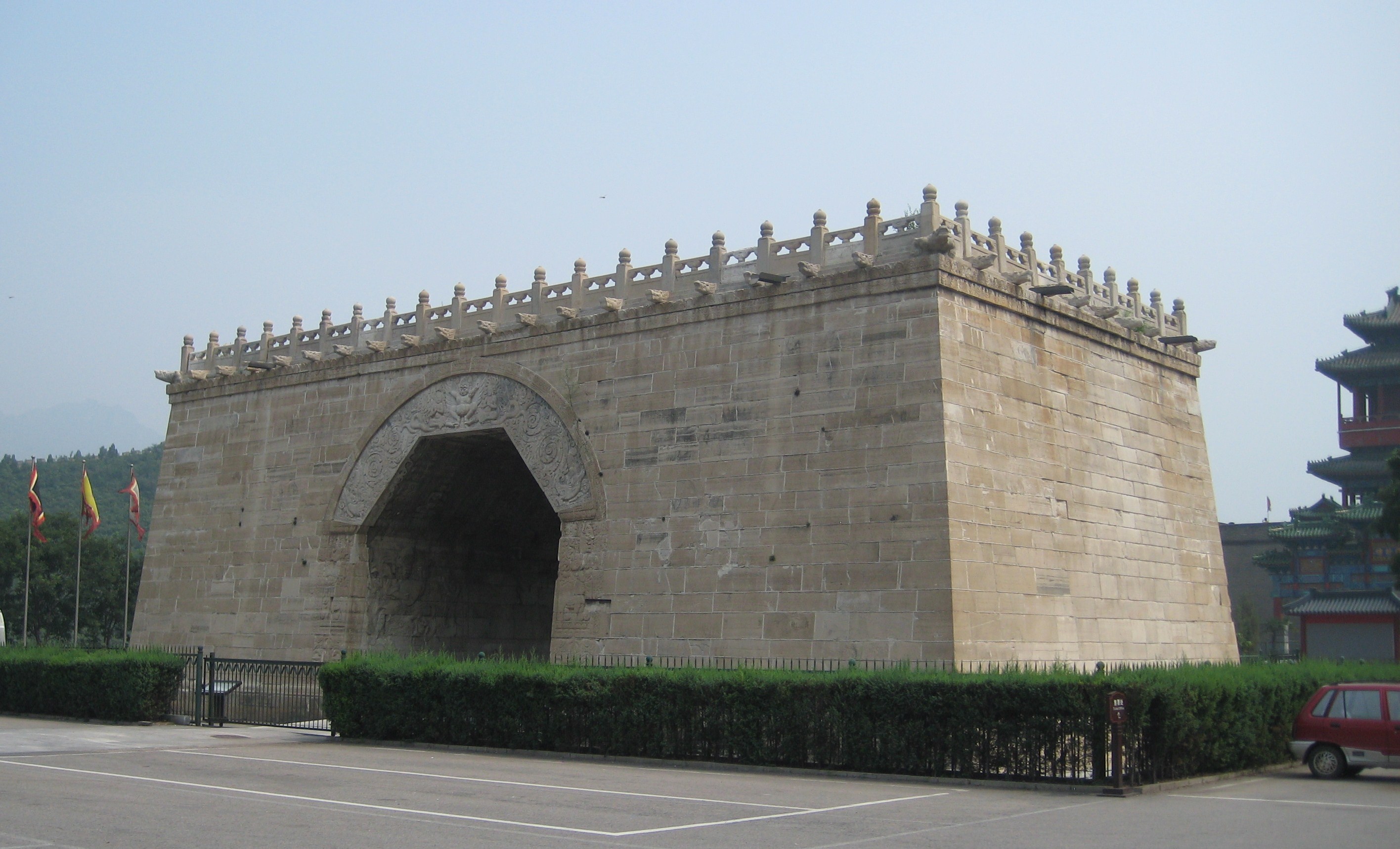
Cloud Platform at Juyong Pass
Six languages, six scripts, one stone archway. The Cloud Platform at Juyong Pass is a white marble gate standing 9.5 meters high in the middle of one of China's most strategic mountain passes. Built in 1342 during the Yuan dynasty, its walls carry Buddhist texts inscribed in Sanskrit, Tibetan, Mongolian, Uyghur, Tangut, and Chinese, a stone record of an empire that governed in six tongues simultaneously.
A Gate Between Worlds
The Cloud Platform sits in the Guangou Valley, midway through the Juyong Pass, where the Great Wall threads between mountains 50 kilometers north of Beijing. Originally called the Crossing Street Tower, it once supported three white pagodas on its top, giving travelers something to look up at as they passed through the arched portal below. Carts, horsemen, and palanquins all moved through this opening, where they were surrounded on both sides by carved images of people, animals, and Buddhist figures. The pagodas were destroyed during the turbulent transition from the Yuan to the Ming dynasty. A Buddhist temple hall, the Tai'an Temple, was later built on the platform during the early Ming period, only to be destroyed itself in 1702 during the Qing dynasty. What survives is the platform itself and its extraordinary inscriptions.
Words Carved in Stone
The inscriptions cover both the east and west inner walls of the passageway. Each wall carries two Buddhist dharani-sutras, ritual incantations transcribed from Sanskrit into all six scripts. The Lanydza script, a decorative form used for Sanskrit, occupies the top panels. Tibetan text fills the middle panels. The lower sections are divided into four vertical columns: 'Phags-pa script running left to right for Mongolian, Old Uyghur script also left to right, Tangut script running right to left, and Chinese characters running right to left. Five of the six scripts also carry a text called the Record of Merits in the Construction of the Pagoda, each in the corresponding language. The Chinese version concludes with a date from the Zhizheng era corresponding to 1345, recorded by a monk named Decheng from the Baoji Temple in Chengdu.
An Empire's Linguistic Ambition
The choice of six scripts was not decorative but political. The Yuan dynasty, founded by Kublai Khan's Mongol court, ruled the most linguistically diverse empire in East Asian history. Sanskrit represented the Buddhist tradition that legitimized imperial power. Tibetan connected to the Tibetan Buddhist clergy who served as spiritual advisors to the court. 'Phags-pa was the official Mongolian script commissioned by Kublai Khan himself. Old Uyghur reflected the administrative class that had served Mongol rulers since Genghis Khan's era. Tangut preserved the language of the conquered Western Xia kingdom. And Chinese was the language of the majority population. By inscribing all six on a single monument, the Yuan court created a statement of imperial universality, declaring that Buddhist truth, and by extension imperial authority, spoke to all peoples equally.
What Outlasts Empires
The Tangut language that appears on these walls belongs to a people whose kingdom was destroyed by the Mongols in 1227. By the time the Cloud Platform was built, the Tangut script had been dead as a living administrative language for over a century, yet here it was, carefully carved alongside the languages of its conquerors. The platform stands today as one of the most important surviving examples of Tangut script, alongside the dharani pillars at Juyong and similar multilingual monuments at the Mogao Caves. The empires that carved these words are gone, but the stone endures, each script a reminder that languages die but the impulse to record them does not.
From the Air
Located at 40.29N, 116.07E within Juyong Pass in the Changping District, about 55 km northwest of central Beijing. The Cloud Platform sits in the narrow Guangou Valley where the Great Wall passes through the mountains. Nearest major airport is Beijing Capital International Airport (ZBAA/PEK), about 65 km to the southeast. The pass itself is a visible terrain feature, a narrow gap in the mountain ridge.