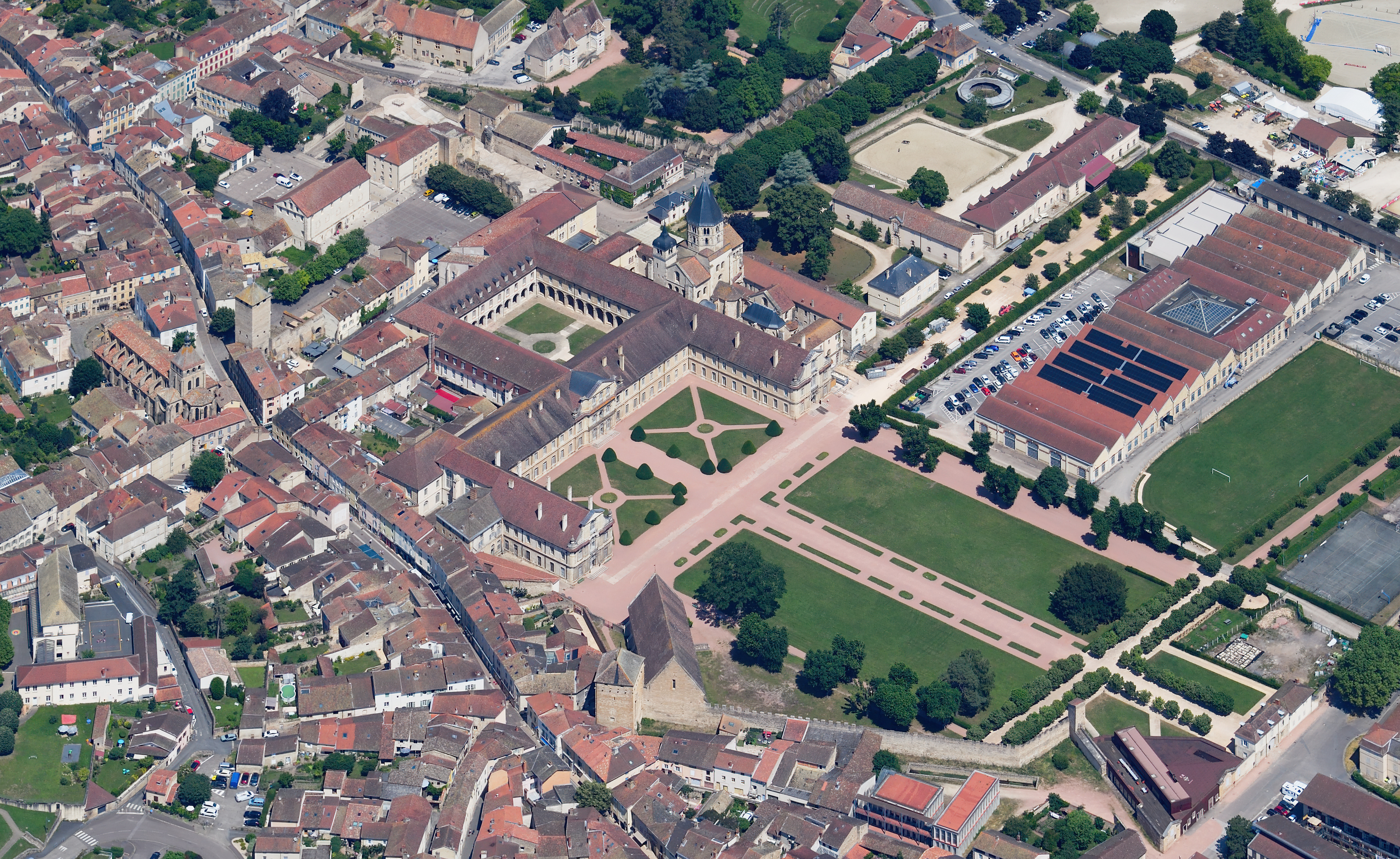
Cluny Abbey
The founding charter of Cluny Abbey, written in 910, contains a curse. Duke William I of Aquitaine, donating his hunting lodge and surrounding lands in Burgundy to establish a Benedictine monastery, placed the institution under the protection of Saints Peter and Paul and declared that anyone who violated the charter would face divine punishment. He also stipulated something radical for the era: the monastery would answer to no local lord, no bishop, no king -- only the Pope. And even the Pope could not seize the property, divide it, or appoint an abbot without the monks' consent. That independence made all the difference. Within two centuries, Cluny had become the most powerful religious institution in Western Europe.
The Largest Church on Earth
Cluny built three successive churches, each grander than the last. Cluny I was modest. Cluny II, constructed between roughly 955 and 981 after Hungarian raiders devastated the region, introduced the stone vaulting that became a hallmark of Burgundian architecture. Then in 1088, Abbot Hugh of Semur began Cluny III, a building of staggering ambition. Designed by Hezelon de Liege, it became the largest church in Europe and held that distinction for nearly 500 years, until the construction of the new St. Peter's Basilica in Rome in the 16th century. The building campaign was financed by an annual payment from Ferdinand I of Leon, ruler of a united Leon-Castile, who set the amount at 1,000 gold aurei -- a sum later doubled by Alfonso VI in 1090. It was the largest annuity the order ever received from any secular patron. When the Spanish payments eventually lapsed, the resulting financial crisis crippled Cluny for decades.
An Empire of Prayer
At its height in the 12th century, 314 monasteries across Europe paid allegiance to Cluny. The network was without precedent. Free from lay and episcopal interference, answerable only to a papacy that was itself often weak and disorganized, Cluny became a kind of parallel power structure -- reforming churches, reorganizing monasteries, and shaping religious practice from Scotland to Spain. Every English and Scottish Cluniac house was governed by French priors and directly controlled from Cluny until the reign of Henry VI, when raising the English priories to independent abbeys became a gesture of national sovereignty. The order's influence extended to the Gregorian reforms that reshaped the relationship between church and state across medieval Europe. At Cluny itself, the central activity was liturgy: extensive, beautifully performed, and believed to be indispensable for achieving a state of grace. Lay rulers competed to be remembered in the monks' endless prayers.
Destruction in Stages
Cluny's decline was neither sudden nor singular. The Huguenots sacked the abbey during the Wars of Religion in 1562, destroying or scattering many manuscripts from one of Europe's richest libraries. The real destruction came during the French Revolution. Seen as an emblem of the Ancien Regime's excesses, the abbey was targeted with methodical fury. In 1790, a rioting mob burned manuscripts that had survived the Huguenot assault. In 1793, the library and archives were put to the flame. The church was opened to plundering. In 1798, the entire estate was sold for 2,140,000 francs, and over the following two decades, the abbey's immense walls were systematically quarried for building stone. The town of Cluny was rebuilt, in part, from the bones of its own monastery.
Ten Percent of a Colossus
What survives of Cluny III amounts to roughly 10 percent of its original floor space: the southern transept with its bell tower, the lower portions of the two western towers, and ruined column bases that trace the outlines of what was once the largest interior space in Christendom. For a generation after the Revolution, even these remnants were neglected. Sentiment shifted in the 1830s, and preservation efforts began. In 1928, the American archaeologist Kenneth J. Conant, backed by the Medieval Academy of America, conducted systematic excavations that clarified the abbey's architectural history. Since 1901, the site has served as a campus for the Ecole nationale superieure d'arts et metiers, an elite engineering school -- a transformation that William the Pious, with his curse against those who would violate the charter, could never have imagined. The British Museum holds some sixty original Cluny charters; the Bibliotheque nationale de France in Paris preserves surviving manuscripts. But the building itself is mostly gone, its absence a measure of its former scale.
From the Air
Located at 46.43°N, 4.66°E in the town of Cluny, Saone-et-Loire, Burgundy. The surviving transept tower and partial ruins are visible from the air, surrounded by the town that grew from the abbey's destruction. The site is embedded in the rolling Burgundian countryside. Nearest airports: Saint-Yan (LFLN) approximately 50 km west, or Macon-Charnay (LFLM) approximately 25 km southeast. The scale of the original abbey complex is best appreciated from altitude, where the surviving fragments can be compared against the surrounding town that absorbed its stone.