Clydebank Blitz
Of the approximately 12,000 houses in the town of Clydebank, eight survived undamaged. Not eight hundred. Not eighty. Eight. On the nights of 13 and 14 March 1941, 439 Luftwaffe bombers dropped over 1,650 incendiary containers and 272 tonnes of high explosive on a small industrial town two miles long, lying along the north bank of the River Clyde. When it was over, 528 people were confirmed dead, more than 1,000 were seriously injured, and 35,000 -- virtually the entire population -- were homeless. The Clydebank Blitz was the most devastating attack on civilian life in wartime Scotland.
A Town Built Around Targets
Clydebank existed because of the Clyde. John Brown and Company's shipyard had launched the Queen Mary and the Queen Elizabeth from its slipways. The Singer sewing machine factory employed thousands. Rothesay Dock handled cargo for the western approaches. To the immediate west of the town sat Clydeside's main Admiralty Oil Storage facility, covering 130 acres -- the Luftwaffe's primary target, clearly marked on German maps. The problem, from the air, was that Clydebank's houses, schools, and churches stood right beside these industrial installations. The town was only two miles long. Target discrimination was functionally impossible. When the bombs fell on the shipyards and the oil tanks, they fell on everything else as well.
The First Night
The raid on 13 March was aimed at Clydebank's industrial infrastructure. Incendiary bombs set the Singer wood yard ablaze, and the flames acted as beacons for the waves of bombers that followed. Eleven oil storage tanks were destroyed and seven severely damaged. The resulting inferno blazed for more than four weeks. But the housing packed around these targets burned too. Four thousand homes were completely destroyed that first night. Another 4,500 were severely damaged. Historian Les Taylor later argued that while this first raid was not conceived as a terror attack, the devastation it caused to civilian housing was inevitable given the proximity of homes to the targets.
The Second Night
The bombers returned on 14 March. Taylor characterized this second raid as deliberately aimed at civilian morale -- 'intended to crack morale and force the people to call for an end to the war.' The attackers knew exactly what they had hit the previous night and returned to complete the destruction. Schools that had served as emergency shelters were struck. Churches were gutted. William Beardmore and Company lost furnaces and industrial infrastructure. By dawn on 15 March, Clydebank as a functioning town had essentially ceased to exist. The eight undamaged houses stood amid acres of rubble and smoldering wreckage. Survivors wandered through streets they could no longer recognize.
The Town That Would Not Break
The intended effect -- the breaking of Scottish civilian morale -- did not materialize. 'It had quite the opposite effect,' Taylor concluded, 'strengthening resolve for the war in Scotland.' The people of Clydebank, many of them sheltering in the surrounding countryside or billeted in nearby towns, began to return and rebuild. A Polish destroyer crew, docked at John Brown's shipyard, had helped defend the town during the raids, and a memorial to their service stands opposite the Town Hall. On the banks of the Clyde, amid the ruins of the shipyard, work resumed. Ships continued to be built. The town that had been nearly erased from the map refused to accept that verdict.
The Memorial Above the Town
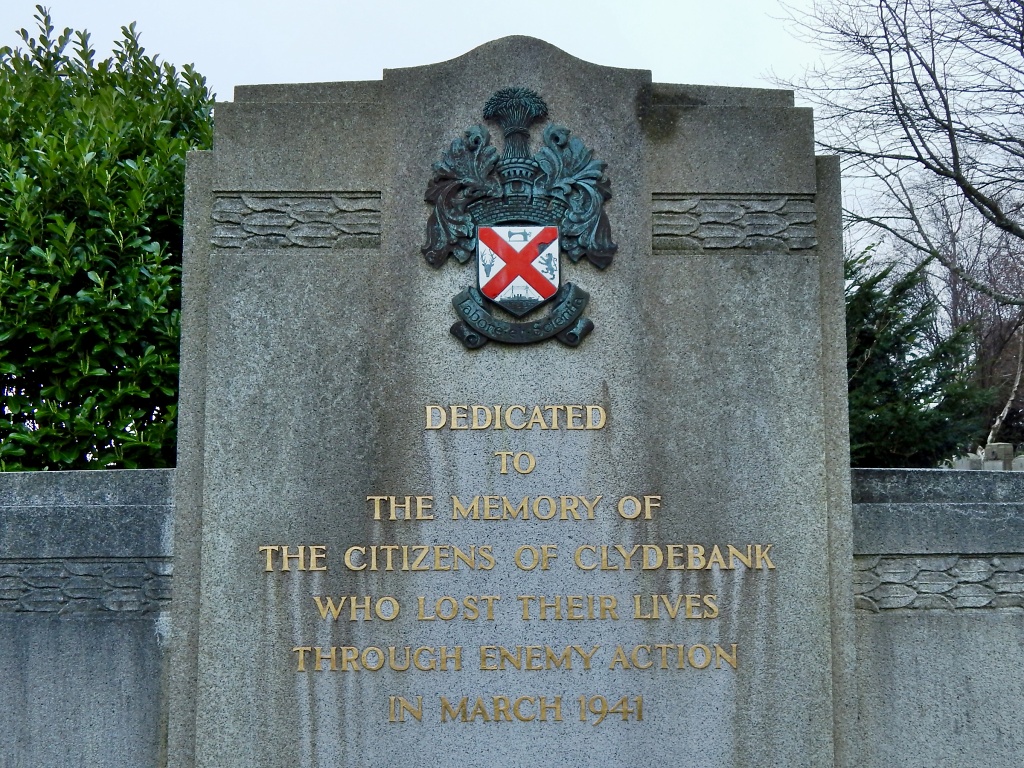
The main Blitz memorial stands in Dalnottar Cemetery, on the hillside above Clydebank. A substantial granite monument with bronze cast plates lists the 528 confirmed casualties by name. Beneath it lie the remains of the town's unclaimed dead -- those whose bodies could not be identified or whose families had themselves perished. A recording made in May 1941 by Tom Wright, a bombed-out civilian, was released on a 2007 audiobook titled The Blitz, preserving one man's voice from the ruins. At Kilbowie Saint Andrew's Parish Church -- the only Church of Scotland building in Clydebank to survive the bombing -- a memorial garden and the Blitz Chapel, added in 1997, hold a triptych painting of the destruction by artist Tom McKendrick. Each March, on the anniversary, the people of Clydebank gather to remember the two nights that tried to destroy their town and failed.
From the Air
Clydebank sits at 55.90°N, 4.40°W on the north bank of the River Clyde, approximately 6 nm west-northwest of Glasgow city center. The town is identifiable from the air by its position along the Clyde, with the Titan Clydebank crane (a preserved cantilever crane) as a landmark. The John Brown shipyard site is on the waterfront. Dalnottar Cemetery, where the Blitz memorial stands, is on the hillside above the town to the northwest. Nearest airport: Glasgow International (EGPF, 3 nm south). The Admiralty Oil Storage facility site lies to the west of the town.