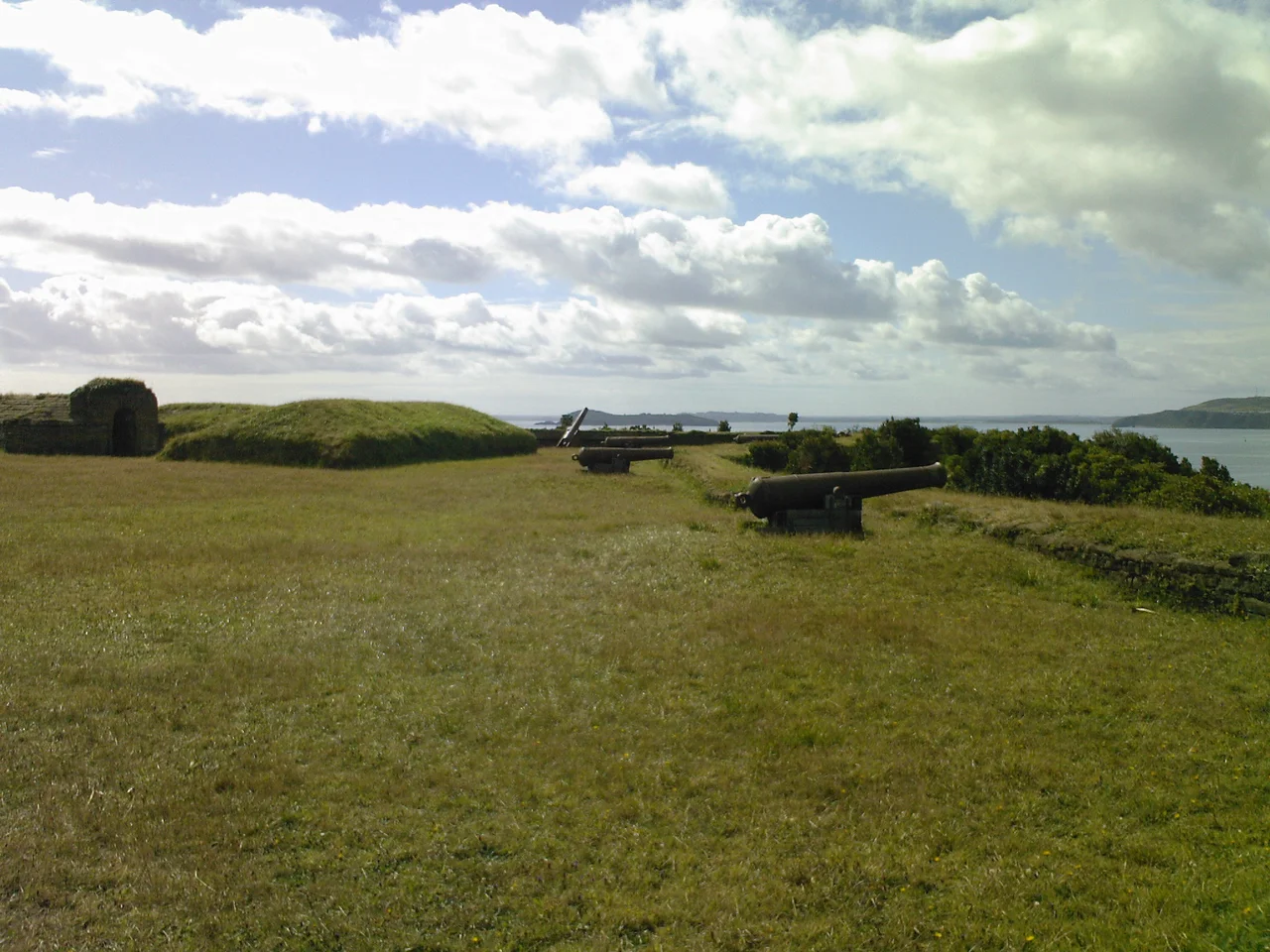

Coastal Fortifications of Colonial Chile
Spain spent two centuries afraid of a colony that was never built. The fear took stone form along the Chilean coast as fort after fort, battery after battery, raised against Dutch and British raiders who might slip up the Pacific to threaten the silver heart of the empire. The defenses peaked in the mid-18th century, an enormous investment in guns and garrisons for one of the most remote frontiers Madrid governed. The strange thing is how much of it was built against a threat that, in the end, simply failed to materialize.
The Empire's Soft Underbelly
The logic ran the length of the Pacific. Spain's wealth flowed north from Peru, and anyone who could establish a base in southern Chile, or seize the Strait of Magellan, could menace that lifeline. In the 16th century the Crown tried to plug the Strait itself; the explorer Sarmiento founded the doomed cities of Nombre de Jesús and Ciudad del Rey Don Felipe there in 1584, settlements so wretched the latter earned the name Puerto del Hambre, Port of Hunger. When the Strait proved impossible to hold, the strategy shifted north into the Captaincy General of Chile, where the coast could be fortified and supplied with greater hope of survival.
The Dutch Ghost
The deepest dread was an alliance the Spanish could barely imagine surviving: the Dutch joining forces with the Mapuche, the indigenous nation that had fought Spain to a standstill in the south for generations. The Spanish knew the Dutch eyed the ruins of Valdivia as a foothold and raced to reoccupy it first. In 1644, on word that the Dutch meant to return, the viceroy in Peru launched an extraordinary response: 1,000 men sent by sea from Callao in twenty ships, with 2,000 more ordered to march overland from central Chile. The land column never arrived, probably stopped by Mapuche resistance. But the fleet was the largest the region had ever seen, mustered against a colony the Dutch ultimately never came back to build.
A Burden in Stone
The forts were a triumph of engineering and a sinkhole of money. The Valdivian Fort System that grew out of the 1644 effort became a permanent drain on colonial finances, the more galling because the enemy it was built to repel never reappeared. Yet the building continued. In the 1740s, with British power rising in the Pacific, the viceroy of Peru and the governor of Chile pushed the frontier outward again: they settled the Juan Fernández Islands and threw up a fort at Tenquehuen in the Chonos Archipelago, manned for barely eighteen months before it was abandoned to the cold and isolation. The defensive instinct kept outrunning the actual threat.
Engineers and Dissenters
By the 18th century, fortification had become a profession, and the engineers who designed these remote bastions stamped them with the neoclassical geometry fashionable in Europe. They also argued. When Governor Antonio Narciso de Santa María judged Chiloé Island the keystone of the whole Patagonian defense, Spain founded the city-fort of Ancud in 1768 on his advice. Decades later the governor of Osorno, Juan Mackenna, wrote a blunt 1810 report urging that the swollen garrison at Valdivia be cut and its resources spent elsewhere, a recommendation promptly rebuked by Manuel Olaguer Feliú, the chief engineer who had helped design Valdivia's defenses. Within a decade the argument was moot: the forts Spain had agonized over for two hundred years fell to Chilean independence.
From the Air
The colonial fort network stretched along southern Chile's Pacific edge, with its core concentrated around Corral Bay near 39.87°S, 73.43°W and a southern anchor at Ancud on Chiloé Island (about 41.87°S, 73.83°W). Outlying sites reached as far as the Juan Fernández Islands far offshore to the northwest and the cold archipelagos toward the Strait of Magellan. From altitude the surviving Valdivian bastions appear as low star-shaped stone works hugging the shorelines of Corral Bay. Recommended viewing altitude 3,000-5,000 ft over the bay; for the broader system, higher transit altitudes reveal how the forts cluster at the few defensible harbor mouths along an otherwise wild coast. Nearest airport is Pichoy / Valdivia (SCVD); Pupelde / Ancud (SCPD) serves the Chiloé fortifications to the south. Persistent maritime cloud and rain are the rule along this coast.
Nearby Stories
- Riñihuazo 24 km away
- Lago Ranco 35 km away
- Villarrica 57 km away
- Sinking of Janequeo and Leucotón 91 km away
- La Imperial 95 km away
- Puyehue-Cordón Caulle 115 km away
- Isla Mocha 131 km away
- Battle of Agüi 224 km away