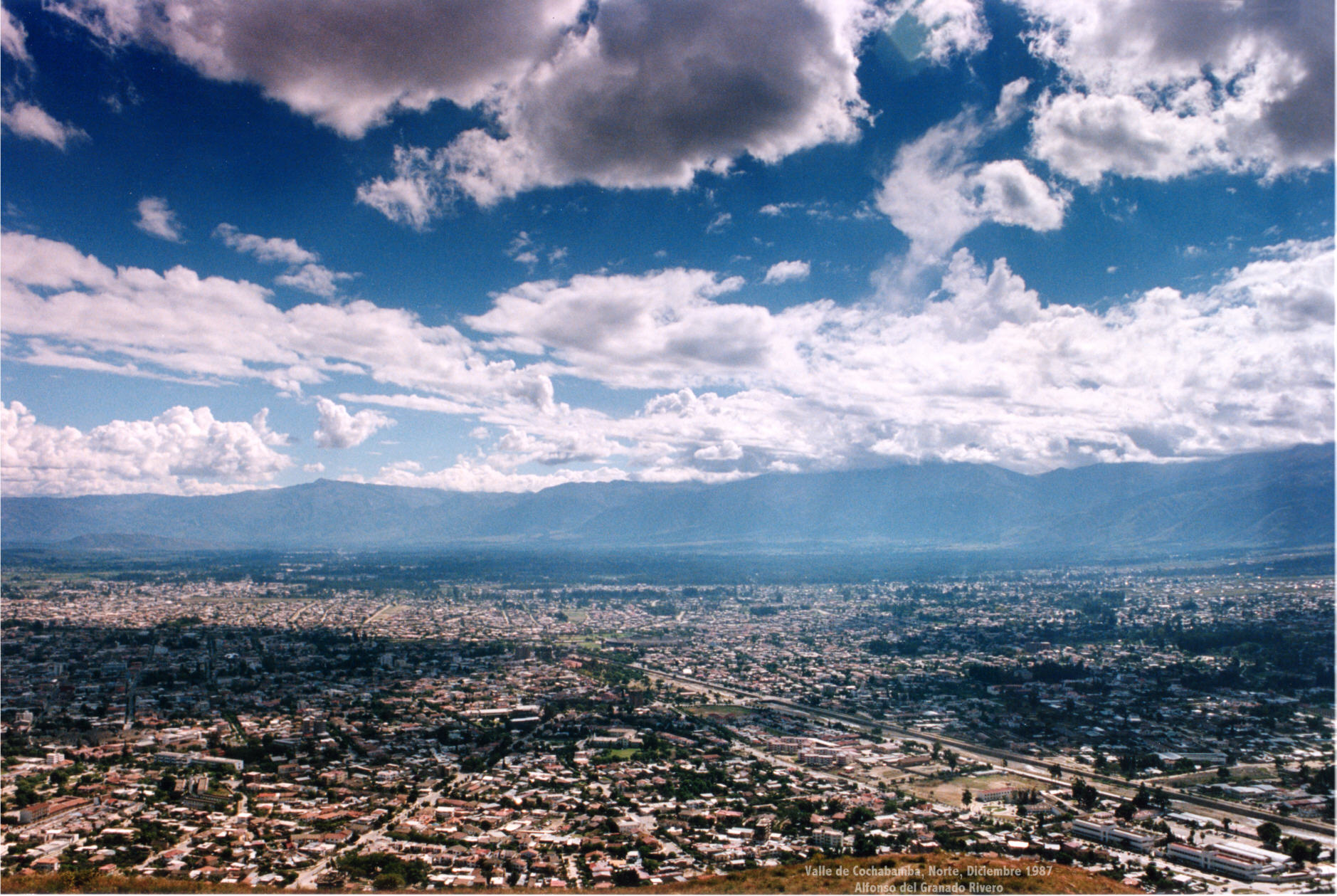
Cochabamba
The name tells you what was here before the city: q'ucha, lake, and pampa, open plain. In Quechua, Cochabamba describes a landscape, not a settlement — a fertile valley cradled by the Andes where water collected and crops grew easily. The Inca recognized this long before the Spanish arrived, using the Cochabamba Valley as a breadbasket for their empire, a source of maize that fed populations hundreds of kilometers away. When the Spanish established a city here in 1571, they inherited that agricultural identity. Four and a half centuries later, Cochabamba is Bolivia's fourth-largest city, known as La Llajta — simply "the town" in Quechua — and still defined by the tension between abundance and scarcity that its valley geography creates.
The Women Who Fought
Cochabamba's colonial history reached its most dramatic chapter in 1812, during the broader upheaval of South American independence movements. Early discontent with Spanish rule had been simmering since the 1780s, and when open rebellion came to Cochabamba, it produced one of the most remarkable episodes of the wars. Confronted by advancing Spanish troops, most of the city's men fled into the surrounding countryside. The women did not. They took up arms and fought the Spanish forces in defense of the city. The episode became a foundational story of Bolivian resistance, commemorated to this day. It speaks to something in Cochabamba's character: a city that has repeatedly proven willing to fight for its autonomy, whether against colonial armies, foreign corporations, or its own national government.
Where Spring Never Ends
Cochabamba earns its nickname — the City of Eternal Spring — honestly. Sitting in its valley at roughly 2,570 meters, the city enjoys temperatures that rarely approach freezing and never climb to oppressive heat. The humidity stays low, the skies are often clear, and the climate is mild enough that the city's other moniker, the Garden City, fits equally well. But this pleasantness masks a chronic problem. Rain is sparse, falling mostly between November and March, and the dry months from May through September can stress water supplies for a growing urban population. The paradox of Cochabamba is that its valley was prized for agriculture precisely because water collected here — yet in the modern era, there is never quite enough of it.
The Water Wars
In the late 1990s, water became the issue that defined Cochabamba to the outside world. Under pressure from the World Bank and International Monetary Fund, Bolivia privatized its water systems as a condition of receiving foreign investment. In Cochabamba, a consortium led by the multinational Bechtel subsidiary Aguas del Tunari took control of the city's water supply. Rates spiked to levels that many residents could not afford, while service remained unreliable for much of the population. Public outrage erupted into street protests in early 2000, pitting residents against riot police in confrontations that drew international media attention. The government ultimately rescinded the privatization contracts. The Water Wars are widely credited with accelerating the political rise of Evo Morales and reshaping Bolivian politics. In Cochabamba, water remains a charged subject — a reminder that the resource the valley was named for is still the resource most fiercely contested.
La Cancha and the Silpancho
Cochabamba's identity as Bolivia's food capital traces directly to its origins as an agricultural supply center for mining communities. The city claims to have the best cuisine in the country, and the claim is difficult to argue. Silpancho, a Bolivian dish of pounded beef served over rice and potatoes with a fried egg on top, supposedly originated here. The almuerzo completo — soup, main course, and often dessert — is available at restaurants throughout the city for modest prices. La Cancha, the sprawling market south of the center, is one of the largest open-air markets in South America, a labyrinth of stalls selling everything from produce to electronics. Nearby, the chicha of the Cochabamba region is considered Bolivia's finest — a fermented corn beverage with roots in pre-Columbian traditions, still brewed in small towns like Punata to the southwest.
A City of Contrasts
Modern Cochabamba arranges itself along clear axes. Avenida de las Heroinas runs east to west; Avenida Ayacucho cuts north to south. Their intersection, known as El Correo for the post office that stands there, marks the commercial heart. Plaza 14 de Septiembre, the city's central square, anchors the historic core, while the tree-lined boulevard of El Prado extends north from Plaza Colon through neighborhoods that grow progressively more affluent. To the south, the city is rougher and poorer. The Cristo de la Concordia, a massive statue of Christ standing on the hill of San Pedro, watches over this division from above — reachable by cable car or by stone stairs that climb the hillside. From its feet, the entire valley spreads out: the spring-like city that sits where a lake once gathered on an open plain.
From the Air
Cochabamba sits at 17.39°S, 66.16°W in a broad valley at approximately 2,570 meters (8,430 feet) elevation, surrounded by the Andes. Jorge Wilstermann International Airport (SLCB) serves the city, located southeast of the center. The valley is clearly visible from altitude, with the Tunari range rising to the north and the Altiplano extending to the west. Expect density altitude effects on aircraft performance and generally clear weather, though rain is possible November through March. The Cristo de la Concordia statue on San Pedro hill is a visual landmark from the air.