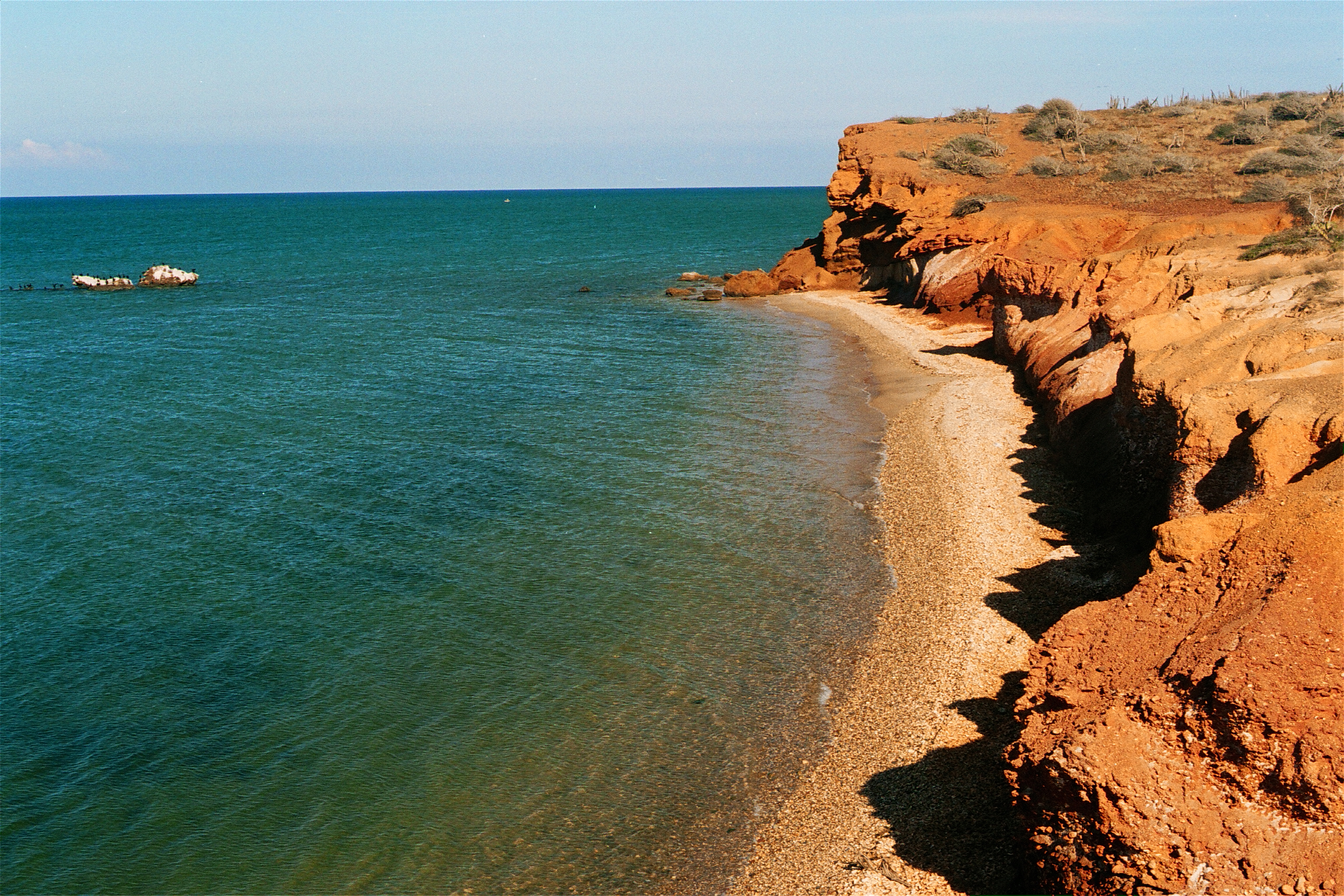
Coche Island
Polish novelist Arkady Fiedler set his 1954 adventure Robinson's Island on Coche -- a small, wind-hammered Caribbean island where a shipwrecked Virginia pioneer and two Arawak companions survive in the 1720s. Fiedler chose well. Coche is the kind of place that breeds survival stories: 55 square kilometers of low, sparse terrain where winds exceed 50 kilometers per hour, rain barely falls, and the sea dominates everything. What Fiedler could not have predicted is that the same relentless wind that battered his fictional castaways would eventually make the island famous for an entirely different reason. Today, Coche's western coast is considered one of the best kiteboarding and windsurfing destinations in the world.
Columbus, Pearls, and Ruins
Christopher Columbus sighted Coche in 1498, finding it inhabited by the Waika Rio indigenous people. The Spanish made their first attempts to settle the island in the early 16th century, drawn by the pearl fisheries that were transforming the entire region. When a tropical storm destroyed Nueva Cádiz on neighboring Cubagua, refugees from that ruined city fled to Coche. But the island could not hold them. By 1574, all settlers -- most of them connected to the pearl trade -- had abandoned Coche entirely. The island sat effectively empty for over two centuries until the next successful settlement in the 19th century. Today it is the municipality of Villalba, with San Pedro de Coche as its modest capital and a population of roughly 8,200 people scattered across a handful of small towns: El Bichar, Guinima, El Amparo, El Guamache, and La Uva.
Where the Wind Never Stops
Coche's defining feature is its wind. The trade winds blast across the island with such consistency and force that the sparse vegetation leans permanently to one side, bent like the trees in a time-lapse photograph. On the western coast, these winds meet a stretch of sea that remains remarkably flat -- waves break on the outer reefs, leaving the inshore waters smooth and fast. The combination of 50-plus kilometer-per-hour winds and waveless water creates conditions that kiteboarders and windsurfers travel from around the world to experience. The island's near-total absence of clouds means the sun burns all day and the breeze intensifies through the afternoon, precisely when riders want the most power. It is an island engineered by nature for exactly one sport, and it has embraced that identity with good hotels and outfitters catering to the wind-sports crowd.
A Fictional Robinson
Coche's literary fame comes from an unlikely source: a Polish adventure writer who never lived there. Arkady Fiedler published Wyspa Robinsona (Robinson's Island) in 1954, telling the story of Jan Bober, a half-Polish, half-English Virginia colonist who flees government pursuit aboard a pirate ship. The ship wrecks near Coche, and Jan survives with two Arawak companions, Arnak and Wagura, who had been enslaved aboard the vessel. Together they live on the island from 1725 to 1726, eventually welcoming a group of people who had escaped enslavement on Margarita Island. Together they defeat their Spanish pursuers and capture a ship. Fiedler continued the story in two sequels -- Orinoko (1957) and Bialy Jaguar (1980) -- creating a trilogy that became a beloved classic of Polish adventure literature, with Coche Island at its origin.
Island Life Between Two Worlds
Coche sits in the Caribbean between Margarita Island to the north and the Venezuelan mainland to the south, the middle sibling of three islands that form Nueva Esparta state. It is the quietest of the three: larger than barren Cubagua but far less developed than Margarita, with its resorts and international airport. The highest point on Coche reaches just 60 meters above sea level. The climate is tropical with average temperatures around 27 degrees Celsius, though the constant wind makes the heat bearable. Fishing remains a core tradition, and the economy depends increasingly on the selective, small-scale tourism the island has cultivated. Andrés Miguel Salazar Marcano Airport (ICAO: SVIE) maintains a single runway at just 10 feet elevation, serving small aircraft. The ferry connection to Margarita keeps Coche linked to the wider world while preserving the quiet that makes it worth visiting.
From the Air
Located at 10.78°N, 63.93°W in the Caribbean Sea, midway between Margarita Island and the Venezuelan mainland. Coche is an elongated, low-profile island approximately 11 km long by 6 km wide with a maximum elevation of 60 meters. Andrés Miguel Salazar Marcano Airport (SVIE) has a single runway of 3,937 feet (1,200 m) at 10 feet elevation. Santiago Mariño Caribbean International Airport (SVMG) on nearby Margarita Island is the closest major airport. The island's windswept, sparse appearance contrasts with greener Margarita to the north.