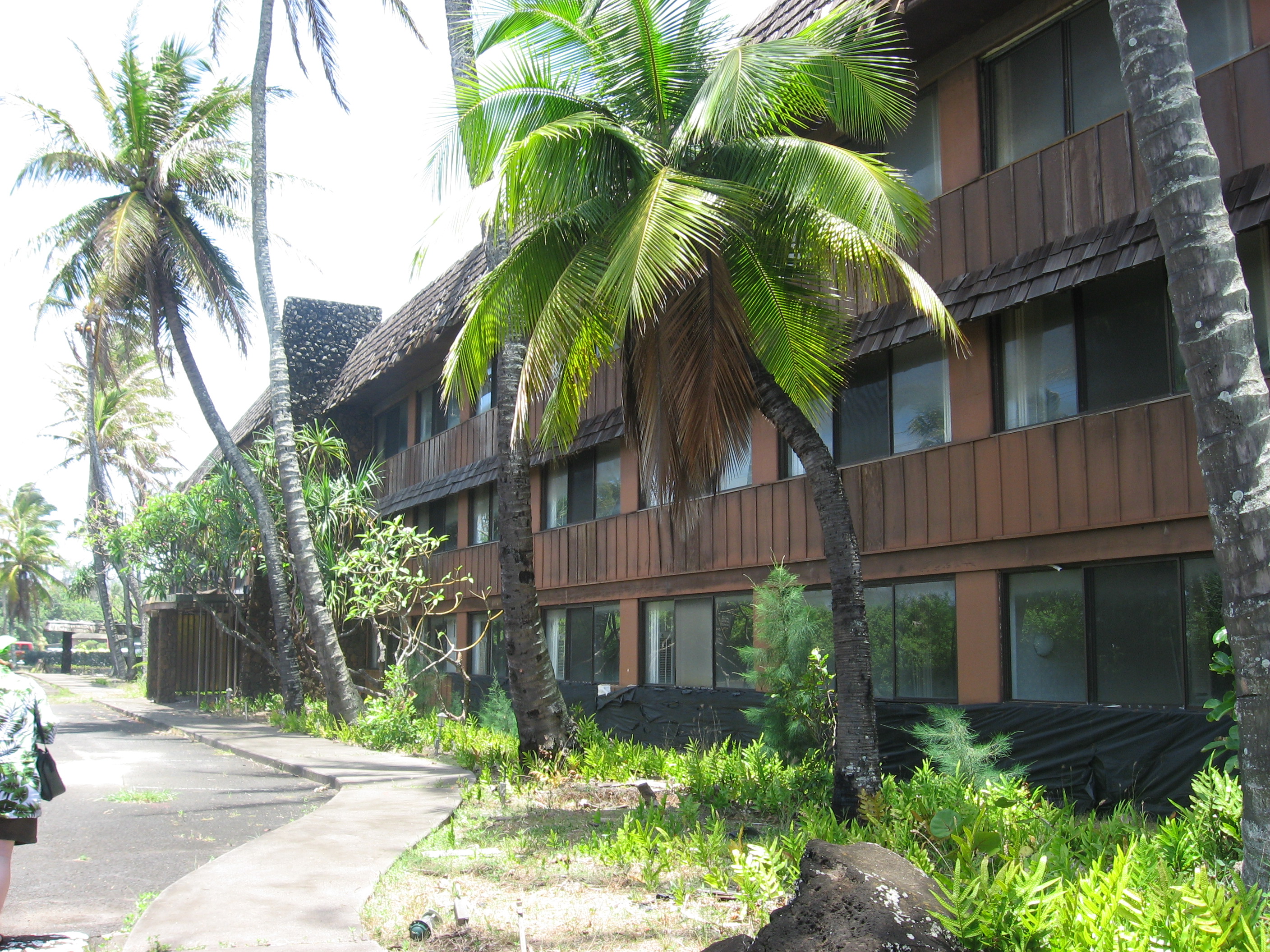
Coco Palms Resort
Long before Elvis Presley was married at its lagoon in the 1961 film Blue Hawaii, the land at the mouth of the Wailua River belonged to Hawaiian royalty. Deborah Kapule, the wife of Kauai's last independent monarch Kaumualii, kept a home here in the 1830s where travelers were always welcome. She called it hospitality. A century later, a hotel manager named Grace Buscher reinvented that tradition for tourists, and the Coco Palms Resort became the most famous hotel in Hawaii. Then Hurricane Iniki arrived in 1992, and the resort has stood in ruins ever since, caught between developers, foreclosures, and Native Hawaiian descendants who say the land was never anyone's to sell.
Deborah's Inn
The Wailua River mouth has been sacred ground for centuries. Hawaiian tradition marks it as the landing place of the Kahiki voyagers around 500 AD, a site of royal compounds and birthing stones. When Kauai's monarch Kaumualii was kidnapped by the powerful regent Kaahumanu in the 1820s, his wife Kekaihaakoulou, later baptized as Deborah Kapule, remained behind on the riverbanks. She remarried, converted to Christianity, and opened her large home to visitors beginning in 1823. Historian James Jarvis, who traveled upriver with her by double-hulled canoe in 1837 to the top of Wailua Falls, wrote that she lived in a beautiful spot that looked more like park scenery than any work of nature. For twenty years she entertained Protestant missionaries, Catholic priests, and passing travelers alike. After she died around 1853, the property deteriorated. The canoes rotted in their shed. Villagers continued to grow taro and tend the fishponds, but the grand house fell to pieces.
Torches and Technicolor
In 1896, a German immigrant named William Lindemann planted over 2,000 coconut trees on the site, dreaming of a copra empire. He did not realize how slowly coconut palms mature, and the plantation failed spectacularly. But the grove survived him. By 1952, Lyle Guslander leased the property and opened the Coco Palms lodge on January 25, 1953, with 24 rooms, five employees, and exactly two guests. His hotel manager Grace Buscher had no experience in hospitality, but she had instincts. She invented the torch-lighting ceremony that became a fixture at Hawaiian hotels across the islands: a conch shell blown at dusk, a drum beaten, and a runner racing through the coconut grove igniting torches until the lagoon blazed with firelight. Hollywood arrived within months. Rita Hayworth filmed Miss Sadie Thompson at the resort in May 1953, and a chapel built for the production became the setting for Buscher's next innovation: the Hawaiian tourist wedding. When Elvis Presley's Blue Hawaii featured the "Hawaiian Wedding Song" at the Coco Palms lagoon in 1961, the hotel became synonymous with tropical romance.
The Storm and the Silence
Hurricane Iniki struck Kauai on September 11, 1992, with sustained winds of 145 miles per hour. The Coco Palms Resort was destroyed, and it has never reopened. For years, the grounds remained accessible through Hawaii Movie Tours, where former caretaker Bob Jasper would greet visitors while entertainer Larry Rivera shared stories of performing alongside Elvis. On July 4, 2014, a fire damaged what remained of the structures. Developer after developer has tried to resurrect the resort. Coco Palms Hui LLC planned to rebuild as part of Hyatt's Unbound Collection, estimating costs at over 100 million dollars. That effort collapsed in 2019 amid loan defaults and a foreclosure lawsuit. The Utah-based Private Capitol Group alleged that the developers had failed to deposit 5 million dollars into escrow as agreed and had made false representations to financiers. Reef Capital Partners later acquired the property, proposing a 350-room resort.
Whose Land Is It?
The legal battles over this land stretch back to 1855, when the will of Kealiiahonui, son of Kaumualii, was filed in probate. In 1866, a petition involving Queen Kapiolani and King Kalakaua sought to revoke that will. The case was dismissed, then relitigated, then dismissed again. It was finally overturned in 1893 by Sanford B. Dole, who adjudicated the case while simultaneously serving as president of the Provisional Government that had just overthrown the Kingdom of Hawaii. Both parties were required to sign an agreement allowing Dole to rule despite no longer sitting on the bench. In 2016, Noa Mau-Espirito, a Native Hawaiian who traced his genealogy to Kaumualii, began occupying a portion of the Coco Palms property, planting taro, caring for burial sites, and clearing a roadway. When developers tried to evict his group as squatters, a judge denied the motion, ruling that property ownership had not been fully determined. A community organization called Ola Wailuanui has gathered over 10,000 signatures supporting the use of the site for cultural and educational purposes rather than resort development.
The Coconut Coast
The old coconut grove, planted by Lindemann more than a century ago, still defines this stretch of Kauai's eastern coastline, even as many of the original trees have outlived their natural lifespan and thinned with time. The state land board ordered developers to stop unpermitted tree clearing in April 2023. What remains at the Coco Palms is a place where every layer of Hawaiian history is visible at once: ancient royal grounds, missionary-era hospitality, plantation agriculture, mid-century Hollywood glamour, and the unresolved consequences of the kingdom's overthrow. Whether the site becomes a resort again or returns to cultural stewardship, the land at the mouth of the Wailua River continues to do what Deborah Kapule always intended. It receives visitors and refuses to let them leave without a story.
From the Air
Located at 22.05°N, 159.34°W on Kauai's eastern coast near the mouth of the Wailua River. Fly along the Coconut Coast at 1,500-2,000 feet AGL for views of the coconut grove and river mouth. Nearby airport: Lihue Airport (PHLI), approximately 5 nm south. The Wailua River and its surrounding wetlands are visible landmarks. Watch for variable trade wind conditions along the coast.