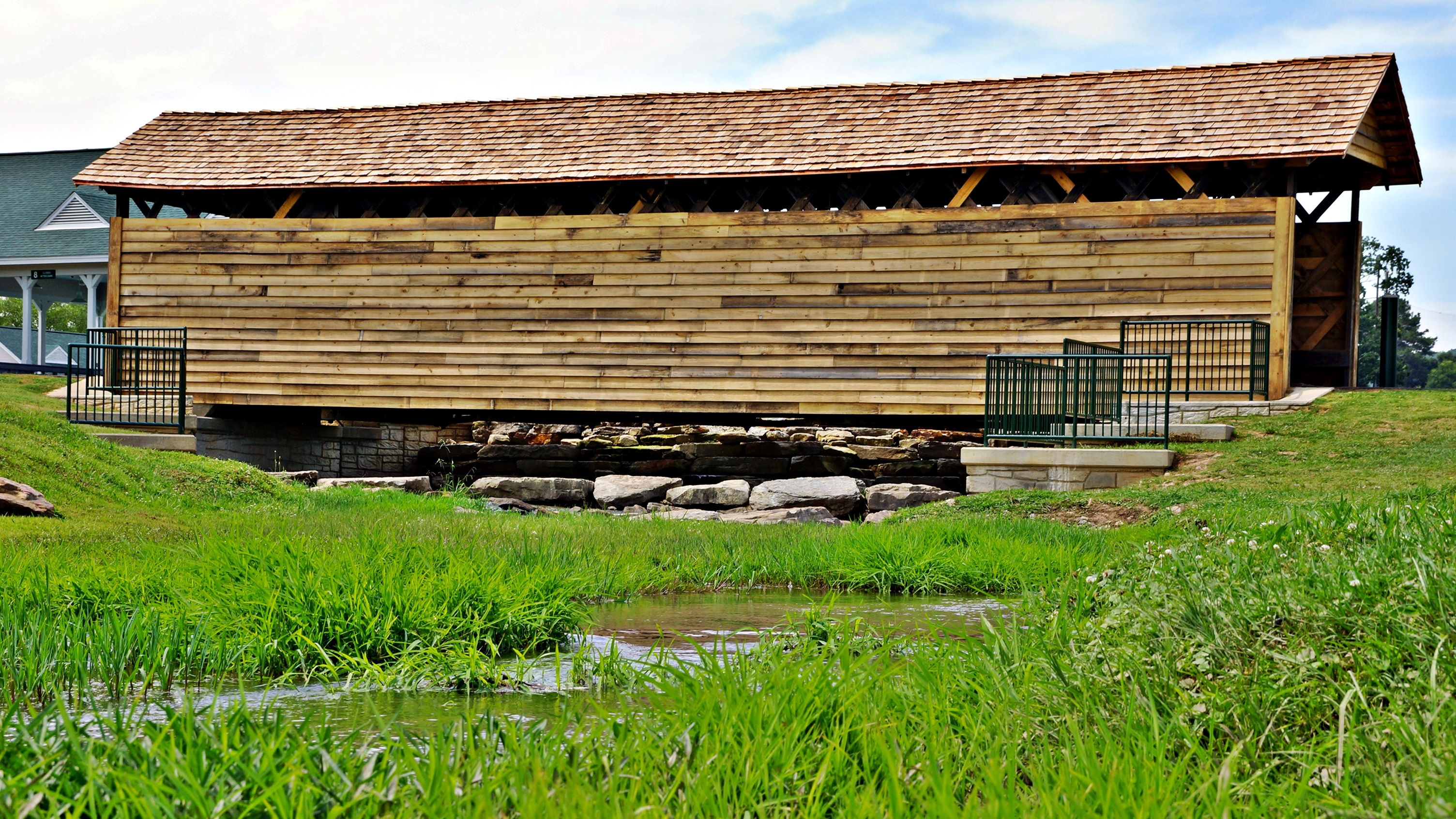
Coldwater Covered Bridge
The builder's name has been lost. What survives is his work: a wooden covered bridge of such precise craftsmanship that it has outlasted every other covered bridge in Alabama. Built around 1850 by a formerly enslaved man whose identity history failed to record, the Coldwater Covered Bridge combines two distinct engineering traditions - the Multiple King-post truss and the Town Lattice pattern - into a single span that has endured fire, neglect, relocation, and nearly two centuries of Alabama weather. It stands today not where it was built, but in Oxford Lake Park, a quiet survivor transplanted to safer ground.
An Engineer Without a Name
The facts are sparse but telling. Sometime around 1850 - though some sources push the date back to 1839 - a formerly enslaved craftsman constructed a covered bridge over Coldwater Creek, near the border of Calhoun and Talladega counties in east-central Alabama. The bridge served the community around Coldwater Mill, a saw and lumber operation owned by Peter N. Hughes and Humphrey Hughes, which also gave the bridge its alternate name: the Hughes Mill Covered Bridge. The builder combined a Multiple King-post truss with a Town Lattice design, a rare hybrid that distributed weight across both vertical posts and a woven lattice of diagonal planks. It was sophisticated engineering from a man whom the legal system of his time had classified as property. His name went unrecorded. His bridge is still standing.
Trial by Fire and Time
For seventy years the bridge carried traffic across Coldwater Creek without incident. Then, in the early morning hours of August 11, 1920, fire partially consumed the structure. But the heavy timbers and the lattice framework held. Repairs were made, and the bridge returned to service, carrying motor vehicles across its wooden deck for another half-century. By 1974, a concrete and steel replacement had rendered it obsolete. The old bridge was left standing beside the new one, exposed to the elements with no particular plan for its future. It had survived fire. Now it had to survive indifference - and for sixteen years, it did, weathering Alabama summers and winters with nothing but its own construction to protect it.
A Bridge Moved to Safety
In 1990, the City of Oxford intervened. The Coldwater Covered Bridge was fully restored and relocated to Oxford Lake Park, off State Route 21, a few miles east of its original creek crossing. Its original tin roof was replaced with shingles. The bridge now spans the outflow from Oxford Lake's marble springs - a gentler assignment than the creek it once crossed. Listed on the National Register of Historic Places since April 11, 1973, and carrying World Guide to Covered Bridges number 01-08-01, it holds the distinction of being the oldest existing covered bridge in Alabama. The Tallahatchee Covered Bridge, a similar structure that once stood elsewhere in Calhoun County, is gone. This one remains.
Wood and Water in the Appalachian Foothills
Oxford Lake Park is a quiet place - walking trails, fishing spots, picnic shelters nestled in the rolling terrain of the Appalachian foothills. The covered bridge fits here in a way that feels almost too natural, as though it had always been part of the landscape rather than a refugee from a vanished crossing several miles to the west. The wooden planks underfoot, the lattice walls filtering afternoon sunlight into geometric patterns, the smell of old timber - these sensory details are the real currency of covered bridges, the reason people seek them out long after their practical purpose has ended. Alabama once had dozens of them. Today only a handful survive, and this one, built by an unnamed craftsman whose skill outlasted the system that enslaved him, is the oldest of them all.
From the Air
Located at 33.607N, 85.817W in Oxford, Alabama. The bridge sits in Oxford Lake Park, visible as a small wooden structure spanning a waterway in the park's green space. Look for Oxford Lake itself as the primary landmark - a modest body of water just off State Route 21. Anniston-Calhoun County Airport (KANB) lies approximately 5 miles to the north. Best viewed at low altitude (1,500-2,500 ft AGL) in clear conditions. The surrounding area features the rolling terrain of the Appalachian foothills with mixed forest and suburban development.