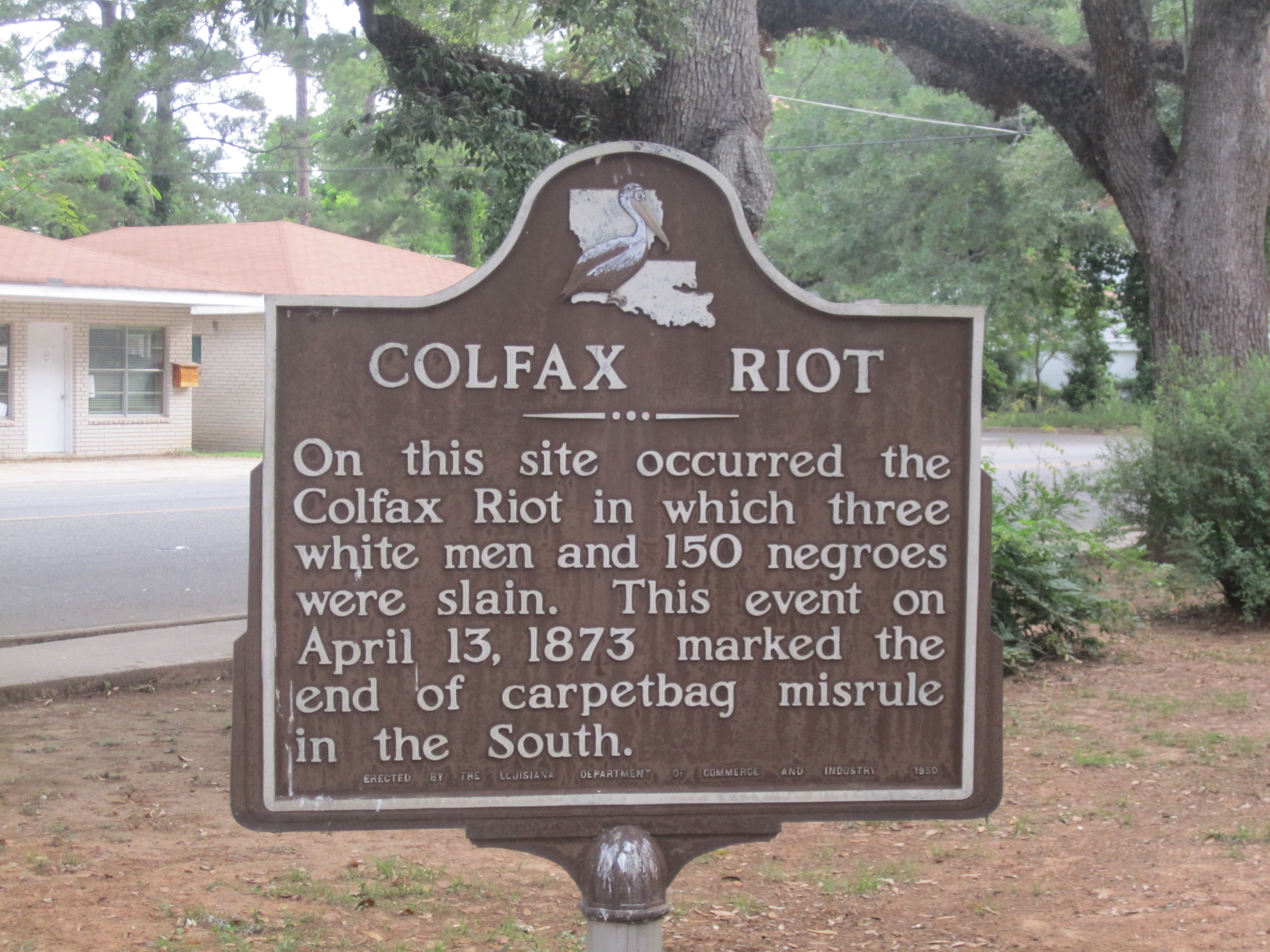
Colfax Massacre
The Klansman Dave Paul put it plainly: 'Boys, this is a struggle for White supremacy.' It was early April 1873 in Grant Parish, Louisiana, and Paul was speaking to a growing force of Confederate veterans and Ku Klux Klan members gathering near the town of Colfax. Inside the parish courthouse, Black freedmen and Republican officeholders had been camped for three weeks, having seized the building to defend what they believed was a legitimately elected government. Outside, former sheriff Christopher Columbus Nash -- a Confederate officer who had spent eighteen months as a prisoner of war at Johnson's Island, Ohio -- was assembling more than 300 armed White men, most on horseback, equipped with rifles and a four-pound cannon that could fire iron slugs. What unfolded on Easter Sunday, April 13, would become what historian Eric Foner called 'the worst instance of racial violence during Reconstruction.' The death toll was never precisely established. Estimates range from 62 to 153 Black men killed. Three White men died.
Two Governors, One Parish
The bloodshed at Colfax grew from a poisoned root: Louisiana's 1872 gubernatorial election produced two winners. A Fusionist coalition of Democrats and Liberal Republicans declared John McEnery governor, while a faction of the state returning board proclaimed Republican William Pitt Kellogg the victor. Both held inaugural ceremonies. Both certified local officials. In Grant Parish, this meant two sets of parish officers -- one commissioned by McEnery, the other by Kellogg -- each insisting they were the legitimate government. Grant Parish itself was a recent creation, carved from Winn and Rapides parishes by planter William Smith Calhoun, who had come to support Black political equality despite having once been a slaveholder. The parish was almost evenly split: 2,400 freedmen against 2,200 Whites. Calhoun's bill creating the parish had passed the Republican legislature, but Democrats saw it as gerrymandering. When Fusionist Democrats Alphonse Cazabat and Nash claimed the courthouse on January 2, 1873, and Republican Robert C. Register seized it back on the night of March 25, the stage was set for confrontation.
The Siege of the Courthouse
Through late March and early April, Black freedmen dug trenches around the Colfax courthouse and drilled with whatever weapons they could find. Women and children joined the men for protection. The Republican officeholders slept inside. Tensions erupted in sporadic gunfire on April 2 and April 5, but the shotguns used on both sides were too inaccurate to cause harm. A brief peace collapsed when a White man shot and killed a Black bystander named Jesse McKinney. William Ward, a Black Union veteran who commanded the local state militia company, wrote desperately to Governor Kellogg requesting federal troops. The letter never arrived -- Ward's messenger, Calhoun himself, was captured on a steamboat by White Fusionists, who ordered him to tell the Black defenders to surrender. They refused. Nash, meanwhile, circulated inflammatory rumors that Black men planned to kill all the White men and take the White women. The New Orleans Daily Picayune further distorted events. Experienced Confederate veterans arrived from surrounding parishes. By Easter morning, Nash had his 300 men, his cannon, and his plan.
Easter Sunday at Noon
Nash moved his forces toward the courthouse at midday on April 13. He ordered the defenders to leave. When they did not, he gave women and children thirty minutes to evacuate. Then the shooting began. For several hours, the two sides exchanged fire with few casualties. The turning point came when Nash maneuvered his cannon behind the building. About sixty defenders fled into nearby woods and the Red River. Nash sent horsemen after them, and most were killed on the spot. Those remaining inside the courthouse were finished when Nash's men forced a Black captive to set the roof ablaze. White flags appeared -- one fashioned from a shirt, another from a page of a book. The defenders surrendered. What happened next produced conflicting accounts: either someone inside the courthouse shot James Hadnot, or an overexcited member of Nash's own force shot him from behind. Either way, Hadnot's wounding unleashed a frenzy. The White paramilitaries murdered unarmed men trying to hide inside the burning courthouse. They rode down those attempting to flee. About fifty Black men survived the afternoon and were taken prisoner. That night, after hours of drinking, their captors executed nearly all of them. Only one man, Levi Nelson, survived -- shot by Bill Cruikshank but able to crawl away unnoticed in the darkness.
The Ruling That Killed Reconstruction
When state militia colonels arrived days later, they found the smoking ruins of the courthouse and bodies shot in the back of the head. Federal troops searched for perpetrators, but many had fled to Texas. Federal prosecutors charged participants under the Enforcement Acts. Convictions were obtained, but the case was appealed to the Supreme Court. In United States v. Cruikshank (1876), the court ruled that the protections of the Fourteenth Amendment applied only to state government actions, not to individuals. The federal government could no longer use the Enforcement Act of 1870 to prosecute paramilitary violence. The decision was devastating. Across Louisiana, the White League formed chapters beginning in 1874, using intimidation and murder to suppress Black voters. By the late 1870s, Democrats had retaken the state legislature. The pattern repeated across the South. Legal scholars have argued that Cruikshank effectively nullified the Fourteenth and Fifteenth Amendments for nearly a century, until the civil rights legislation of the 1960s.
Markers and Memory
For decades, a state historical marker at Colfax described the events as a 'riot' and characterized the massacre as marking 'the end of carpetbagger misrule in the South.' The marker, erected in 1950, stood on public ground until it was removed in May 2021. A second monument nearby, erected by White residents in 1921, honored the three White men who died 'fighting for White supremacy.' The Southern Poverty Law Center identified both markers as monuments to White supremacy on public land. In April 2023, a new memorial was dedicated, acknowledging the massacre for what it was. The town of Colfax itself remains small -- the parish seat of Grant Parish, population barely over a thousand, sitting along the Red River in central Louisiana. The courthouse where freedmen made their stand is long gone. But the Supreme Court case born from the violence at Colfax shaped American constitutional law for generations, making this quiet bend in the Red River one of the most consequential sites in the history of American civil rights.
From the Air
Located at 31.52°N, 92.71°W along the Red River in Grant Parish, central Louisiana. Colfax is a small town visible as a cluster of buildings near a bend in the Red River. Recommended viewing altitude: 2,000-4,000 ft AGL. Nearest airports: KAEX (Alexandria International, 25 nm S), KESF (Esler Regional, 30 nm SE). The Red River meanders prominently through the landscape. The town sits at the intersection of LA-8 and US-71. Clear weather typical in spring and fall offers best visibility.