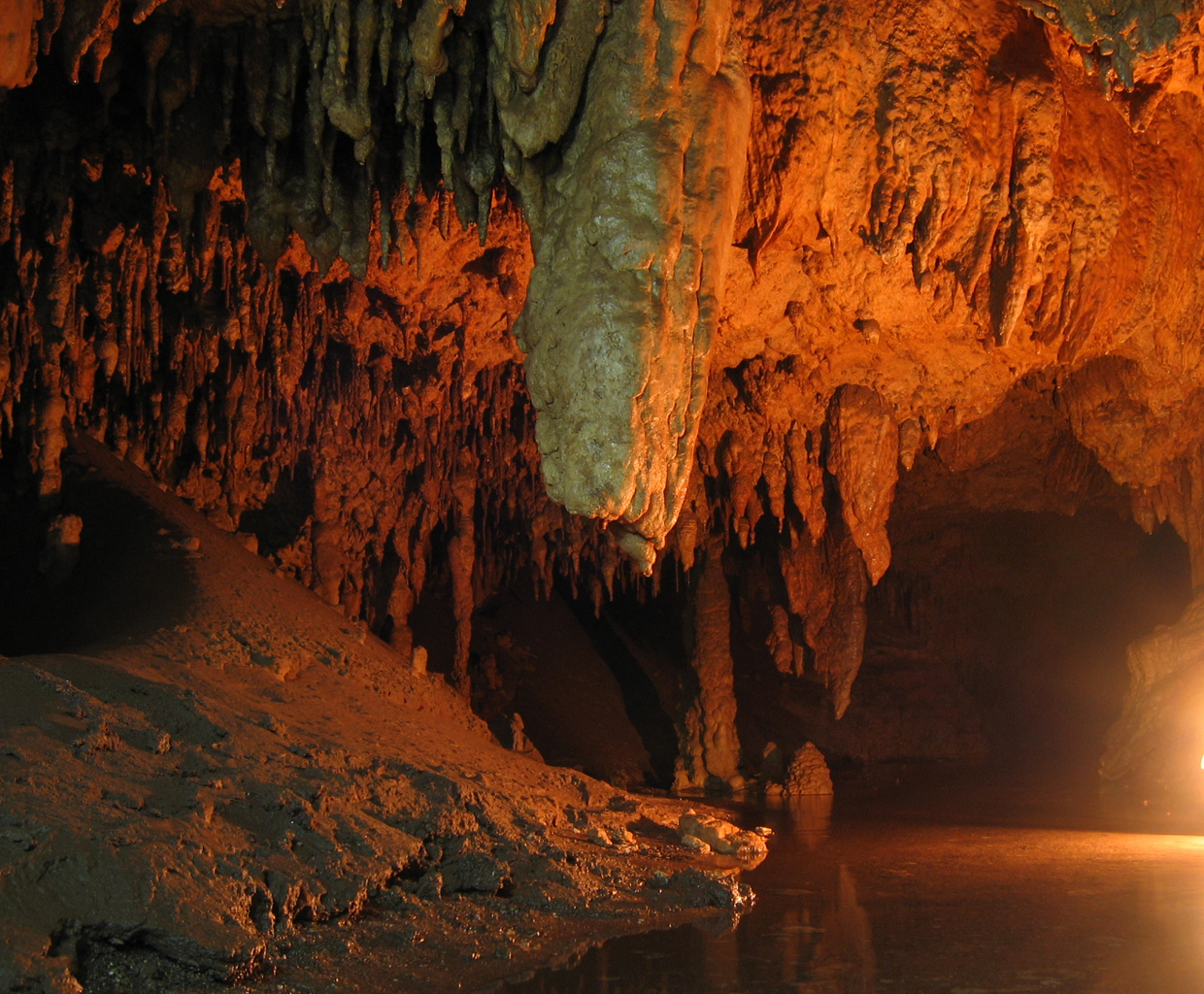
Coliboaia Cave
For tens of thousands of years, the drawings waited in darkness. Bison heads sketched in charcoal on limestone walls. The outline of a rhinoceros. The shape of a bear. They had been there since sometime between 35,000 and 23,000 BCE -- roughly contemporary with the famous paintings at Chauvet Cave in southern France -- but nobody knew. Coliboaia Cave had been mentioned in Romanian literature before 1900. Gabor Halasi investigated it extensively in 1981. Spelunkers had explored its passages for decades. Yet it was not until September 2009 that someone noticed what the firelight of Paleolithic artists had left behind: what may be the oldest known cave paintings in Central Europe.
An Art Gallery Underground
The drawings occupy a section of the cave that researchers have named, with understated precision, the Art Gallery. The images are rendered in black, almost certainly with charcoal, on both walls of the passage. They do not follow any symmetrical pattern or obvious compositional logic -- they are scattered across the rock surfaces as if placed by different hands at different times, which may well be the case. On the right wall, a bison appears roughly 1.4 meters above the ground, drawn in bluish-gray lines. On the left, a rhinoceros head sits just 58 centimeters from the floor, close enough that the artist must have crouched or knelt to draw it. About half a dozen images have been identified in total, including bear heads, two rhinoceros heads, a bison, and the outline of a horse -- a repertoire closely matching the animal subjects found in western European cave art of the same period.
The Dating Puzzle
Radiocarbon analysis has placed the drawings between 32,000 and 35,000 years before present, which would align them with the Aurignacian culture -- the earliest modern human culture in Europe, associated with the arrival of Homo sapiens on the continent. Some estimates extend the range to as recently as 23,000 BCE, overlapping with the Gravettian culture that followed. The debate is not merely academic. Cave bears and rhinoceros were already becoming scarce during these periods, raising questions about whether the artists were drawing from life or from memory and tradition. Adding complexity, the drawings do not appear entirely uniform in style, suggesting they were not all created at the same time. The cave may have served as a canvas across millennia, visited and added to by successive generations separated by thousands of years.
Hidden in the Apuseni
Coliboaia sits within the Apuseni Natural Park, in the mountains of Bihor County in western Romania. The Apuseni range is one of Romania's most cave-rich landscapes, harboring roughly 400 caves carved through limestone over geological ages. That Coliboaia's art went unnoticed for so long is partly a function of geography: the cave is remote, the Art Gallery section is not easily accessible, and the charcoal lines on dark stone can be invisible without the right angle of light. Once discovered, the Romanian Federation of Speleology moved quickly to place the site under protection. Access is now restricted to prevent the damage that tourism and uncontrolled visitation have inflicted on other painted caves around the world.
A Window onto Ice Age Minds
The significance of Coliboaia extends beyond its age. Until its discovery, Central Europe had virtually no known examples of Paleolithic cave art comparable to the famous sites in France and Spain. Chauvet, Lascaux, and Altamira dominated the narrative of early human artistic expression, creating the impression that this impulse was concentrated in western Europe. Coliboaia redraws that map. The charcoal technique closely resembles the methods used at Chauvet Cave, 1,500 kilometers to the west, suggesting either cultural connections across vast distances or parallel invention by separate groups facing similar environments. Either possibility is extraordinary. These drawings were made by people living during the last Ice Age, when glaciers covered much of northern Europe and the Carpathian Mountains formed a refuge for both human populations and the megafauna they depicted on stone walls in the dark.
From the Air
Coliboaia Cave is located at 46.531°N, 22.596°E in the Apuseni Mountains of Bihor County, western Romania. The cave entrance is in rugged, forested mountain terrain within the Apuseni Natural Park. From 5,000-8,000 feet AGL, the Apuseni range appears as heavily forested, moderately elevated terrain (peaks to approximately 6,000 feet MSL) with deep karst valleys. The nearest airport is Oradea International Airport (LROD), approximately 50 nm northwest. Mountain weather can be unpredictable with orographic clouds and turbulence. The cave itself is not visible from the air, but the Apuseni Natural Park boundaries and forested mountain terrain are distinctive.