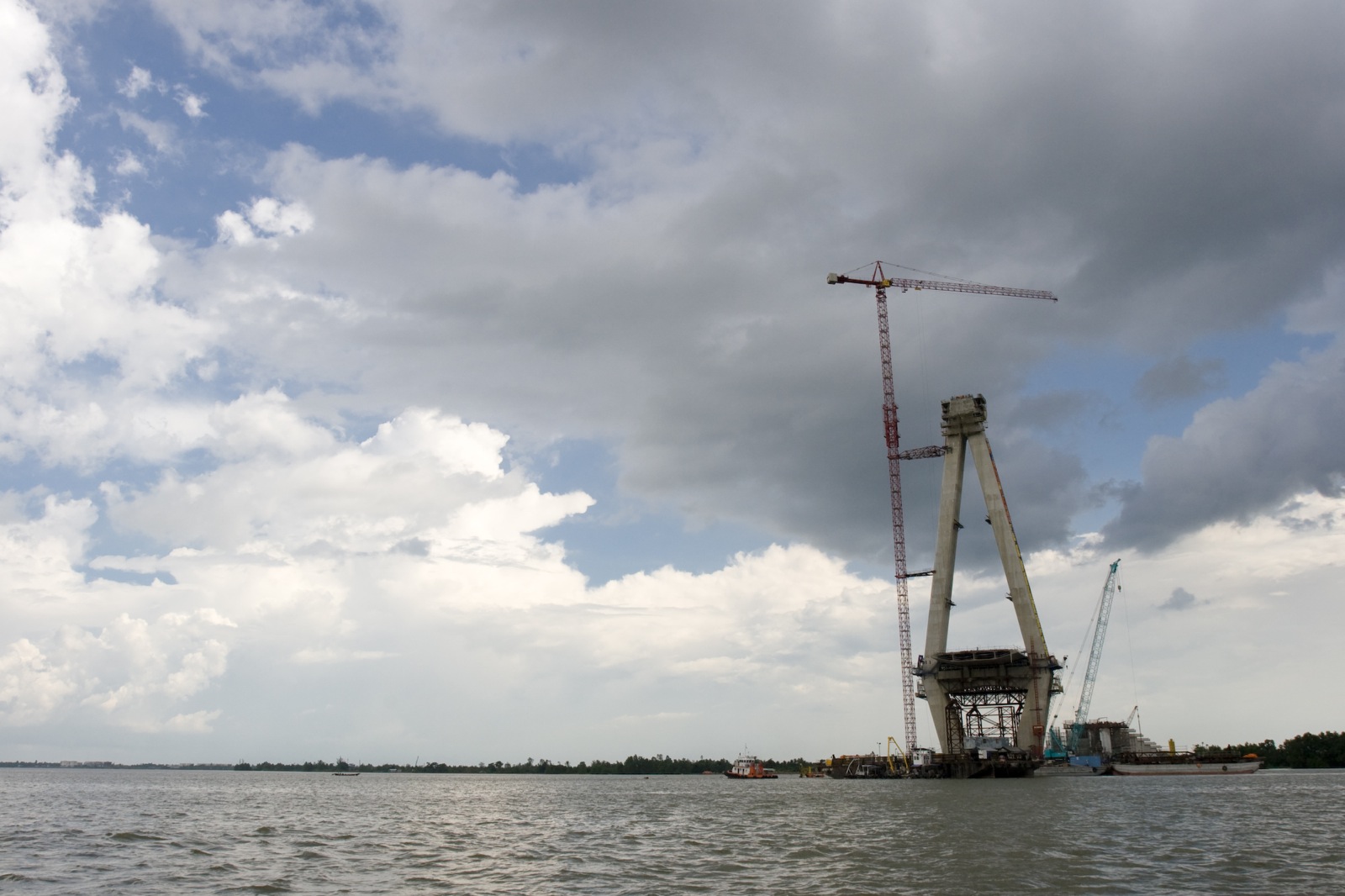
Collapse of Can Tho Bridge
The temporary pillars met just 15 percent of the required load capacity. A Japanese consultant had flagged the problem nine months earlier, recommending that contractors redo their designs. On the morning of September 26, 2007, those pillars gave way. A 90-meter section of steel and concrete -- part of an approach ramp for the massive Can Tho Bridge over the Mekong's largest distributary -- dropped more than 30 meters onto a small island near the Vinh Long side of the river, burying roughly 250 workers under rubble.
A Bridge for the Delta
Can Tho Bridge was supposed to be transformative. The 2.75-kilometer, four-lane cable-stayed bridge would span the Hau River -- the Bassac, the Mekong's largest distributary -- connecting Vinh Long Province to Can Tho city approximately 170 kilometers south of Ho Chi Minh City. For decades, travelers on National Route 1 had relied on a ferry system to cross the river, a bottleneck in one of Vietnam's most productive agricultural regions. Prime Minister Phan Van Khai launched construction on September 25, 2004, with an estimated cost of 4,832 billion Vietnamese dong, roughly US$342.6 million. Funding came from the Japan International Cooperation Agency, and the project was supervised by consultant Nippon Koei-Chodai alongside Japanese contractors Taisei Corporation, Kajima Construction, and Nippon Steel. It was the largest infrastructure project in the Mekong Delta.
Eight O'Clock on a Wednesday
At 8 a.m. local time, construction team leader Manh Hung heard a great explosion at one of the bridge-heads. Dust swallowed the sky. Workers screamed. A massive block of concrete had fallen onto the people below. The collapse happened so suddenly that the roughly 250 engineers and workers on or under the span had no chance to escape. Initial reports counted about 50 dead and over 100 injured, with others trapped beneath twisted steel and shattered concrete. Rescue teams converged from every direction -- local volunteers, students, hospital crews from Cho Ray Hospital in Ho Chi Minh City, and 30 professional rescuers dispatched from Japan and the Philippines. Vice Premier Hoang Trung Hai took command of the operation. Cranes, not people, were sent into the wreckage, because the remaining ramp sections threatened to collapse as well. After four days, with no hope of finding further survivors, the search was called off.
Warnings Ignored
The investigation that followed exposed a chain of failures rooted in cost-cutting and disregarded expertise. Japanese consultant Hiroshi Kudo had identified the danger as early as January 12, 2007. His analysis showed that contractors had used an overloading ratio of 1.15 instead of the 1.25 required by American standards or 1.35 by Japanese standards. They had calculated wind force on the temporary piles at 0.5 kPa -- one-fifth of the 2.5 kPa that conditions demanded. Kudo ordered the contractors to redesign the temporary piling and shoring. Whether those redesigns were ever properly implemented became the central question of the eight-month investigation led by Lieutenant-General Pham Nam Tao. The official report, released in March 2008, concluded that sinking of the makeshift foundation was the primary cause, triggering a domino-effect collapse of two bridge spans. Police investigations further revealed that subcontractors had removed temporary shoring ahead of schedule and reused worn-out materials from previous projects.
Accountability and Aftermath
The death toll was disputed for months. Different Vietnamese news outlets reported figures ranging from 36 to 59 dead; Reuters quoted a Chinese subcontractor who claimed 60. The Vietnamese government ultimately established that 54 workers died and 80 were seriously injured. Transport Minister Ho Nghia Dung called it the most serious workplace accident in the transport sector and offered a public apology, suggesting he would consider resignation. Top officials from the Japanese contracting firms flew to Vietnam to bow in apology before the victims' families. On October 2, 2007, the Ministry of Public Security began criminal proceedings under Article 229 of the Vietnamese Penal Code -- violation of construction regulations leading to severe consequences. The bridge itself was eventually completed and opened to traffic in April 2010, three years late. It now carries four lanes across the Hau River, fulfilling the promise its construction cost so many lives to keep.
From the Air
Located at 10.055N, 105.794E spanning the Hau (Bassac) River between Vinh Long Province and Can Tho in the Mekong Delta, approximately 170 km south of Ho Chi Minh City. The completed cable-stayed bridge is clearly visible from altitude, stretching 2.75 km across the river. Nearest airport is Can Tho International Airport (VVCT) roughly 15 km south. The flat delta terrain makes the bridge towers stand out prominently. Best viewed at 2,000-5,000 feet altitude.