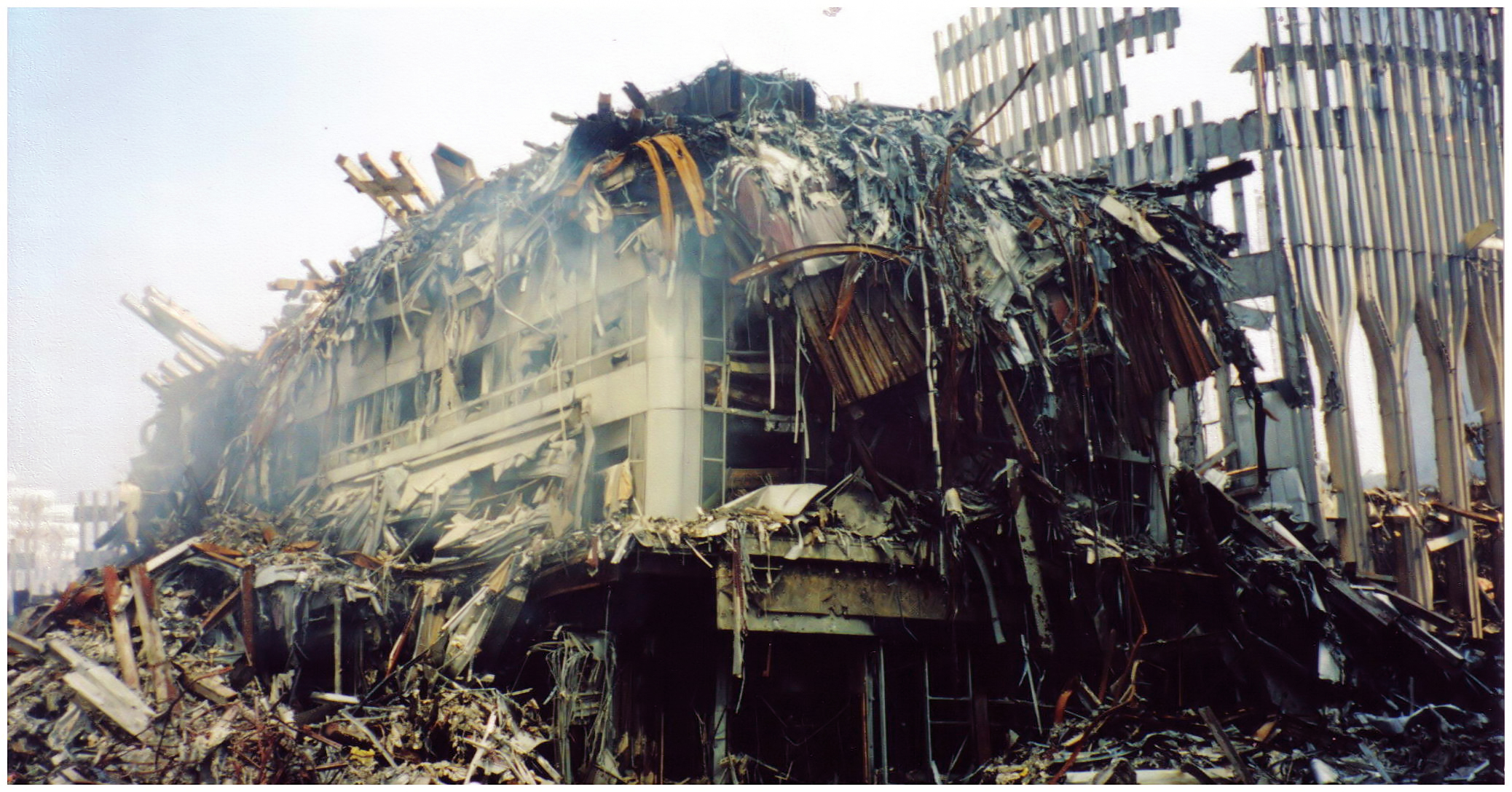
The Collapse of the World Trade Center
When they opened in 1973, the Twin Towers of the World Trade Center were the tallest buildings in the world. Built with a novel "framed tube" design that used 40 percent less steel than conventional skyscrapers, they stood at the southern tip of Manhattan for 28 years, their flat rooftops visible from every approach to New York City. On the morning of September 11, 2001, two hijacked commercial airliners were deliberately flown into the towers. The North Tower burned for one hour and 42 minutes. The South Tower lasted 56 minutes. By 10:28 that morning, both 110-story buildings had undergone total progressive collapse. Nearly 3,000 people were killed. They remain the tallest freestanding structures ever destroyed.
Towers Built for a Different World
The World Trade Center's structural engineers had considered the possibility of an aircraft impact. In 1945, a B-25 bomber lost in fog had crashed into the Empire State Building. Leslie Robertson, one of the towers' chief engineers, studied the scenario of a Boeing 707 flying at low speed, lost while seeking to land at JFK or Newark. But as Robertson later told the BBC, "the fuel load was not considered in the design. I don't know how it could have been considered." The towers were designed to survive an accidental collision, not a deliberate attack at full speed with fuel-laden aircraft. Lead structural engineer John Skilling said after the 1993 World Trade Center bombing that the buildings would survive the impact but acknowledged the real danger: "There would be a horrendous fire. A lot of people would be killed. The building structure would still be there." On September 11, it was not.
102 Minutes
American Airlines Flight 11 struck the North Tower at 8:46 a.m., crashing between the 93rd and 99th floors nearly dead center. The impact severed all three main stairways, trapping everyone above the crash zone. Burning jet fuel shot down elevator shafts to the lobby, more than 90 floors below. Seventeen minutes later, United Airlines Flight 175 hit the South Tower at 9:03 a.m., slicing through its southeastern corner between the 77th and 85th floors. Because the impact was off-center, one stairway in the northwest corner remained passable, and 18 civilians escaped from at or above the impact zone. In both towers, the aircraft impacts stripped fire insulation from dozens of core columns and floor trusses, leaving the steel exposed to fires fueled by the buildings' contents.
Why the Towers Fell
The National Institute of Standards and Technology spent three years and $16 million investigating the collapses. NIST found nothing substandard in the towers' design but determined that the fires were the primary cause. With protective fireproofing sheared away by the impacts, temperatures climbed until the exposed steel columns and floor trusses weakened severely. Sagging floors pulled inward on the perimeter columns, causing them to bow and buckle. When the columns failed, the entire upper section of each building dropped onto the first intact floor below. The connections could support six additional floors if the load were applied gradually, but the falling mass of 12 floors in the North Tower and 29 in the South Tower arrived as a sudden impact. Each successive floor failed in turn. The South Tower fell first at 9:59 a.m., despite being struck second, because the off-center hit had unbalanced the structure on one side.
The Human Cost
Almost all deaths in the towers occurred at or above the points of aircraft impact. In the North Tower, 1,402 civilians perished at or above the crash zone. In the South Tower, 614 civilians died at the impacted floors and above. The emergency response was staggering in its sacrifice: 342 members of the New York City Fire Department, 23 NYPD officers, and 37 Port Authority police officers were among the dead. The total death toll at the site reached 2,606 people. Building 7 of the World Trade Center, damaged by debris from the North Tower and burning uncontrolled all afternoon with no water for firefighting, collapsed at 5:21 p.m. that evening with no casualties. More than a dozen surrounding structures were damaged or destroyed.
What Remains
The cleanup of the World Trade Center site was a round-the-clock operation costing hundreds of millions of dollars. The debris pile burned for three months. Enormous dust clouds covered Lower Manhattan for days, and the EPA's initial assurance that the air was "safe to breathe" was later found to lack sufficient supporting data. More than 18,000 people have since suffered illnesses linked to the toxic dust, including elevated rates of asthma, sinusitis, and post-traumatic stress disorder among first responders. The new One World Trade Center opened in 2014, and the National September 11 Memorial and Museum now occupies the footprints of the original towers, two reflecting pools set into the bedrock where the buildings once stood. The skyline changed forever that morning, but Lower Manhattan rebuilt.
From the Air
The World Trade Center site (40.7117N, 74.0125W) is in Lower Manhattan at the intersection of Church, Vesey, Liberty, and West Streets. One World Trade Center, the replacement tower, is now the tallest building in the Western Hemisphere at 1,776 feet and is a prominent visual landmark. The 9/11 Memorial reflecting pools occupy the original tower footprints. Nearby airports: KJFK (John F. Kennedy, 22km SE), KLGA (LaGuardia, 15km NE), KEWR (Newark Liberty, 10km W). The site is visible from virtually any approach to Lower Manhattan. Please note this is a memorial site and place of great significance.