College of Saint Benedict and Saint John's University
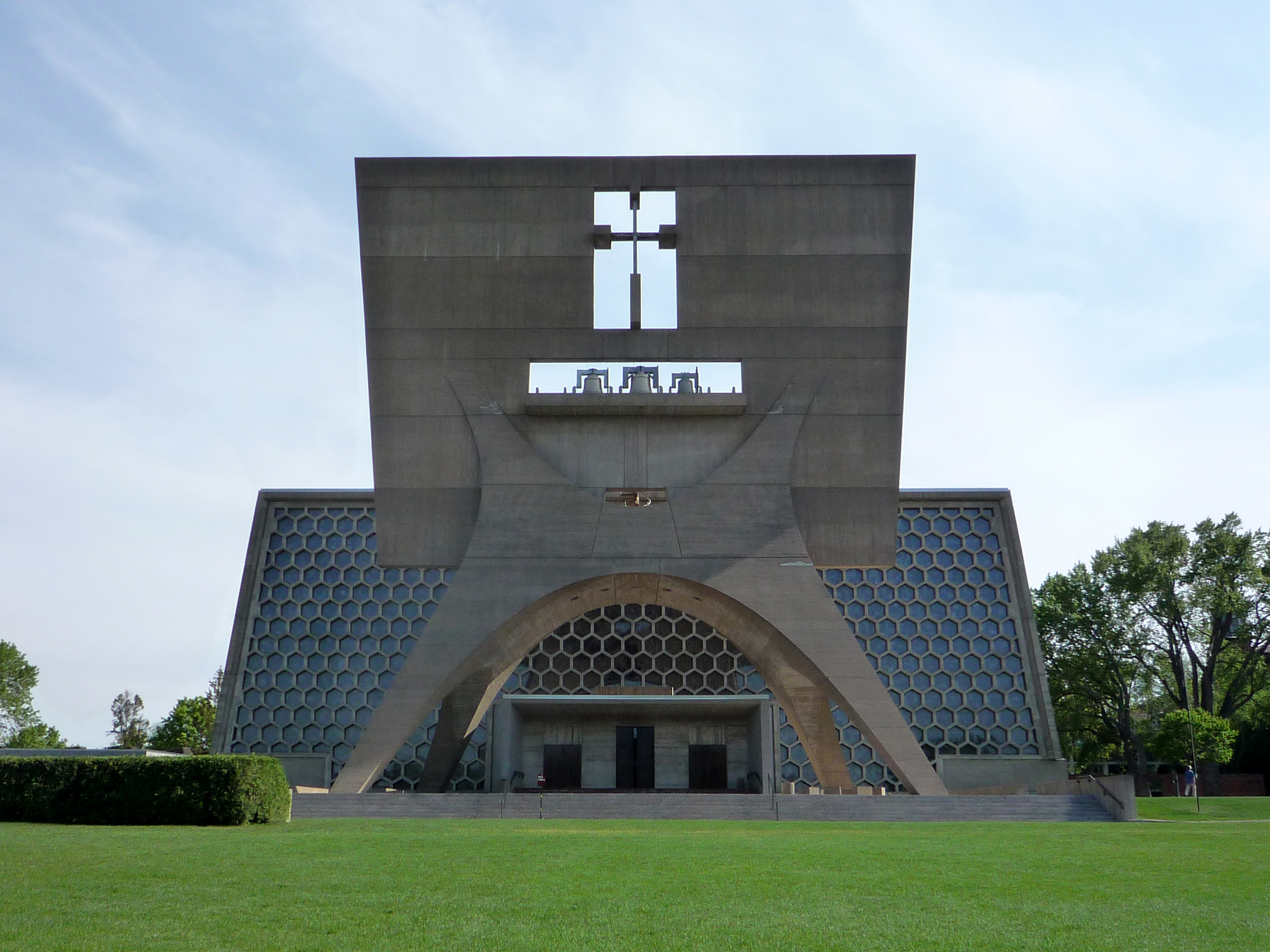
The monks have been baking Johnnie Bread since 1856 -- a year before Minnesota became a state -- and they have used the proceeds to build a church. Not just any church: in 1954, the Benedictine community at Saint John's Abbey invited twelve architects to submit plans for a house of worship that would be "truly an architectural monument to the service of God." They chose Marcel Breuer, the Hungarian-born Bauhaus master, whose bold concrete Abbey Church and its freestanding bell banner now rise above 2,500 acres of oak savanna, wetlands, and lakes in Collegeville Township. Three and a half miles east, in the town of St. Joseph, the College of Saint Benedict occupies its own historic campus. Together, these two Benedictine institutions -- Saint John's University for men, founded in 1857, and the College of Saint Benedict for women, opened in 1913 -- form one of the most distinctive liberal arts partnerships in America, with 3,000 students sharing a single academic program across two campuses linked by a bus they call "The Link."
Bavarian Roots on the Prairie
The story begins with five monks from Saint Vincent Archabbey in Latrobe, Pennsylvania, who arrived in St. Cloud, Minnesota, in 1856. They had emigrated from the Kingdom of Bavaria under the patronage of King Ludwig II, and their mission was to minister to the growing population of German immigrants settling across central Minnesota. The monks founded a school that would become Saint John's Preparatory School, moved their community westward twice, and finally settled on the shores of Lake Sagatagan in 1865. A year later, the priory was elevated to an abbey, and Father Rupert Seidenbusch was elected as its first abbot. Saint John's University holds the distinction of being the oldest continuously operating institution of higher learning in Minnesota. The College of Saint Benedict grew out of St. Benedict's Academy, founded by the Benedictine sisters in 1889, and opened its doors to six students in 1913.
Breuer's Concrete Cathedral
By the early 1950s, the monastic community had swelled to roughly 450 monks, and the original abbey church could no longer hold them all. The selection of Marcel Breuer proved inspired. His design incorporated the traditional liturgical axis -- baptistery, nave, altar -- within a dramatic Brutalist concrete shell. The monastic choir stalls curve in a semicircle around the main altar, a layout that anticipated the reforms of the Second Vatican Council so precisely that almost no changes were needed after the council concluded. The bell banner, a massive concrete honeycomb standing apart from the church, has become an icon of modern sacred architecture. Breuer went on to design several other campus buildings, including Alcuin Library, Peter Engel Science Center, and four residence halls. The central cores of both campuses are listed as historic districts on the National Register of Historic Places, and the 17 buildings constructed between 1868 and 1959 form the St. John's Abbey and University Historic District.
One Curriculum, Two Campuses
The partnership between CSB and SJU began modestly in 1955 with joint evening classes. By the 1960s, the schools shared a full academic program, and today approximately 300 professors -- 85 percent of them full-time -- teach co-educational classes across both campuses. The results speak for themselves: four Rhodes Scholars, nine Truman Scholars, and 39 Fulbright Scholarship recipients between 2013 and 2020. The institutions rank second in the nation among undergraduate schools for participation in semester-long study abroad programs, sending students to 17 sites across six continents. In 2022, Brian J. Bruess became the first person to serve as president of both institutions simultaneously, formalizing a unity that students had long taken for granted. The Bennies and the Johnnies, as the athletic teams are known, compete separately in the NCAA Division III Minnesota Intercollegiate Athletic Conference.
Maple Syrup, Manuscripts, and a Solar Farm
The SJU campus is wrapped in 2,500 acres of arboretum -- oak savanna, forest, prairie, wetlands, and lakes crisscrossed by Nordic skiing and hiking trails. The most beloved path is the chapel walk along Lake Sagatagan to Stella Maris Chapel. Every spring since 1942, when wartime sugar shortages inspired the monks to tap their maples, the community produces Saint John's Maple Syrup. In 2019 alone, more than 2,800 people participated in the process. The abbey also houses one of the largest solar farms in Minnesota, built in 2009 and expanded in 2014 to produce over 600 kilowatts of electricity -- enough to power up to 30 percent of the SJU campus in peak conditions. Meanwhile, inside Alcuin Library, visitors can view The Saint John's Bible, the first handwritten and illuminated Bible commissioned by a monastery since the invention of the printing press. Its pages are cared for by the Hill Museum and Manuscript Library, an independent nonprofit on campus.
From Eugene McCarthy to the NSA Director
The alumni roster reads like a cross-section of American public life. Eugene McCarthy, class of 1935, served in Congress from 1949 to 1971 and launched an antiwar presidential campaign that helped reshape the Democratic Party. Denis McDonough, class of 1992, became White House Chief of Staff under President Barack Obama and later served as Secretary of Veterans Affairs under President Joe Biden. General Paul Nakasone, class of 1986, commanded United States Army Cyber Command and directed the National Security Agency. Tom Burnett, who attended SJU for two years, was among the passengers who fought back on United Airlines Flight 93 on September 11, 2001. Corie Barry, class of 1997, became CEO of Best Buy. Minnesota Public Radio itself was born here on January 22, 1967, when KSJR signed on from the Saint John's campus under alumnus Bill Kling's direction.
From the Air
Located at 45.56°N, 94.32°W in Stearns County, central Minnesota, at approximately 1,200 feet MSL. The two campuses are three and a half miles apart along County Road 159, with SJU in Collegeville Township and CSB in St. Joseph. Marcel Breuer's Abbey Church and bell banner are visible from altitude as distinctive concrete forms amid the forested campus. The 2,500-acre Saint John's Arboretum and Lake Sagatagan are prominent landmarks. St. Cloud Regional Airport (KSTC) is approximately 10 miles east. The campuses sit in a rolling glacial moraine landscape of lakes, prairies, and hardwood forests. Best viewed at 3,000-5,000 feet AGL to appreciate the relationship between the two campuses and the surrounding arboretum.