College of the Ozarks
The Beverly Hillbillies truck sits in a museum on a campus where nobody pays tuition. College of the Ozarks, perched on a hilltop at Point Lookout, Missouri, just west of Branson, has operated on a radical economic premise since its founding in 1906: students work instead of paying. Fifteen hours a week at one of 90 campus work stations -- the fruitcake kitchen, the water-powered gristmill, the greenhouse, the radio station -- plus two 40-hour weeks during breaks. The school calls itself "Hard Work U." The original George Barris-modified 1921 Oldsmobile truck from the television series sits in the Ralph Foster Museum, donated by series creator Paul Henning, who was inspired to create the show after a Boy Scout camping trip in these same Ozark hills.
A School Born in Fire
The School of the Ozarks opened on September 11, 1906, atop Mount Huggins, named for brothers Louis and William Huggins of St. Joseph, Missouri, who were among the founders of Nabisco and donated money for the school. The first term enrolled 180 students, 36 of them boarders. From the start, the work-for-tuition model was the school's identity. On January 12, 1915, fire destroyed the original building. Classes temporarily moved to the public school in nearby Forsyth. The replacement centerpiece was an extraordinary transplant: the Maine Hunting and Fishing Club building, originally the State of Maine exhibit at the 1904 St. Louis World's Fair, physically transported to the Ozarks hilltop by sportsmen. Renamed the Dobyns Building, it served as the campus center until it too burned on February 1, 1930. The school kept rebuilding, each fire only reinforcing the work ethic at its core.
Fruitcakes, Rifles, and a Water Wheel
The Fruitcake and Jelly Kitchen opened in 1934 to provide student work opportunities. Today more than 100 fruitcakes are baked daily, and the kitchen is one of 90 work stations that sustain the no-tuition model. Edwards Mill receives power from a twelve-foot water wheel and produces meal and flour. The Hoge Greenhouse holds more than 7,000 plants. The Gaetz Tractor Museum preserves antique farm equipment dating to the early 1900s. And the Ralph Foster Museum, which began in the 1920s in the basement of a boys' dormitory called Abernathy Hall, now houses a broad collection of Ozark heritage -- including, alongside the Hillbillies truck, a large firearm display featuring a rifle that once belonged to Pancho Villa. The campus is a working landscape where education and production overlap at every turn.
From Country School to College
For its first six decades, the School of the Ozarks granted no bachelor's degrees. It became a four-year institution in 1965 but did not achieve regional accreditation until the 1990s -- a delay that reflected tensions between the school's intensely insular culture and the standards of outside accrediting bodies. In 1994, it was renamed College of the Ozarks upon receiving accreditation. The school is selective in its own way: out of more than 4,000 applicants, approximately 400 are accepted each fall. Admission factors include financial need alongside academic merit. The 2005-06 men's basketball team won the NAIA Division II national championship. The Neo-Gothic Williams Memorial Chapel, built in 1956, holds regular Sunday services. Lake Honor, a small body of water in the center of campus, houses the school's swans and their cygnets -- a surprisingly pastoral touch for a college defined by labor.
A Culture Unto Itself
College of the Ozarks has carved out a distinctive identity built on conservative Christian values, vocational education, and patriotic programming. In 2017, the college introduced a required freshman course combining military-style physical education with military science. From 2000 to 2017, the campus hosted the NAIA Division II Basketball Championship. The college withdrew from hosting after announcing it would forfeit any game in which opposing players knelt during the national anthem. In 2018, the school boycotted Nike products following an ad campaign. The college has drawn both admirers for its tuition-free model and critics for its strict culture. What remains undeniable is the distinctiveness of the place: a hilltop campus in the Ozarks where students grind grain, bake fruitcakes, tend greenhouses, and earn their education through sweat rather than debt.
From the Air
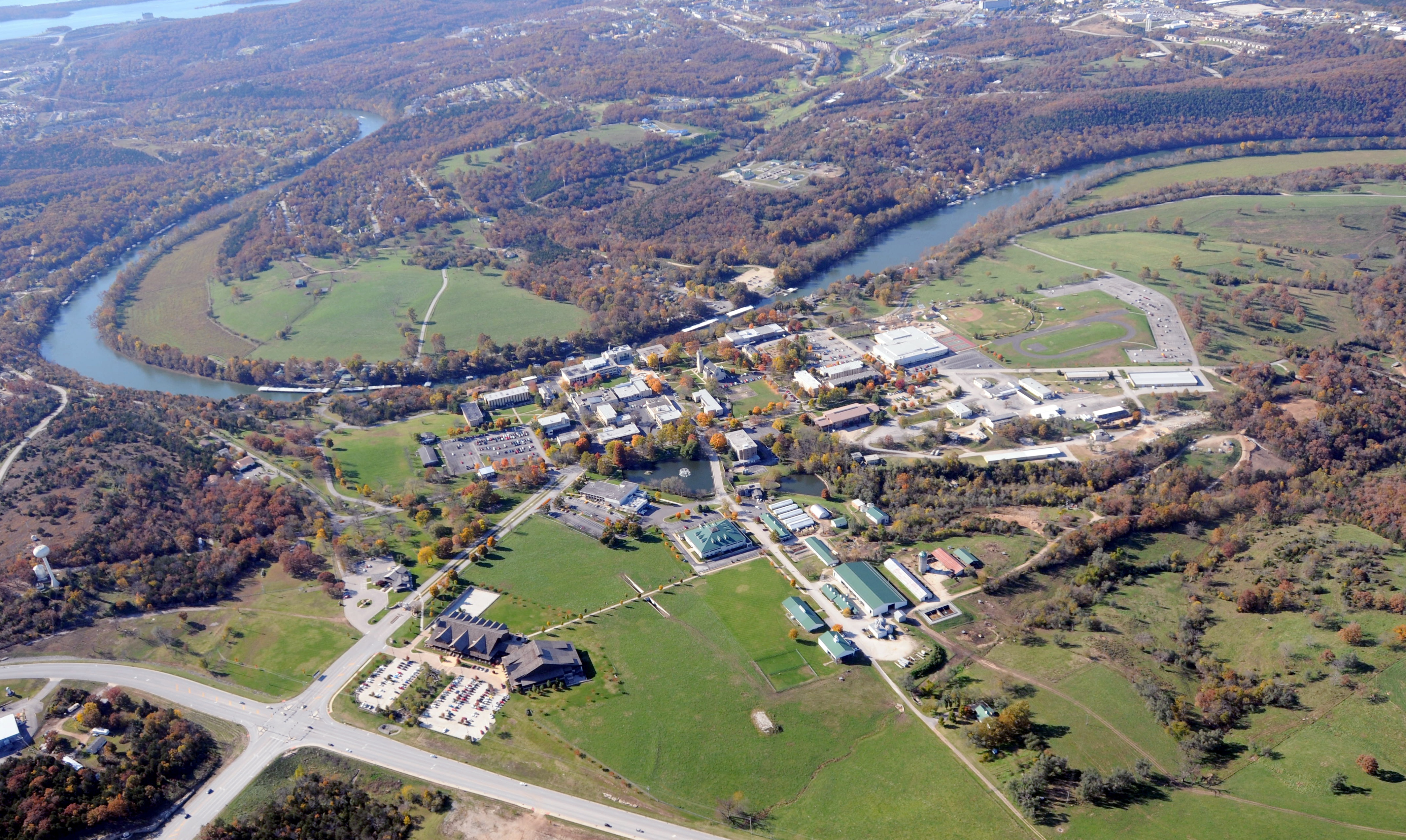
Located at 36.618N, 93.241W at Point Lookout, Missouri, approximately 1,200 feet MSL on a hilltop overlooking the Table Rock Lake area near Branson. Branson Airport (KBBG) is approximately 8 nm to the south. Springfield-Branson National Airport (KSGF) lies 35 nm to the north. The campus hilltop is visible from altitude, situated above the lake-dotted Ozark terrain. Table Rock Lake and Lake Taneycomo are prominent visual landmarks to the south and east. The Williams Memorial Chapel is a recognizable structure. Best viewed at 3,000-5,000 feet AGL to see the campus against its Ozark ridge setting.