College Park Airport
Wilbur Wright uncrated a biplane on a leased field in Maryland on October 7, 1909, and aviation in the nation's capital began. The United States Army Signal Corps had secured the site -- a flat stretch of ground in College Park, Prince George's County -- as a place for Wright to teach two lieutenants, Frederic Humphreys and Frank Lahm, how to fly the government's first airplane. Humphreys soloed first, becoming the military's inaugural solo pilot in a government aircraft. Twenty days later, Wright took Mrs. Ralph Henry Van Deman aloft, making her the first woman to fly in a powered aircraft in the United States. That modest field never closed. Over a century later, College Park Airport remains operational -- the oldest continuously operating airport on Earth.
A Field of Firsts
The list of milestones born at College Park reads like a compressed history of flight itself. In 1911, the U.S. Army opened its first military aviation school here, with future five-star General Henry H. Arnold and Lieutenant Thomas DeWitt Milling serving as Wright pilot instructors. That same year, civilian flying began when Rex Smith's aeroplane company set up operations on the field. On October 7, 1912, Bernetta Adams Miller became the first woman to demonstrate flight in a military aircraft. In 1918, the Post Office Department launched the nation's first regularly scheduled airmail service from College Park, connecting Washington to Philadelphia and New York City. The original airmail hangar and a compass rose still mark the spot. Even the airport's three-letter code, CGS, nods to its airmail roots -- ColleGe Station.
Vertical Ambitions
The field did not limit itself to fixed wings. In 1920, inventor Emile Berliner and his son Henry brought their theories of vertical flight to College Park, and by 1924 they achieved what is recognized as the first controlled helicopter flight. Their Berliner Helicopter No. 5 now sits inside the College Park Aviation Museum, a tangible artifact of a breakthrough that would reshape military and civilian aviation for the rest of the century. Meanwhile, from 1927 to 1933, the National Bureau of Standards used the airport to develop and test the first radio navigational aids for instrument flying -- the direct ancestor of the Instrument Landing System that guides aircraft to runways worldwide today. In 1937, the Engineering and Research Corporation tested the Ercoupe here, an airplane deliberately designed to be spin-proof, another idea ahead of its time.
Survival Against the Odds
Airports of this vintage rarely survive. College Park almost did not. The Maryland-National Capital Park and Planning Commission purchased the field in 1973, preserving it from development. In 1977, it was added to the National Register of Historic Places. A small museum opened in 1981, drawing hundreds of visitors on weekends. But proximity to Washington, D.C. exacted a heavy toll after September 11, 2001. The Transportation Security Administration imposed severe restrictions on the airport's operations, requiring civilian pilots to undergo background checks before flying in or out. In 2015, a proposed 13-story hotel on adjacent University of Maryland property threatened the approach path, forcing a redesign to 10 stories after the FAA flagged it as a flight hazard. The airport has bent under pressure but never broken.
The Museum in the Hangar
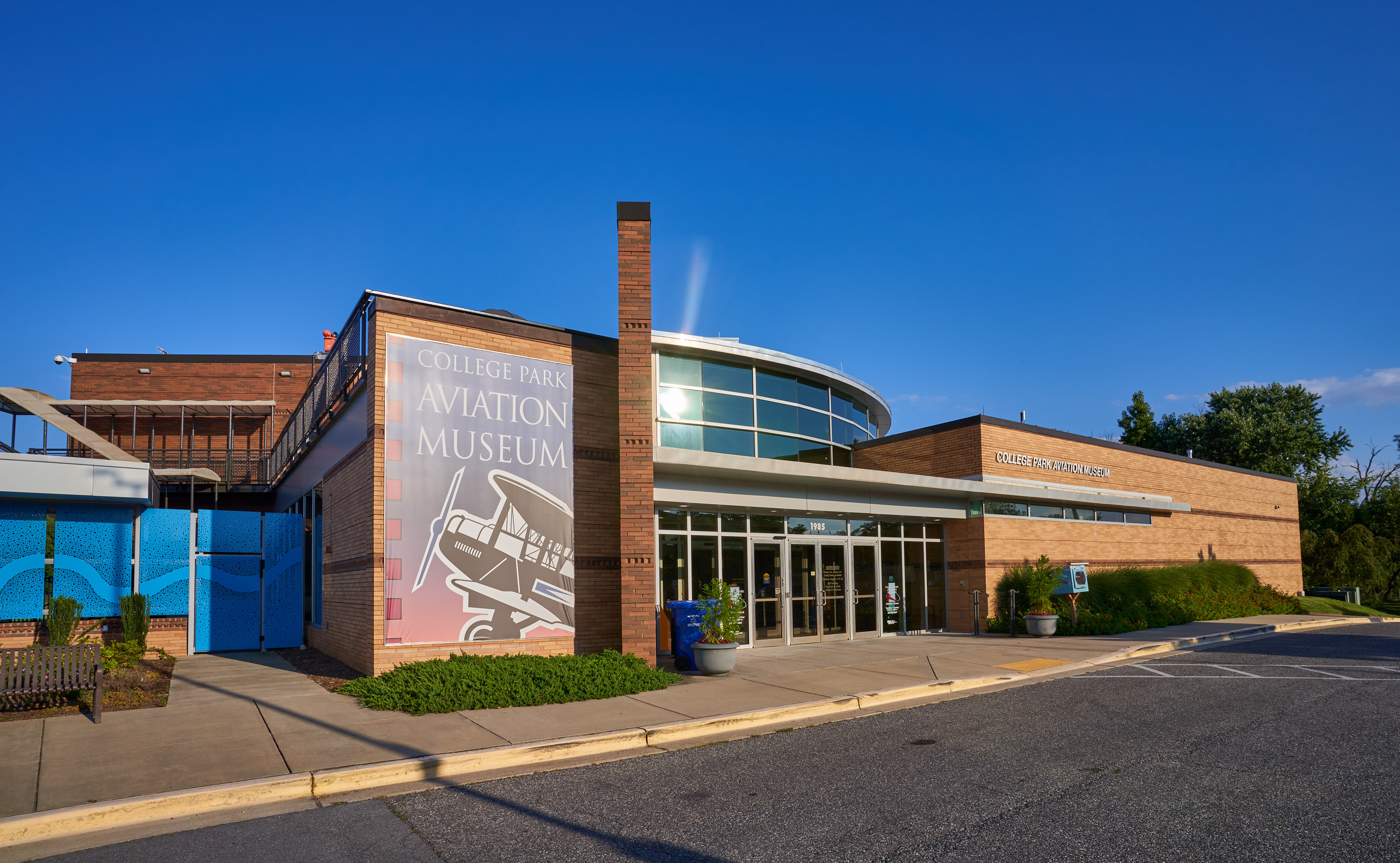
The College Park Aviation Museum, a Smithsonian affiliate, occupies a building that opened in 1998 and includes a replica of the original 1909 hangar. Inside, ten aircraft trace the field's lineage: a Wright Model B reproduction, a Curtiss JN-4D Jenny, a Boeing-Stearman Model 75, the Berliner Helicopter, and the Ercoupe among them. The museum holds an extensive library and archives documenting early aviation history, particularly in Maryland. Outside, the single asphalt runway -- designated 15/33 -- still handles light aircraft, a working airport and a working monument occupying the same footprint. The road leading in bears the name of Corporal Frank S. Scott, the first U.S. enlisted man killed in a military aircraft accident, which happened right here. At College Park, history does not sit behind glass. It taxis past you.
From the Air
Located at 38.981N, 76.922W in College Park, Maryland. Airport code CGS. Single runway 15/33, asphalt surface. CAUTION: This airport lies within the Washington D.C. Special Flight Rules Area (SFRA) and the Flight Restricted Zone (FRZ). Strict security requirements apply -- pilots must complete a background check and obtain prior authorization. Recommended viewing altitude: 2,000-3,000 feet AGL, but airspace restrictions require careful compliance. Nearby airports: KDCA (Ronald Reagan National), approximately 10 nm southwest; KADW (Joint Base Andrews), approximately 10 nm south-southeast. Visual landmarks include the University of Maryland campus to the west and Lake Artemesia to the north.