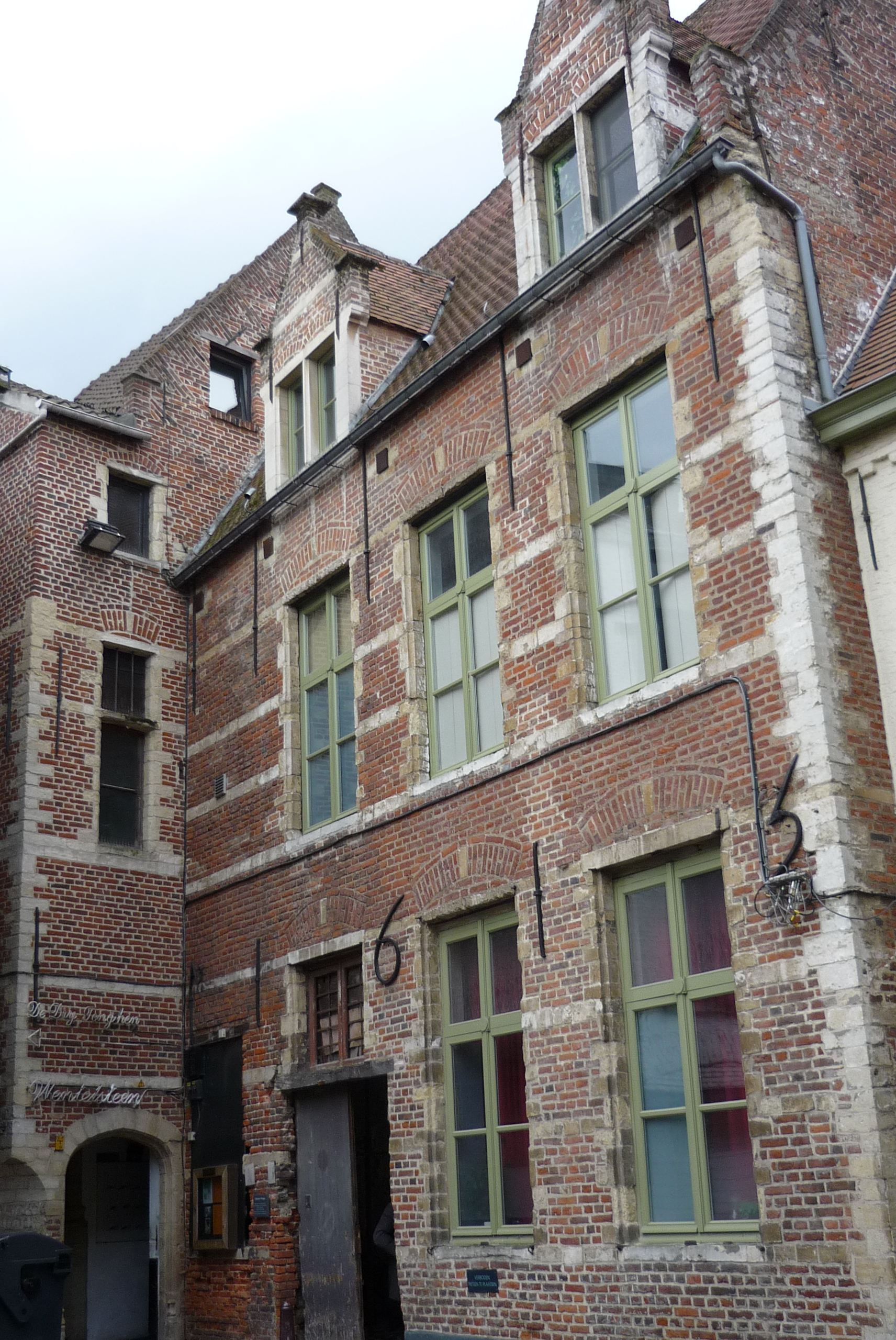
Collegium Trilingue
In the spring of 1517, a wealthy diplomat named Hieronymus Busleyden died unexpectedly on the road to Spain on a diplomatic mission. His will, dated 22 June 1517, set aside a sum of money for what he described, with humanist precision, as a Collegium trium linguarum - a College of the Three Languages. The languages were Latin, Greek, and Hebrew, the three holy tongues of Western Christendom. The instruction was to be free. Ten poor students were to receive scholarships. The professors were to teach publicly, in lectures open to anyone who wished to attend. And Busleyden's friend Desiderius Erasmus - the most famous intellectual of the age - was to advise on how the whole thing should be organized. The college that opened in Leuven in 1518 was small. It never enrolled more than a few dozen residents at any one time. But within a decade it would attract students from across Europe, give the Renaissance its educational template, and serve as the explicit model for the Collège de France in Paris when Francis I founded it thirteen years later.
Ad Fontes
The intellectual program behind the Collegium Trilingue was summed up in a Latin phrase that became the slogan of Renaissance humanism: ad fontes. To the sources. The scholastic theologians of the medieval university had built their teaching on Latin commentaries upon Latin translations of texts originally written in Greek and Hebrew. Each layer of translation, the humanists argued, introduced errors. The Italian polemicist Lorenzo Valla had demonstrated this with devastating clarity in his Annotationes in Novum Testamentum, a critical comparison of the Latin Vulgate with the original Greek New Testament. Erasmus discovered Valla's work in 1504 in the Park Abbey just outside Leuven, and it transformed his thinking. If Christianity was a religion of the book, then the only honest way to study theology was to read those books in the languages they had originally been written in. Greek for the New Testament. Hebrew for the Old. Latin not as the sole authority but as one language among three. The Collegium Trilingue existed to make this possible. It was not a school of theology. It was a school for the linguistic tools without which theology, as Erasmus and his circle understood it, could not honestly be done.
The Theology Faculty Was Not Pleased
The reception in Leuven was hostile from the start. The university's Arts Faculty, which had a monopoly on Latin instruction, objected to the competition. The Theology Faculty, alarmed by the recent Reuchlin affair in Cologne and the rising controversy around Martin Luther in Wittenberg, was openly suspicious of Greek and Hebrew studies. A Leuven theologian named Jacobus Latomus - professor and advisor to the Inquisition - published a 1519 dialogue arguing that the study of biblical languages was at best useless and at worst spiritually dangerous. Erasmus was repeatedly attacked in sermons and academic disputations. The Hebrew professor Matthaeus Adrianus left in disgrace in 1519; his immediate successors, two Englishmen named Robert Wakefield and Robert Sherwood, did not stay long either. The Greek professor Rutger Rescius was actually thrown in jail for a time. Only the intervention of senior figures - including the future Pope Adrian VI - secured formal recognition of the college by the university council in March 1520. Even then it was never properly incorporated into the Arts Faculty, where it would have belonged. The Collegium Trilingue spent its entire history as a tolerated anomaly, a brilliant orphan inside a university that did not really want it.
The Alumni Who Reshaped Europe
Despite all this, students came. By the 1520s the college had to expand its lecture halls because Conrad Goclenius, who had succeeded the original Latin professor Hadrianus Barlandus, was teaching the same class twice for lack of seats. The roster of sixteenth-century Trilingue alumni reads like an index of the Northern Renaissance. The Flemish cartographer Gerardus Mercator, whose projection still shapes how the world is mapped, studied here. Andreas Vesalius, the Brussels-born physician whose De Humani Corporis Fabrica founded modern anatomy, came through the college. So did Rembert Dodoens, the botanist whose herbal influenced European pharmacy for two centuries. Justus Lipsius, the great Flemish humanist and student of Roman history, returned as Latin professor in 1592. The Latin chair under Erycius Puteanus - a student of Lipsius who held it for nearly forty years starting in 1607 - drew students from across Europe to a college whose entire administrative staff numbered no more than twenty. Even the daily routine became famous: copious communal meals, household chores shared by students and staff, and a curious medieval game called pelotte played in five courts when classes ended.
The Long Decline
What ruined the Collegium Trilingue was politics, not pedagogy. In the last quarter of the sixteenth century, Spanish troops occupied Leuven during the Eighty Years War. The city was sacked. Famine and plague followed. Student numbers collapsed; most of the professors fled. The college recovered somewhat under the presidency of Adrianus Baecx after 1606, but it never regained its early splendor. By the eighteenth century only the occasional gifted teacher kept it alive - the Latinist Johannes Gerardus Kerkherderen in the 1720s and 1730s, the Hebraist Jean-Noel Paquot, whose eighteen-volume Memoires pour servir a l'histoire litteraire des dix-sept provinces des Pays-Bas remains the principal source for the college's own history. The Latin chair fell vacant in 1768 and was never filled again. In 1797, French revolutionary law suppressed the university and with it the college. When the Catholic University of Leuven was reestablished in 1834, the Trilingue was not revived. The buildings near the Vismarkt were sold off and put to less elevated uses - a print shop, an ice factory, a fish smokehouse, a social house. In the early twentieth century the rector Paulin Ladeuze tried to repurchase them and re-create a center of humanist studies; the financial pressures of the First World War defeated him. A second attempt in the 1970s went nowhere either. The original buildings still stand at the Vismarkt today, restored, marked with a small plaque, and now belonging again to KU Leuven, which has begun using them for humanities research.
What the Three Languages Gave Us
It is hard, five hundred years later, to feel the radicalism of what the Collegium Trilingue did. Reading the Bible in Greek and Hebrew is something modern scholars take for granted. In 1517 it was a small revolution. Within a generation, the methods pioneered at the college had spread across northern Europe. The Erasmian principle - that any serious reading of an ancient text required familiarity with its original language - became the foundation of philology, the parent discipline of nearly every modern humanities field. The Collegium also produced something less tangible: a model of an educational institution that took religious questions seriously without yielding the academic territory to clerical authority. Erasmus himself never taught at the college and never held any administrative position there. He simply offered the design. The bequest, the library brought up by boat from Mechelen, the three salaried professors, the open public lectures, the scholarships for the poor - all of it traced back to a single will written in the summer of 1517 by a man who did not live to see his college open. The Wentelsteen, the spiral staircase by which generations of students once climbed to their rooms, still stands at the Vismarkt building. So does the idea.
From the Air
The Collegium Trilingue building stands near the Vismarkt in central Leuven, at approximately 50.881 N, 4.700 E - about 300 meters southwest of the Grote Markt and 600 meters from the Mgr. Ladeuzeplein library tower. Brussels Airport (EBBR) lies 25 km to the northwest. From cruise altitude over the Brabant plain, central Leuven is identifiable by the distinct unfinished west tower of Saint Peter's Church on the Grote Markt and the dense medieval street pattern around the bend of the Dijle river.