Cologne War
On Candlemas — the second of February, 1583 — a Catholic archbishop got married in a private house outside Bonn. The bride was Agnes von Mansfeld-Eisleben, a Protestant canoness from a cloister in what is now a district of Düsseldorf. The groom was Gebhard Truchsess von Waldburg, Prince-Elector of Cologne, one of seven men who chose the Holy Roman Emperor. While the couple processed back to the Elector's palace to celebrate, soldiers loyal to the Cathedral Chapter that had elected Gebhard six years earlier were attacking a fortress across the river. The war that followed would last six years, draw in Spain and the Netherlands and England and the papacy, and turn the towns and farms of the Rhineland into something they had only barely been before: a battlefield where ordinary people were the casualties.
The Principle That Broke
The Peace of Augsburg of 1555 had stitched the Holy Roman Empire back together after the first wars of religion with a principle as elegant as it was brittle: cuius regio, eius religio — whose realm, his religion. A prince's faith would be his subjects' faith. But the bishops and archbishops who ruled the Empire's ecclesiastical territories were a problem, because if they converted to Protestantism they could in theory drag their lands across the confessional line. The treaty's solution was a clause called ecclesiastical reservation: a bishop who changed his faith was expected to resign his office. Gebhard, who declared his conversion to the Reformed faith in December 1582, refused to do that. He intended to keep the Electorate, turn it into a secular dynastic duchy, and have children — children who might shift the balance of the imperial electoral college away from the Catholic majority that had held it for centuries. The Pope excommunicated him in March 1583. The Cathedral Chapter elected a rival archbishop: the twenty-nine-year-old Ernst of Bavaria, of the powerful House of Wittelsbach. Two men now claimed the same throne.
The Sewer War
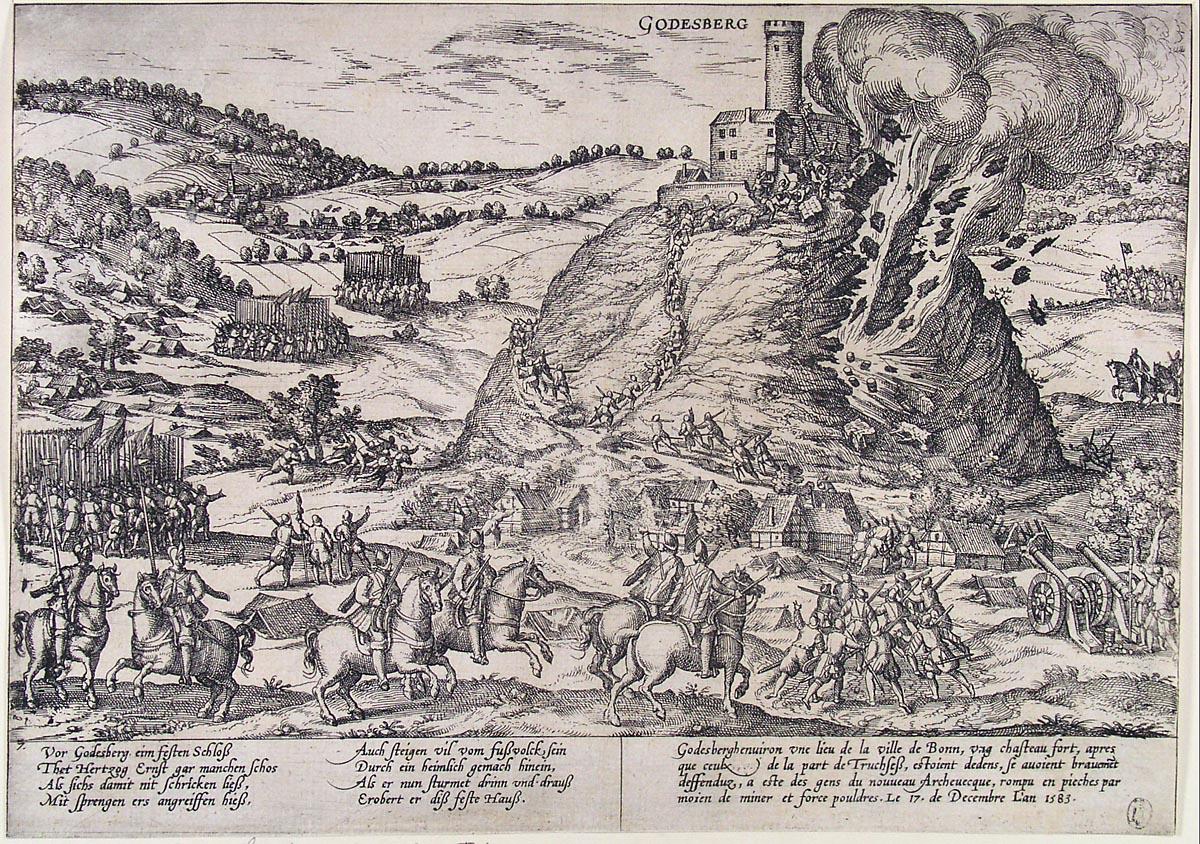
The first battles were local — the troops of two rival archbishops trading villages and abbeys up and down the Rhineland. The countryside took the worst of it. Towns that swore loyalty to the right side were spared; those that didn't were plundered and burned. At Godesburg, a fortress a few kilometers from Bonn, the Bavarian artillery failed to break the walls during a month-long siege in late 1583, so the attackers' sappers tunneled underneath and blew the foundations apart. When even that didn't open the bastion, soldiers crawled through the garderobe sluices — the latrine drains — to take it from inside. The grim local nickname for the war came from that day: the Truchsessian War, the Seneschal's War, and sometimes simply the Sewer War. Of the garrison at Godesburg, four men survived. The five miles of road between the fortress and Bonn was so crowded with soldiers that contemporaries described it as a single continuous military camp.
Spain Arrives
Gebhard begged for help. From Queen Elizabeth he requested ten thousand angelots — gold coins — promising that without Bonn his cause was lost. From William the Silent in Holland he sought soldiers and refuge; when William was assassinated in July 1584, Gebhard turned to the Earl of Leicester, Elizabeth's commander in the Netherlands, who sold his own silver plate trying to keep an army in the field. None of it was enough. Ernst, meanwhile, called on his family connections to summon Alexander Farnese, Duke of Parma — the most feared general of his age — who commanded Spain's Army of Flanders. For Philip II of Spain, the Electorate of Cologne was strategic gold: a Rhineland corridor through which to attack the rebellious Dutch provinces. Parma marched. In July 1586, his forces of roughly ten thousand soldiers — eight thousand foot and two thousand cavalry — supported by forty-five cannons, surrounded the Protestant garrison city of Neuss. The town's fate became a warning the rest of the region understood instantly. The destruction was total.
The Long Shadow
By the spring of 1588, Gebhard had run out of everything. His Protestant princes had hedged. His foreign patrons could send sympathy and little else. After the loss of Neuss and then Bonn and Godesberg and the cluster of fortified towns across the Oberstift, only Rheinberg in the far north still flew his banner — and by 1589 it too had fallen to Parma. Gebhard retired to Strassburg, where he lived until 1601, his marriage to Agnes intact, his Electorate gone. Ernst of Bavaria took full possession; his Wittelsbach successors would hold Cologne until 1761. But the deeper lesson of the war was the one that should have terrified everyone: outside powers — Spain, England, France, the Dutch, the Pope — had learned that they could intervene at scale in a German confessional dispute, and that German princes would invite them in. Thirty years after Gebhard's defeat, in 1618, that lesson would be applied again on a continental scale. Historians point to the Cologne War as the rehearsal. The dress rehearsal was already devastating enough.
From the Air
The Cologne War unfolded across the Electorate of Cologne — roughly the Rhine valley between Bonn and the Dutch border. The two confessional capitals lay close: Bonn (the Elector's residence) and Cologne itself were 30 km apart. Key sites are spread along the river: Godesberg on the heights above Bonn (51.16°N, 7.16°E), Neuss across from Düsseldorf (51.20°N, 6.69°E), Rheinberg in the north (51.55°N, 6.60°E), and Bonn (50.74°N, 7.10°E). From altitude, the Rhine threads them all together. Cologne-Bonn (EDDK/CGN) and Düsseldorf (EDDL/DUS) offer the closest modern approaches; the region's cathedral skylines and the wooded Siebengebirge near Bonn are the most prominent visual landmarks.