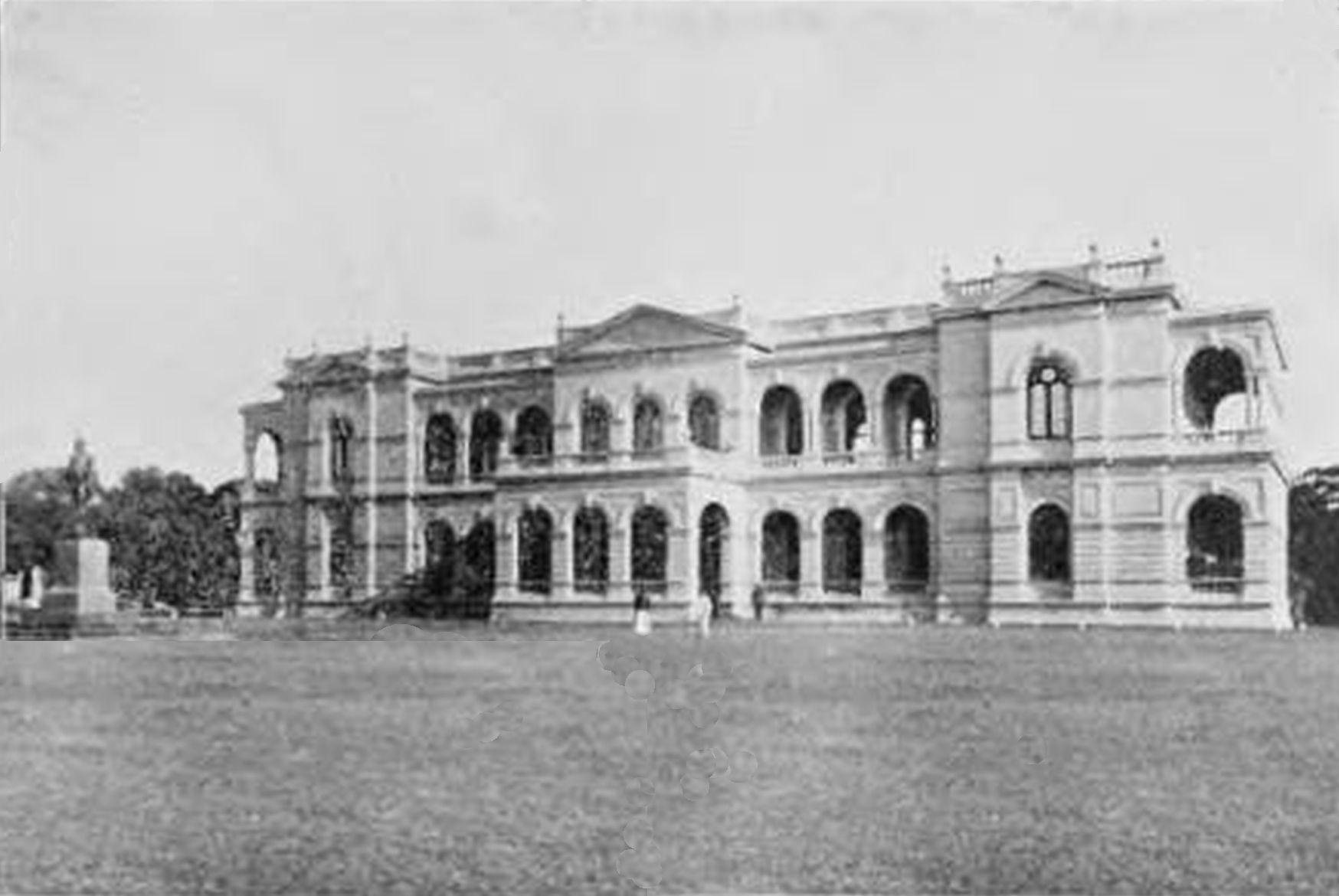
Colombo National Museum
The throne of the last King of Kandy sits inside a museum that a British governor built. There is something in that arrangement worth pausing over. Sri Vikrama Rajasinha lost his throne in 1815 when the Kandyan Convention handed his kingdom to the British. The crown jewels and the throne itself were taken to London. When they were eventually returned, they did not go back to a palace - they went into a display case at the Colombo National Museum, founded in 1877 by Governor Sir William Henry Gregory. The museum was, and is, an act of collection: gathering the cultural and natural heritage of Sri Lanka under one roof, arranging it in galleries, making it available for study. That the colonizer built the institution that now preserves the colonized kingdom's regalia is one of those colonial ironies that refuses to resolve itself cleanly.
A Governor's Gift in Italian Stone
Sir William Henry Gregory established the Colombo Museum on 1 January 1877 in a building designed in the Italian architectural style, constructed by Arasi Marikar Wapchie Marikar. The building was completed in 1876 and opened the following year, its facade a piece of European formality set down in the tropics. Gregory was an unusual governor - a former British MP who had seen famine in Ireland and colonial administration in Ceylon, and who believed that a museum could do what governance often could not: preserve a people's material culture against the erosions of time and indifference. The museum became the nucleus around which Sri Lanka's institutional heritage coalesced. A library was established the same day, incorporating the Government Oriental Library founded in 1870. Since 1885, Sri Lankan law has required that a copy of every document printed in the country be deposited with the museum library - making it an unofficial national library and the most complete record of the island's published thought.
The Statue That Stayed in London
Among the museum's holdings is a copy of the Statue of Tara, a three-quarter life-size bronze that ranks among the finest surviving examples of medieval Sri Lankan art. The original is in the British Museum in London, taken during the colonial period and never returned. The copy in Colombo is technically excellent, but it is a copy - a reminder that Sri Lanka's cultural patrimony is distributed across the institutions of its former rulers. The crown jewels and throne of the last Kandyan king were returned, at least. When they were first exhibited, Prime Minister D.S. Senanayake negotiated with Sir Razik Fareed, the grandson of the museum's original builder Wapchie Marikar, to keep the museum open on intervening Fridays. The regalia of a fallen kingdom drew crowds who came not to mourn but to reclaim - to see their own history behind glass rather than behind an ocean.
From One Museum to Nine
Under the directorship of P.E.P. Deraniyagala, the Colombo Museum was elevated to national status, and a fully-fledged Department of National Museums was established in 1942 under Act No. 31. Branch museums followed in Jaffna, Kandy, and Ratnapura, eventually growing to nine across the island. Deraniyagala expanded the institution's scope beyond colonial-era collecting, adding a natural history wing and an auditorium, establishing a school science program and a mobile museum service that brought exhibits to communities that could not travel to Colombo. Dr. Arthur Willey and Dr. Joseph Pearson directed further structural additions. New buildings facilitated ethnological and anthropological studies, extending the museum's mission from display to research. In 1982, Dr. Thelma Gunawardena became the first woman to direct the National Museum of Colombo, a position she held for twelve years. The ground floor galleries are arranged in historical sequence; the upper galleries are organized thematically - a structure that lets visitors choose between narrative and subject, between the story of Sri Lanka told chronologically and the same story told by theme.
The Library Beneath the Museum
The museum's library may be its most consequential legacy. Established on the same day as the museum itself, it absorbed the Government Oriental Library and began collecting with a focus on Sri Lanka, the broader Orient, and natural science. The legal deposit requirement, in place since 1885, means that every book, pamphlet, newspaper, and government report published in Sri Lanka for the past 140 years exists somewhere in the museum's stacks. It is, by accumulation, the closest thing the country has to a national library - a role it held unofficially for decades before formal national library legislation. The collection runs to hundreds of thousands of items. Researchers studying Sri Lankan history, language, or culture begin here, in reading rooms that share walls with galleries of Kandyan-era swords and colonial-era maps. The building that Gregory built to house artifacts has become, through its library, a living archive of the ideas that shaped the island as much as any crown or throne.
From the Air
Located at 6.910°N, 79.861°E in Colombo's Cinnamon Gardens district (now Colombo 7), south of the Fort area. The museum's Italian-style building and surrounding grounds are visible from the air as a distinctive colonial structure with gardens in a densely built urban area. Viharamahadevi Park (formerly Victoria Park) is immediately adjacent - a large green space useful as an aerial landmark. Bandaranaike International Airport (VCBI) lies 30 km north. Ratmalana Airport (VCCC) is 10 km south. Best viewed at 1,500-3,000 ft. Tropical weather year-round.