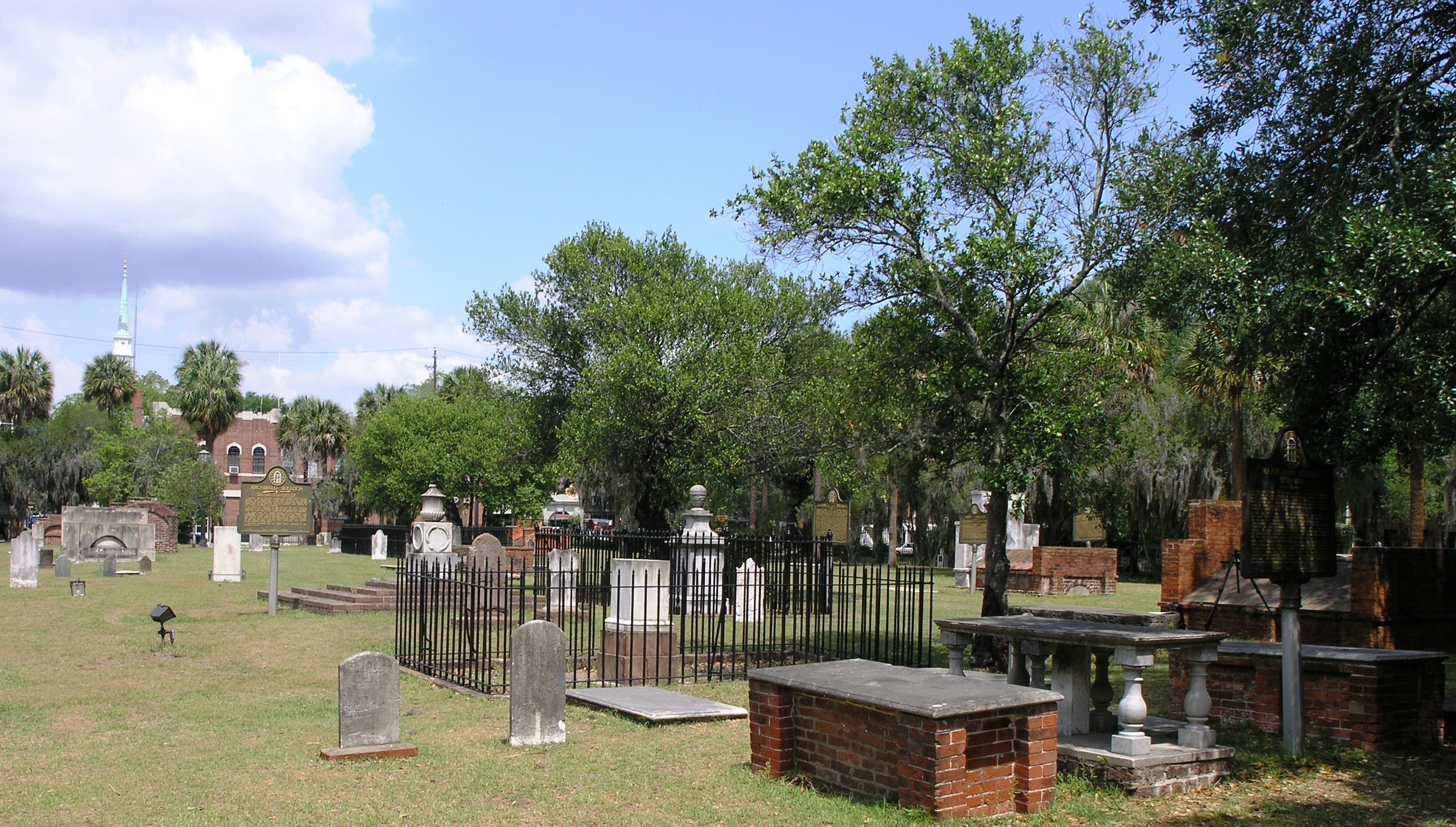
Colonial Park Cemetery: Savannah's Oldest Burial Ground
Button Gwinnett signed the Declaration of Independence on August 2, 1776, and was dead before the following summer. A political feud with General Lachlan McIntosh ended in a duel on May 16, 1777. McIntosh walked away wounded; Gwinnett died days later at the age of 42. Both men now lie in Colonial Park Cemetery in downtown Savannah, the oldest burial ground in a city that has always kept close company with its dead. Established in 1750, when Savannah was still the capital of the last of the Thirteen Colonies, Colonial Park served as the city's primary public cemetery for 103 years. Six acres of weathered headstones, tabby walls, and ancient oaks sit in the heart of the historic district, surrounded by the living city on all four sides.
The Parish Burial Ground
Colonial Park began as the burial ground for Christ Church Parish, Savannah's Church of England congregation, in 1750. For its first four decades, it served only the Anglican community. In 1789, as the new American republic reshaped old allegiances, the cemetery opened to Savannahians of all denominations. By that year it had expanded three times to reach its current six acres, bounded by East Oglethorpe Avenue to the north, Habersham Street to the east, East Perry Lane to the south, and Abercorn Street to the west. Over the years, it carried many names: the Old Cemetery, the Old Brick Graveyard, the South Broad Street Cemetery, and Christ Church Cemetery. Each name reflects a different era of the city's identity, but the ground itself has remained unchanged since the last expansion.
The Fever Year
In the summer of 1820, yellow fever swept through Savannah with devastating speed. The disease, carried by mosquitoes from arriving ships, killed hundreds in a city that had no understanding of how the illness spread. Nearly 700 victims were buried in Colonial Park Cemetery, many in a mass grave at the northern end of the grounds. The epidemic killed roughly ten percent of Savannah's population in a single season. Two local physicians died caring for their patients. The mass grave remains one of the most sobering features of the cemetery, a reminder that beneath the picturesque headstones and Spanish moss lies a record of genuine catastrophe. A historical marker near the burial site commemorates those who perished.
Founding Fathers and Rival Generals
The headstones of Colonial Park read like a roster of Georgia's founding generation. Button Gwinnett, one of only 56 signers of the Declaration of Independence, lies here. His signature is among the rarest in American autograph collecting because so few of his documents survived. Archibald Bulloch, governor of Georgia's Provincial Congress, was buried in the cemetery in 1777. Samuel Elbert, a Revolutionary War soldier who later served as governor of Georgia, rests nearby. The Habersham family occupies multiple plots: James Habersham served as acting royal governor of the Province of Georgia, while his son Joseph became Postmaster General of the United States under three presidents. Major General Lachlan McIntosh, the man who killed Gwinnett in their duel, is buried in the same cemetery as his victim.
The General and His Rival's Vault
Perhaps the strangest story in Colonial Park belongs to Nathanael Greene, George Washington's most trusted general during the Revolutionary War. Greene died in 1786 and was placed in the cemetery's Graham vault. For over a century, his remains shared that vault with those of John Maitland, his arch-rival from the war. An American hero and a British commander rested side by side in the same stone chamber for 115 years. In 1901, Greene's remains were finally exhumed and reinterred beneath a monument in Johnson Square, along with those of his eldest son George. Maitland's remains were returned to his native Scotland in 1981. The Graham vault still stands in the cemetery, emptied of its famous occupants but heavy with the irony of enemies sharing quarters in death.
Altered Stones and Open Gates
Colonial Park Cemetery was closed to burials in 1853 and became a public park in 1896. During the Civil War, Union soldiers occupying Savannah allegedly defaced some of the headstones, altering dates and ages as either vandalism or dark humor. Visitors today can spot stones with improbable inscriptions, ages stretched to hundreds of years, as possible evidence of the tampering. Soldiers also reportedly sheltered inside the cemetery's larger vaults, including the Gaston Tomb. Today the cemetery sits open to the public, its six acres a quiet green space in the middle of downtown Savannah's busiest historic blocks. The tabby walls and iron gates frame one of the oldest outdoor spaces in the American South, a place where the eighteenth century remains visible beneath the twenty-first.
From the Air
Located at 32.075°N, 81.090°W in the heart of Savannah's historic district. Colonial Park Cemetery occupies six acres bounded by Oglethorpe Avenue, Habersham Street, Perry Lane, and Abercorn Street. From altitude, it appears as a green rectangle within Savannah's distinctive grid of squares and tree-lined streets. The cemetery is roughly 2 miles south of Savannah/Hilton Head International Airport (KSAV). On approach, the historic district's regular pattern of squares is one of the most recognizable urban plans visible from the air. The Savannah River marks the northern edge of the city, with the port facilities clearly visible. Bonaventure Cemetery lies approximately 4 miles to the southeast along the Wilmington River.