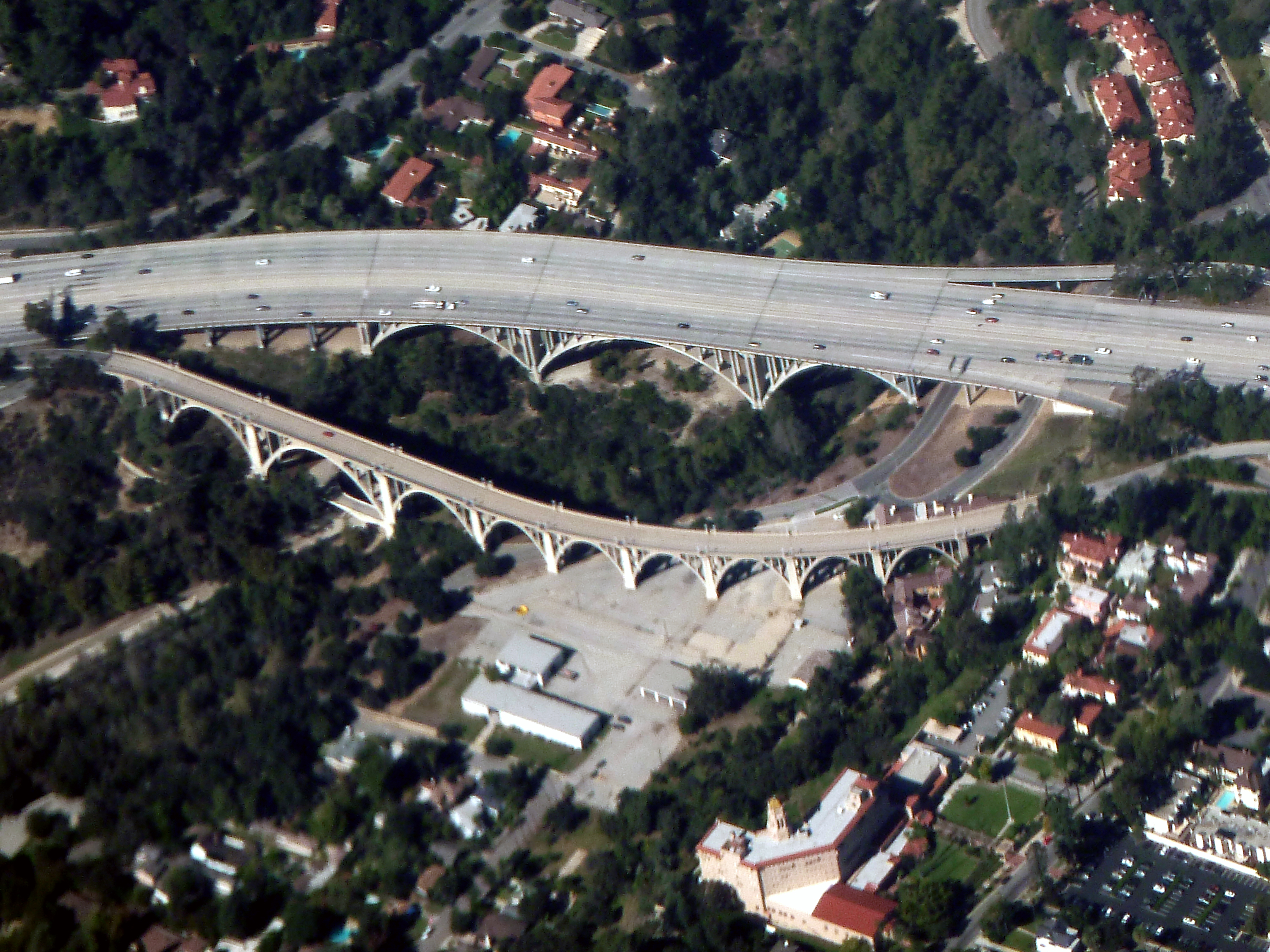
Colorado Street Bridge (Pasadena, California)
Charlie Chaplin filmed here in 1921. Lana Del Rey filmed here in 2012. Ninety years apart, both were drawn to the same architectural drama: Beaux Arts arches curving above the Arroyo Seco, light standards casting long shadows across Colorado Boulevard, the San Gabriel Mountains framing the view to the north. The Colorado Street Bridge in Pasadena is that rare structure that looks exactly as striking as it does in movies — which is why it keeps appearing in them.
Built for $191,000 and a Legend
When the bridge opened on December 13, 1913, it replaced a far humbler structure and announced Pasadena's ambitions. Designed by the engineering firm Waddell & Harrington at a cost of $191,000, the new span stretched across the broad, rocky wash of the Arroyo Seco on a series of elegant concrete arches. The design was deliberately civic: Beaux Arts in style, with ornamental railings, sculpted light standards, and seating alcoves where pedestrians could pause and take in the view. It was, from the first, a place meant to be admired.
The bridge follows a curved path rather than a straight one — a practical choice, since the curve allowed the footings to rest on more solid ground beneath the riverbed. The result was a structure that photographs well from almost any angle. Within a few years it was carrying U.S. Route 66 traffic, connecting Pasadena to Eagle Rock and Glendale in one elegant sweep. A construction myth entered local lore: that a worker caught in a concrete mixer had been poured into one of the bridge's supports. No evidence supports it. The bridge has never needed such embellishment.
The Darker Name
By the 1930s, Pasadena's beautiful bridge had acquired a second name: Suicide Bridge. Dozens of people had died jumping from its arches into the Arroyo Seco below — 87 by 1937, according to newspaper accounts of the era. The Great Depression deepened the toll. The seating alcoves that were meant for contemplative rest became, for some, a final destination.
The city has struggled with this legacy for nearly a century. When the bridge was closed and renovated following the 1989 Loma Prieta earthquake, barriers were added during the restoration — the span reopened in December 1993 with physical deterrents in place. In 2016, temporary chain-link fencing was installed over the alcoves. Nine people died in 2017 alone; four more in the first nine months of 2018. The fencing was extended to cover the entire bridge. Plans for permanent barriers remain ongoing. The bridge remains, in its way, a measure of how seriously a city takes the lives of the people who cross it.
Hollywood's Favorite Bridge
Film crews discovered the Colorado Street Bridge early. Chaplin's 1921 film The Kid used the east end as a location. The bridge has appeared in La La Land (2016), as the setting for an evening stroll; in Yes Man (2008), as a bungee jumping platform; and in episodes of Full House, ER, and Emergency! — where it stood in for San Francisco, San Diego, and various unspecified urban backdrops. Fear Factor hung a trapeze bar over its edge. The Amazing Race started a season with contestants rappelling down its face.
The bridge also appears in music. A 1984 album called Songs from Suicide Bridge was named after it. Part of Lana Del Rey's "Summertime Sadness" video was filmed here in 2012, with actress Jaime King climbing a railing and jumping — a moment that found its resonance precisely because the bridge's history is known.
Each summer, Pasadena Heritage closes the bridge for a street festival celebrating its survival. The span is listed on the National Register of Historic Places and carries the designation of California Historic Civil Engineering Landmark. It is 112 years old, structurally sound, and still beautiful.
The View from the Bridge
Standing on the Colorado Street Bridge today, the Arroyo Seco drops away below — a rocky, seasonally dry riverbed flanked by sycamores and scrub. The Ventura Freeway runs beside the bridge to the south, close enough to hear but low enough not to intrude on the view. To the north, the San Gabriel Mountains rise in a wall of chaparral and granite. On clear winter days after rain, the peaks hold snow.
The curve of the bridge means that looking west from the east end, the span bends away from you in a graceful arc, the arches repeating themselves toward Glendale. The light standards — original in design, though replaced over decades — stand at intervals like sentinels. In the early morning, with low sun raking across the concrete, the bridge looks like something from another era of American infrastructure, one when cities hired engineers who also knew how to make beautiful things.
From the Air
Located at 34.14°N, 118.16°W in Pasadena, the bridge spans the Arroyo Seco canyon — visible as a graceful curve over the rocky wash just west of the I-210/Ventura Freeway interchange. Best viewed from low altitude (1,000–2,000 ft AGL) on a north-south approach. Nearest airports: Burbank (KBUR, 7 miles NW), El Monte (KEMT, 6 miles SE), Brackett Field (KPOC, 13 miles E).