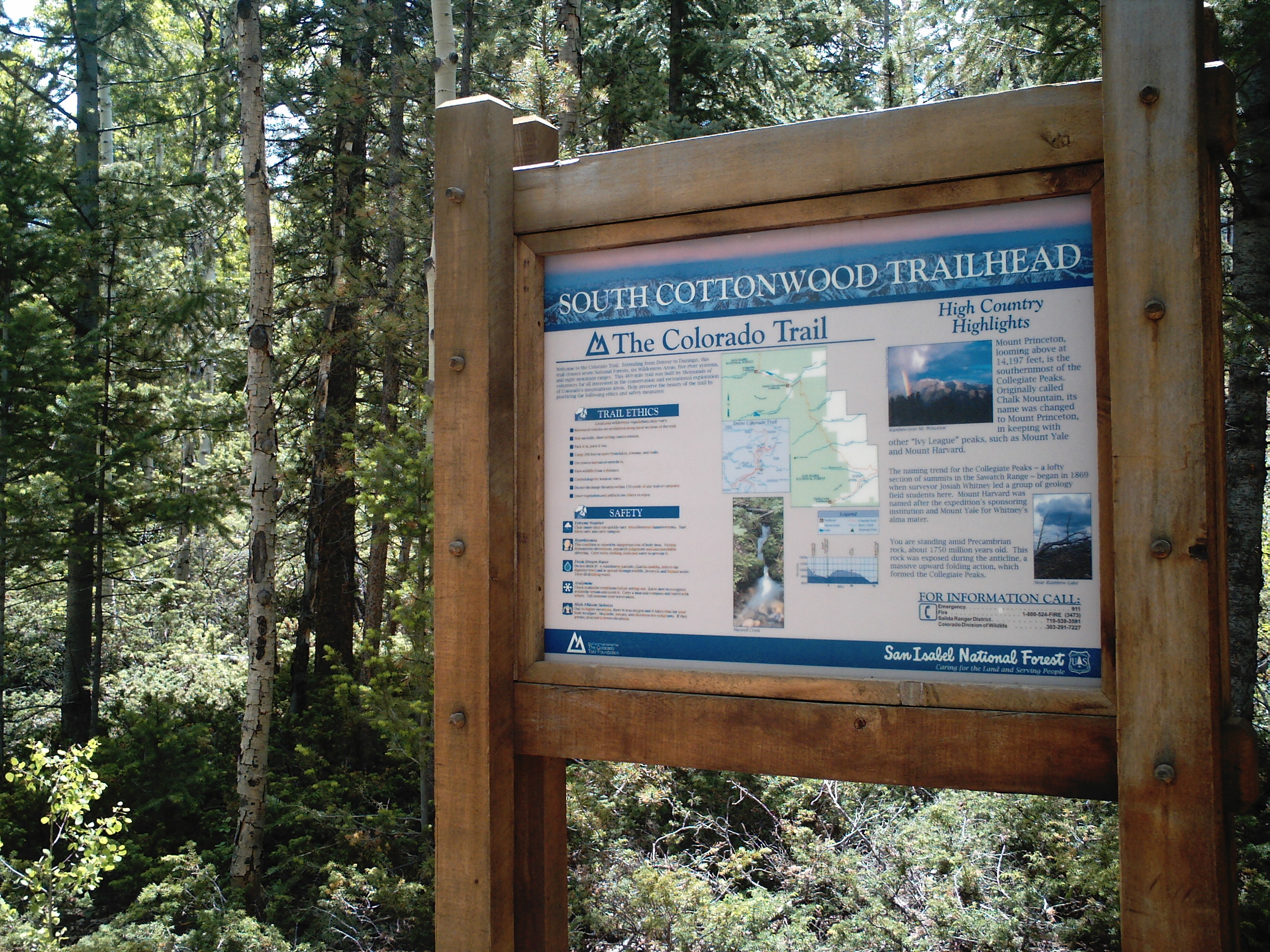
Colorado Trail
Four hundred and eighty-five miles separate a gravel road at Waterton Canyon, southwest of Denver, from a footbridge outside Durango. Between those two points, the Colorado Trail crosses the spine of the Rocky Mountains in a way no highway ever could. The route threads through eight mountain ranges, seven national forests, and six designated wilderness areas, rarely dropping below 8,000 feet and regularly climbing above 12,000. It traverses the Continental Divide. It passes within sight of Mount Elbert, the highest point in Colorado at 14,440 feet, and skirts the flanks of Mount Massive just beside it. The trail is divided into 28 segments, each with its own character - from the ponderosa pine forests of the Front Range to the vast alpine tundra of the San Juans, where snow lingers in the basins well into summer and the nearest road feels like it belongs to another world entirely.
Starting in a Canyon, Ending in the Sky
The Colorado Trail begins modestly. A wide gravel road follows the South Platte River upstream through Waterton Canyon, where sheer walls rise on either side and bighorn sheep pick their way along the ledges. After about six miles, the road ends at Strontia Springs Dam and the route narrows to true singletrack, climbing through ponderosa pine on switchbacks before leveling out on a ridge. This is the Front Range - the opening act. The trail pushes west through the Buffalo Creek burn scar, an exposed stretch with big views and almost no shade, before entering the Lost Creek Wilderness, where granite domes and wildflower meadows replace the dry plateau. By the time you reach Kenosha Pass and look out over South Park, with the Continental Divide jagging across the western horizon, the trail has left the foothills behind entirely. The real mountains are ahead.
High Country and Ghost Towns
Between Breckenridge and Leadville, the trail enters some of its most dramatic terrain. A traverse of the Tenmile Range runs above treeline for nearly four miles at just under 12,500 feet, with views stretching across Lake Dillon and the Copper Mountain ski slopes. Near Camp Hale, the remnants of old mining camps dot the landscape - rusting machinery and collapsed timbers that recall the era when these mountains were valued for what lay beneath them rather than on top. The Holy Cross Wilderness offers fragrant pine groves and bubbling streams before the route passes close to both Mount Massive and Mount Elbert, Colorado's two highest peaks. A spur trail tempts hikers to bag Elbert's summit. Then comes Twin Lakes, where the trail follows the shoreline with the Sawatch Range reflected in still water - a moment of calm before the grueling climb to Hope Pass at over 12,500 feet, one of the trail's most physically demanding ascents.
Walking the Divide
South of Monarch Pass, the Colorado Trail and the Continental Divide become nearly inseparable. The route follows broad ridges above 12,000 feet through the Cochetopa Hills, where the landscape opens into rolling tundra so vast it can feel oceanic. Elk graze in the distance. The San Luis Valley spreads out below like a map. For miles, the only sounds are wind and the crunch of boots on high-altitude gravel. The trail crosses the La Garita Mountains and descends toward San Luis Pass before climbing again into the San Juan Mountains, where the terrain becomes wilder and more remote with each segment. Above Carson Saddle, mining relics near Cataract Lake mark the passage of an earlier generation. Near Stony Pass, the trail enters some of the most isolated country on the entire route - broad alpine plateaus and airy ridges with views of the jagged Grenadier Range, where you can walk for hours without seeing another person.
The San Juans and the Final Descent
The San Juan Mountains deliver the Colorado Trail's climactic scenery. From Molas Pass, the route climbs through spruce and fir into high meadows thick with wildflowers, rolling along alpine benches near 12,000 feet with the full sweep of the San Juan high country visible in every direction. Bolam Pass and Hotel Draw offer dense forest broken by clearings where the La Plata Mountains frame the western sky. The final push over Blackhawk Pass at nearly 12,000 feet provides one last panoramic farewell before the trail begins its long descent toward Durango. Pine and aspen give way to juniper and sage as the elevation drops. Red-rock outcrops appear. The landscape shifts from alpine to high desert, and then the footbridge appears - the end of a 485-mile journey from the edge of Denver to the edge of the San Juans.
Respect the Altitude
The Colorado Trail demands preparation. The ideal thru-hike window runs from late June to early September, bracketed by snowpack on one end and early-season storms on the other. Afternoon thunderstorms with lightning are a serious hazard above treeline from July through August - experienced hikers plan to clear high passes before noon. The trail rarely drops below 8,000 feet, and altitude sickness is a genuine concern for anyone arriving from sea level. Black bears, mountain lions, and moose inhabit the corridor, making proper food storage essential. Resupply stops in Breckenridge, Leadville, Salida, and Silverton break the journey into manageable stretches. Many hikers mail supply boxes ahead. No permits are required for the trail itself, though overnight stays in the six wilderness areas need them. The reward for all this planning is a route that shares significant mileage with the Continental Divide Trail - a natural stepping stone to an even grander adventure.
From the Air
The Colorado Trail stretches 485 miles from Waterton Canyon southwest of Denver (39.34N, 105.40W) to Durango (37.28N, 107.88W). The trail crosses the Continental Divide multiple times and traverses eight mountain ranges. Key visual landmarks from the air include the Tenmile Range near Breckenridge, Mount Elbert and Mount Massive near Leadville, the broad tundra of the Cochetopa Hills, and the jagged San Juan Mountains near Silverton and Durango. The northern terminus is near Denver International Airport (KDEN). The southern terminus is near Durango-La Plata County Airport (KDRO). The trail passes near numerous small mountain airports. Much of the route runs above treeline at 11,000-12,500 feet, making the trail corridor visible as a line crossing alpine terrain.