Colt Paterson
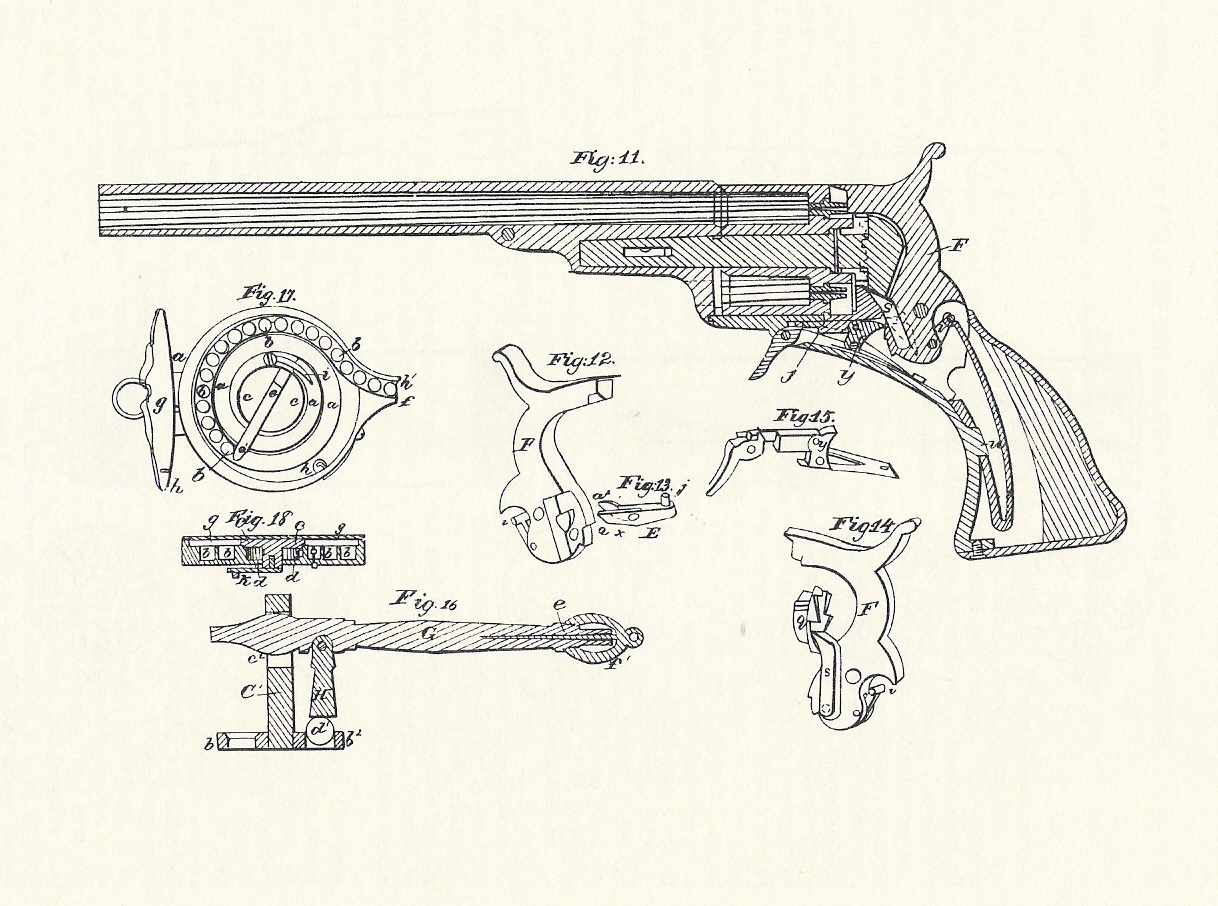
Samuel Colt was sixteen years old, sailing on the brig Corvo from Boston to Calcutta, when the idea came to him. Whether he was watching the ship's windlass mechanism or, as some historians believe, examining a Collier flintlock revolver during a stop at the Tower of London, he saw the principle that would reshape the American frontier: a revolving cylinder aligned with a single barrel, each chamber firing in succession. He carved a wooden model aboard the ship -- it survives today at the Wadsworth Atheneum in Hartford, Connecticut -- and spent the next six years refining the concept. On February 25, 1836, he received patents in the United States, England, and France for the Colt Paterson, the world's first commercial repeating revolver.
The Factory on the Passaic
Colt established the Patent Arms Company in Paterson, New Jersey, along the Passaic River, to manufacture his invention. Between 1836 and 1842, the factory produced 1,450 revolving rifles and carbines, 462 revolving shotguns, and 2,350 revolving pistols. The numbers were modest, and the early design had significant limitations. The original Paterson was a five-shot revolver, produced first in .28 caliber and later in .36, with a folding trigger that appeared only when the hammer was cocked. Reloading required partially disassembling the weapon -- removing the barrel and cylinder to load powder and ball. Starting in 1839, a loading lever and capping window were added, but the improvement came too late to save the business. The Patent Arms Company failed in 1842. A creditor named John Ehlers continued manufacturing and selling approximately 500 additional pistols through 1847.
Ten Shots on Horseback
The Paterson revolver might have vanished into footnote status if not for the Texas Rangers. When Sam Houston disbanded the Texas Navy in 1843, Captain Jack Hays armed his company with surplus Paterson pistols from the navy's stocks. For the Rangers, fighting mounted Comanche warriors across open territory, the Paterson was a revelation. A single Ranger carrying two pistols had ten shots at his disposal before needing to reload -- a staggering advantage in an era when most firearms required reloading after every shot. The effective range from horseback was measured in feet rather than yards, but in close-quarters mounted combat, volume of fire mattered more than precision.
The Battle That Proved the Concept
The Paterson revolver proved especially decisive at the Battle of Bandera Pass, where the Rangers' sustained firepower overwhelmed their Comanche adversaries. Captain Hays and Captain Samuel Walker became vocal advocates for Colt's design, pushing for military adoption of the revolving pistol. In 1846, General Zachary Taylor, commanding American forces on the Mexican border, sent Walker to New York to meet with Colt personally. Walker, then serving with the U.S. Mounted Rifles, discussed specific improvements needed for military use -- a heavier frame, a fixed trigger, a loading lever built into the design. The collaboration produced the Walker Colt, a larger and more powerful successor that secured Colt his first major military contract and launched the company that would become an American industrial giant.
From Paterson to Empire
The Colt Paterson's power was roughly comparable to a modern .380 pistol cartridge -- the .375-to-.380-inch round ball weighed about 83 grains and traveled at similar velocity. It was not a powerful weapon by later standards. But its real significance was conceptual rather than ballistic. Colt's 1836 patent, renewed in 1849 and defended through aggressive litigation, gave him a domestic monopoly on revolver development until the mid-1850s. That monopoly became the foundation for Colt's Manufacturing Company, and the revolving cylinder became the dominant handgun mechanism for more than a century. The Patent Arms Company's ruins still mark the site in Paterson where it all began -- a factory that went bankrupt making a weapon that changed the world.
From the Air
Located at 40.92N, 74.18W in Paterson, New Jersey, along the Passaic River near the Great Falls. The site of Colt's Patent Arms Company factory is in the historic industrial district of Paterson. The Great Falls of the Passaic are a prominent landmark visible from the air. Nearby airports: Teterboro (KTEB) approximately 10 nm southeast, Essex County (KCDW) approximately 6 nm southwest. Best viewed at 2,000-3,000 ft AGL.