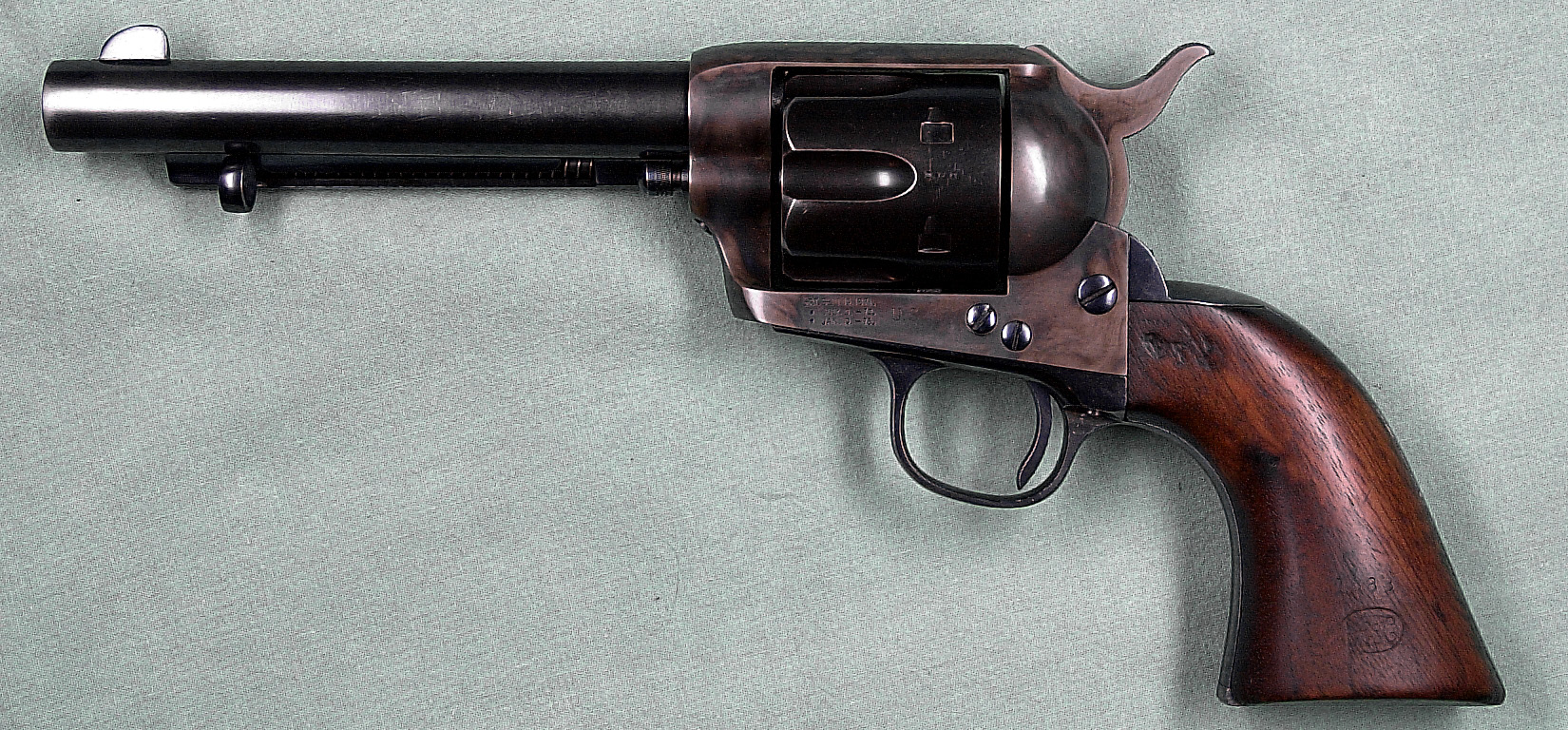
Colt's Manufacturing Company
At the 1851 Great Exhibition in London, a brash American showman disassembled ten revolvers and reassembled them using random parts from different guns. The audience gasped. No European gunmaker could match such a feat. The man was Samuel Colt, and his demonstration did more than sell firearms -- it announced the arrival of a new industrial age. From a modest Hartford factory topped by a distinctive blue dome, Colt's Manufacturing Company would go on to arm cowboys and cavalry, equip soldiers in every major American conflict from the Civil War to Vietnam, and pioneer the mass production techniques that transformed manufacturing worldwide.
The Tinkerer and the Revolution
Samuel Colt did not invent the revolver, but he perfected it. After receiving his first U.S. patents in 1836, he founded the Patent Arms Manufacturing Company in Paterson, New Jersey. The early results were mixed -- the Marine Corps and Army reported quality problems, and the Paterson plant closed by 1842. Colt learned a hard lesson about the gap between brilliant design and reliable mass production. When he established his Hartford factory, he brought something new: steam-powered machinery that could produce truly interchangeable parts, assembled by unskilled laborers using standardized gauges and patterns. His armory became a training ground for generations of machinists and toolmakers who carried these revolutionary techniques into industries far beyond firearms. The Institution of Civil Engineers in London awarded Colt the Telford Gold Medal for his contributions to manufacturing science.
An Industrial Palace Under a Blue Dome
By the Civil War, Colt's Hartford factory had earned the nickname "an industrial palace topped by a blue dome." Powered by a 250-horsepower steam engine, 1,500 employees produced 150,000 muskets and pistols annually. The company sold 107,000 of the Colt Army Model 1860 alone between 1861 and 1863. The war made Samuel Colt America's first manufacturing tycoon, though he never saw its end -- he died of rheumatic fever on January 10, 1862. Tragedy compounded: a devastating fire destroyed most of the factory on February 4, 1864, consuming arms, machinery, plans, and irreplaceable records. Colt's close friend and successor Elisha K. Root died just a year after the war ended, leaving the company in precarious hands with expired patents and no military contracts.
The Gun That Won the West
From the ashes of the post-war crisis emerged the firearm that would define an era. Engineer William Mason designed a new metallic-cartridge revolver with a reinforced top-strap frame and chambered it in the powerful .45 Colt cartridge. The U.S. Army adopted it in 1873, with the first order of 8,000 revolvers shipping in the summer of 1873. The Colt Single Action Army -- nicknamed the "Peacemaker" -- became the iconic sidearm of lawmen, outlaws, and settlers across the expanding American West. Through the 1870s and 1880s, as European-American society pushed westward, demand for Colt firearms surged from the Army, civilians, and police alike. The Peacemaker remained in continuous production for decades, becoming perhaps the most recognized revolver in history.
World Wars and the M1911
Legendary firearms designer John Browning collaborated with Colt to develop a semiautomatic pistol that debuted as the Colt M1900 and evolved into the M1911 -- the longest-serving military handgun in history. During World War I, Colt's workforce swelled to 10,000 employees, its stock price surged 400 percent, and the factory produced 425,500 M1911 pistols by 1918, plus 151,700 revolvers and thousands of machine guns. World War II pushed the company even harder: 15,000 men and women worked three shifts around the clock across three factories, manufacturing over 629,000 M1911A1 pistols and earning the Army-Navy "E" for excellence. Colt also produced the first 15,000 Thompson submachine guns under contract in 1921 -- the weapon that would become synonymous with both Prohibition-era gangsters and World War II infantrymen.
Reinvention and Legacy
The decades after World War II brought dramatic swings. The Vietnam-era M16 rifle contract made the 1960s boom years, with over five million units sold worldwide. But complacency set in. A bitter labor strike in the 1980s degraded quality, costing Colt its M16 contract to Fabrique Nationale in 1988. The company filed for bankruptcy in 1992, then again in 2015 after losing its M4 carbine contract. Through it all, the Hartford factory endured. Colt revived its legendary Python revolver in 2020, reintroduced the Anaconda in 2021, and found new ownership under Czech firm Colt CZ Group -- with an explicit commitment that Colt products would continue to be manufactured in the United States. Today, Samuel Colt's personal collection resides at the Wadsworth Atheneum, while the company archives fill the Connecticut State Library, testaments to a firm that helped forge the industrial character of America itself.
From the Air
Located in Hartford, Connecticut at 41.74N, 72.72W, along the Connecticut River valley. The Colt factory complex with its distinctive blue onion dome is a recognizable landmark from the air. Nearest major airport is Bradley International (KBDL), about 12 nm north. Hartford-Brainard Airport (KHFD) is closer at approximately 3 nm southeast. Best viewed at 2,000-3,000 feet AGL. The factory site sits along the west bank of the Connecticut River, which provides a clear navigation reference.