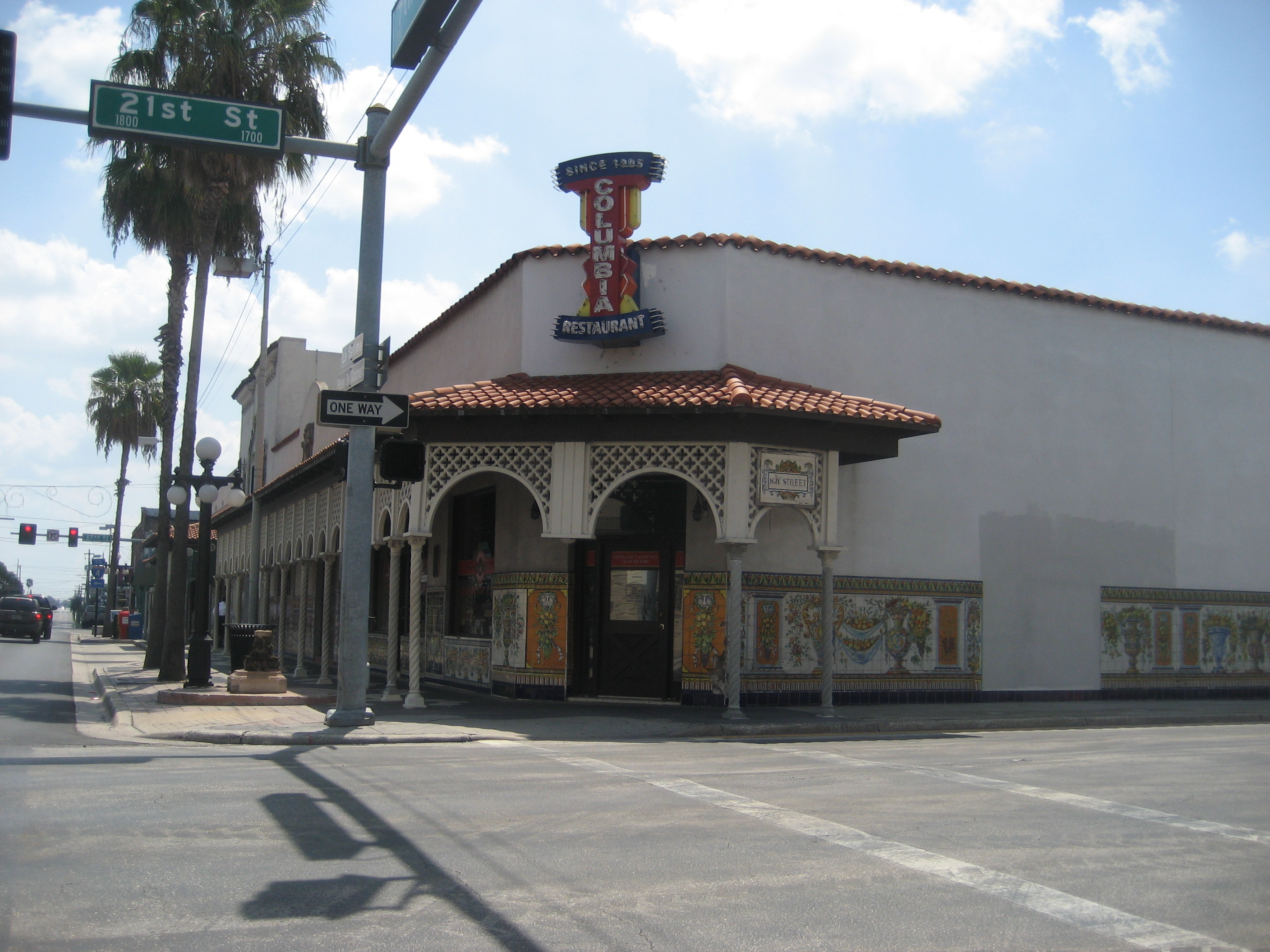
Columbia Restaurant
The sangria arrives in a glass pitcher, mixed tableside with a flourish that has been rehearsed ten thousand times. At the Columbia Restaurant in Ybor City, Tampa, this is not performance but inheritance -- a ritual passed down through five generations of the Hernandez-Gonzmart family since Casimiro Hernandez Sr. opened a small corner saloon here in 1903. What began as Saloon Columbia, a tasting room for the Florida Brewery, has become the oldest continuously operated restaurant in Florida, the oldest Spanish restaurant in the United States, and the largest Spanish restaurant in the world. The building now occupies an entire city block, holds 15 dining rooms across 52,000 square feet, and seats 1,700 guests at a time.
From Saloon to Institution
Casimiro Hernandez Sr. founded Saloon Columbia in 1903 in the heart of Ybor City, Tampa's cigar-making district, where Cuban, Spanish, and Italian immigrants rolled tobacco by the millions and needed somewhere to eat and drink when the shift ended. In 1905, the saloon was renamed Columbia Restaurant and began serving the Spanish and Cuban dishes that would define it for the next century. The timing was everything. Ybor City in the early 1900s was one of the most culturally dense neighborhoods in the American South, a place where Spanish was spoken as freely as English and where the traditions of Havana, Asturias, and Sicily collided at every intersection. The Columbia grew alongside that community, expanding room by room, decade by decade, absorbing neighboring buildings until the restaurant covered the entire block.
The Musician Who Became a Restaurateur
In the early 1950s, Cesar Gonzmart faced a choice. A trained musician with real talent, he gave up a career in music to take over the family restaurant as general manager. But he never fully left the stage. For decades, Gonzmart serenaded his guests with his violin and a small orchestra, blurring the line between owner and entertainer, between dining room and concert hall. Under his stewardship, the Columbia expanded to a second location in Sarasota in 1959, and the restaurant developed a reputation that extended well beyond Tampa. Music became inseparable from the Columbia experience, and even after illness eventually forced Gonzmart from the floor, live performances on weekends continued the tradition he had made central to the restaurant's identity. The state of Florida recognized him as a Great Floridian in 2000.
Footwork and Fire
Since 1988, the sharp crack of flamenco heels has echoed through the Columbia's dining rooms. Dancer Maria Esparza brought flamenco to the restaurant that year and has directed the show since 2008, building it into one of Tampa's signature cultural experiences. The coordination, she explains, is unlike anything else in dance -- hands moving in one rhythm, feet hammering out percussion in another, the whole body becoming an instrument. The flamenco shows connect the Columbia to the Spanish roots of Ybor City in a visceral, physical way that no menu item ever could. Guests come for the food and stay for the performance, watching dancers in the same dining rooms where cigar workers once gathered after long shifts in the factories across the street.
An Empire in Spanish Tile
The Columbia's original Ybor City location remains the flagship, but the family has extended its reach across Florida. A Sarasota outpost opened in 1959, followed by St. Augustine in 1983, Sand Key in 1989, and Celebration in 1997. Each location carries the family name and menu, but the Ybor City original is the one that matters most. Its 15 dining rooms are a layered history of the restaurant's expansion, each room reflecting the era in which it was added. The restaurant features private-label wines and liquors created to honor various family members, and the house sangria -- mixed tableside from a recipe that has been shared, copied, and posted across the internet countless times -- remains the most requested drink. The restaurant's identity as a family business, now in its fifth generation, gives it a continuity that no chain restaurant can replicate.
Ybor City's Living Room
What makes the Columbia more than a restaurant is what it represents to Tampa. Ybor City's cigar factories are mostly gone, the immigrant neighborhoods have gentrified or dispersed, and the streetcar that once connected the district to downtown now runs largely for tourists. But the Columbia remains. It is the anchor of a neighborhood in constant reinvention, a place where the history of Cuban and Spanish Tampa is not archived behind glass but served on plates. The Hernandez-Gonzmart family has published cookbooks, supported local charities, and contributed to community organizations, but the restaurant's real civic function is simpler than any of that. It is the place where Tampa celebrates, mourns, proposes, and remembers. Five generations in, the sangria is still mixed tableside, the flamenco dancers still stamp, and the dining rooms still fill.
From the Air
Located at 27.96N, 82.44W in Ybor City, the historic cigar district northeast of downtown Tampa. The restaurant occupies an entire city block along 7th Avenue (La Septima), visible as a large terra-cotta-roofed structure amid the neighborhood's low-rise commercial buildings. Ybor City is identifiable from the air by its grid street pattern and historic brick buildings. Nearest airports: KTPA (Tampa International Airport), approximately 7 nm west; KTPF (Peter O. Knight Airport) on Davis Islands, roughly 3 nm southwest. The Hillsborough River and I-4 corridor provide strong visual references for locating the district.