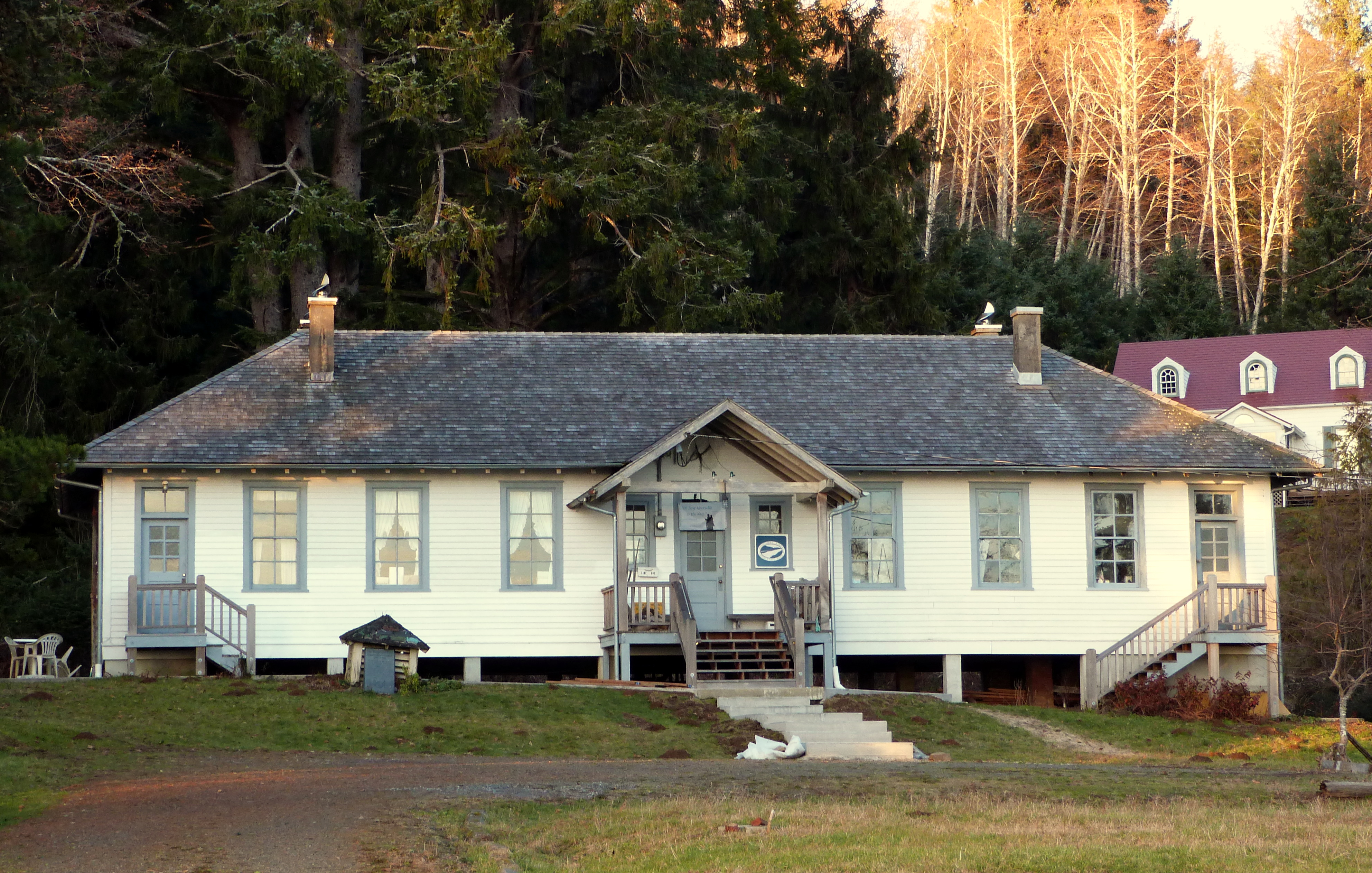
Columbia River Quarantine Station
Every other quarantine station on the West Coast was burned. Angel Island's station near San Francisco, the facilities at San Diego, Port Townsend's outpost on Puget Sound -- all of them eventually destroyed, typically out of fear that the buildings themselves harbored contamination. Only one survived: a cluster of modest wooden buildings tucked into a cove on the Columbia River's north bank, near the ghost town of Knappton, Washington. The Columbia River Quarantine Station operated from 1899 to 1938, inspecting thousands of immigrants and fumigating hundreds of ships. A 1921 article in The Sunday Oregonian called it the "Ellis Island" of the Pacific Northwest. Today it is a museum, the Knappton Cove Heritage Center -- the sole physical remnant of the system that once screened every person arriving by sea on the American West Coast.
Plague Ships and Sulfur Pots
The station owed its existence to global panic. A cholera epidemic in 1892 had swept through ports worldwide, and outbreaks of smallpox, bubonic plague, and yellow fever were active in South American, European, and Asian harbors. Ships arriving at the port of Astoria, Oregon, on the Columbia River faced a problem: if disease was discovered on board, the vessel had to travel 275 miles north to the disinfecting station at Port Townsend before anyone could disembark. The federal government decided the Columbia needed its own facility. In 1899, they purchased a defunct fish cannery at Knappton Cove for $8,000 -- roughly $250,000 in today's dollars -- and converted its wharf and buildings into a quarantine station. When a ship arrived under suspicion, passengers went ashore for showers and delousing while their clothing and baggage were disinfected. Below decks, workers sealed the holds and set pots of sulfur on fire, filling the ship with choking fumes designed to kill the rats and fleas that carried bubonic plague. The fumigation took about 48 hours. In 1929, sulfur gave way to cyanide gas -- more effective, and considerably more dangerous for the workers handling it.
The Ellis Island Nobody Knows
By the end of its first year of operation, the Knappton station had inspected 6,120 immigrants, passengers, and crew arriving on 132 ships. Only two people required quarantine that year -- a testament to the station's role as a filter rather than a hospital. Most arrivals passed through quickly, their ships fumigated as a precaution, their bodies examined for symptoms of the diseases that terrified port authorities. The sick were isolated in the station's hospital building, separated from the healthy until they either recovered or were sent back. Four West Coast ports accepted immigrants during this era: San Diego, San Francisco, Astoria, and Port Townsend. The Columbia River station served Astoria's traffic, processing the sailors, laborers, and families arriving from Pacific Rim ports who hoped to start new lives in the timber towns and fishing villages of the Pacific Northwest. For them, Knappton Cove was the last barrier between the ocean crossing and America.
Closing the Gates
The station closed in 1938, its mission overtaken by changing immigration patterns and improved public health measures. The buildings sat empty, deteriorating quietly above the Columbia's north bank. Unlike its counterparts along the coast, Knappton's station was never burned. Perhaps its isolation protected it -- there was no pressing reason to destroy buildings in a place almost no one visited. The neglect that might have doomed the structures paradoxically preserved them. In 1980, the Columbia River Quarantine Station was added to the National Register of Historic Places, recognizing what had by then become obvious: this was the last one left. Fifteen years later, in 1995, the old hospital building reopened as the Knappton Cove Heritage Center, a small museum dedicated to the quarantine station's history. Students from Clatsop Community College's historic preservation program assisted with renovations, and in 2017 the museum received a $5,000 grant from the National Trust for Preservation to continue its work.
What the Cove Remembers
Knappton itself is barely a place anymore. The sawmills and canneries that once sustained the community are long gone, and the cove sits quietly at the river's edge, flanked by forest. The heritage center occupies the only building most visitors will ever enter here, its exhibits documenting the diseases that ships carried, the fumigation methods that attempted to stop them, and the thousands of people who passed through on their way to somewhere else. The station's survival feels almost accidental, yet it preserves something that the burned stations cannot: the physical reality of what immigration looked like at the western edge of the continent. Not the grand halls and copper-clad statue of Ellis Island, but a wooden building on a muddy shore where sulfur smoke drifted through ship holds and immigrants waited to learn whether America would let them in. The Columbia still flows past the cove, wide and gray and indifferent to the human dramas that once played out on its banks.
From the Air
The Columbia River Quarantine Station (Knappton Cove Heritage Center) is located at 46.27N, 123.83W on the north bank of the Columbia River in Pacific County, Washington, approximately 15nm upriver from the river's mouth. From the air, look for a small cove on the Washington side of the river near where it begins to widen toward the Pacific. The site is modest -- a few structures nestled against the forested hillside above the waterline. Nearest airports: Astoria Regional Airport (KAST) approximately 8nm south-southwest across the river in Oregon, Southwest Washington Regional (KELSO) approximately 40nm east. Best viewed at 1,000-2,000 feet for detail on the cove and its remaining structures. The Columbia is broad and easily identifiable at this point, with the town of Astoria visible on the Oregon side.