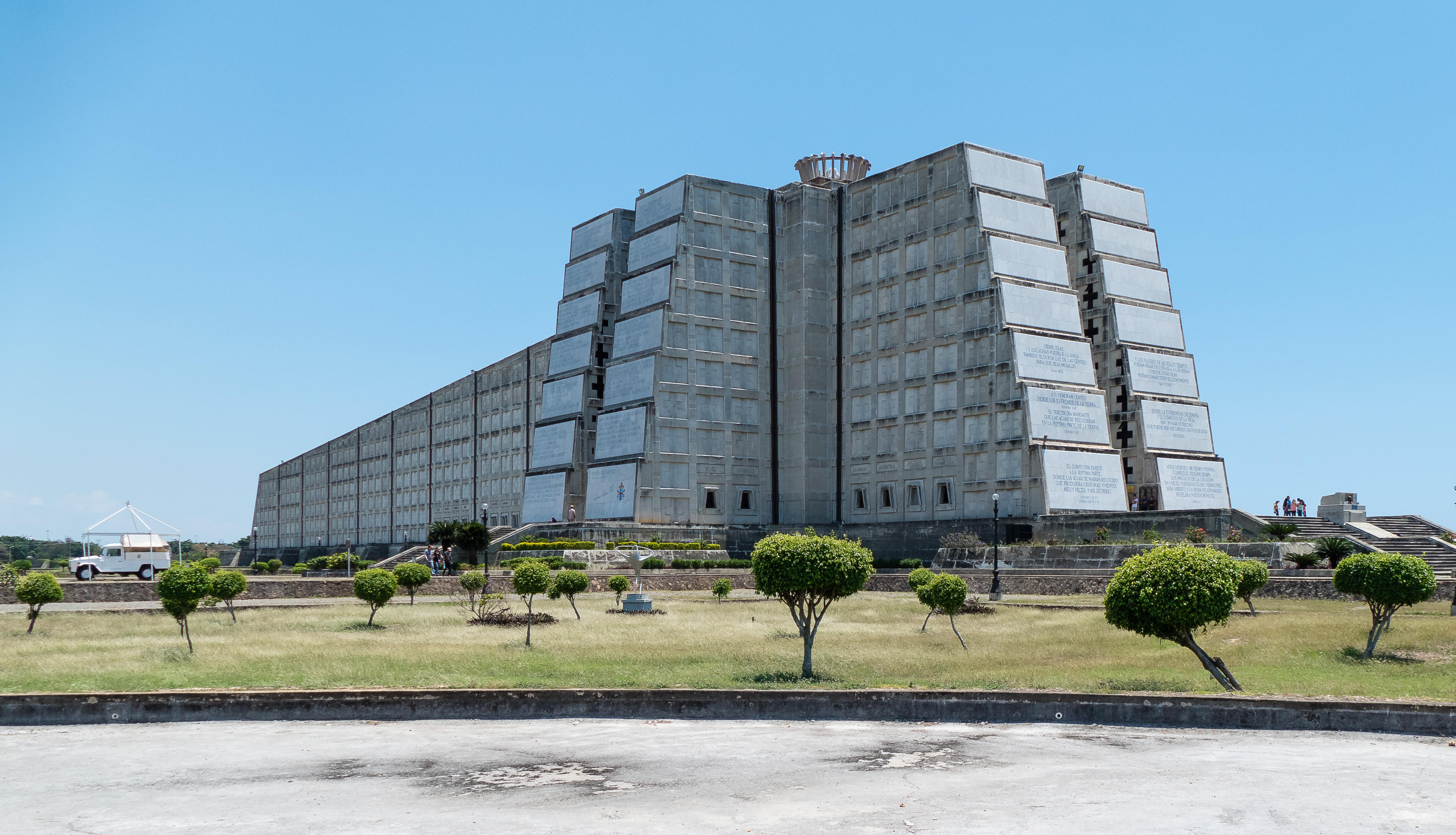
Columbus Lighthouse
Frank Lloyd Wright helped judge the competition. Eliel Saarinen sat beside him. Four hundred and fifty-five architects from 48 countries submitted designs for what would become one of the strangest monuments in the Western Hemisphere - a colossal cross laid flat on the earth, 680 feet long and 195 feet wide, built of reinforced concrete on the outskirts of Santo Domingo. The Columbus Lighthouse is not a lighthouse in any navigational sense. It is a mausoleum, a museum, and a political statement, conceived in 1852, designed in 1931, and not completed until 1992. The light beams that project skyward from its roof form a cross visible from Puerto Rico, some 250 miles away. But the building's most dramatic feature may be what it contains: a glass-covered crypt holding bones that the Dominican Republic insists belong to Christopher Columbus, a claim that Spain disputes with its own set of remains in Seville. The argument has not been settled. Perhaps it never will be.
A Monument 140 Years in the Making
The idea was born in 1852, when Dominican historian Antonio Delmonte y Tejada proposed erecting a monument to Columbus in the city he had founded. It was a modest suggestion for what would become anything but modest. In 1914, an American named William Ellis began promoting the concept of a monumental beacon in Santo Domingo to the press. By 1923, the Fifth International Conference in Chile had decreed that all governments and peoples of the Americas should cooperate to build it. The international design competition, held in Brazil in 1931, drew entries from nearly every corner of the globe. A young Scottish architect named Joseph Lea Gleave won. His design was audacious: a cross-shaped structure lying horizontal, massive enough to be visible from the air, with light beams powerful enough to project a crucifix into the night sky. The ambition was staggering. The funding was not. By 1950, only eight countries had contributed a combined total of less than $15,000.
Decades of Dust
The Dominican government dug the foundation in 1948, unwilling to wait for international generosity that showed no sign of arriving. Then political instability froze everything. For nearly four decades, the site sat dormant - a hole in the ground representing a promise no one seemed able to keep. Construction did not resume until 1986, under President Joaquin Balaguer, who saw the approaching quincentennial of Columbus's 1492 voyage as both deadline and opportunity. Dominican architect Teofilo Carbonell supervised the resurrection of Gleave's decades-old design, adapted now to serve as more than a mausoleum. Balaguer wanted exhibitions from countries across the Americas and beyond, a permanent collection showcasing cultural heritage from every participating nation. The total cost reached approximately $70 million, funded largely by the Dominican Republic and other Latin American states. When the monument opened in 1992, exactly 500 years after Columbus first made landfall in the Caribbean, it had taken 140 years to travel from idea to concrete.
Whose Bones?
The question at the heart of the Columbus Lighthouse is deceptively simple: whose remains actually rest inside? Columbus died in Valladolid, Spain, in 1506. His remains were moved to Seville, then to Santo Domingo's cathedral, then - according to Spain - to Havana in 1795 when Spain ceded the colony, and finally back to Seville in 1898. But the Dominican Republic has always insisted that the Spanish took the wrong bones from the cathedral. In 1877, workers discovered a lead box behind the altar of Santo Domingo's cathedral inscribed with Columbus's name. Those remains are the ones now housed in the lighthouse. DNA testing conducted on the Seville remains in 2006 confirmed that at least some bones there belong to Columbus. The Dominican Republic has declined to allow similar testing on its set. Once a year, on Columbus Day, the crypt opens and visitors can view the remains through glass. The ambiguity is perhaps fitting for a man whose own origins remain debated - born in Genoa, possibly Portuguese, claimed by half a dozen nations in death as in life.
A Cross on the Caribbean Night
Whatever one thinks of the politics, the building itself is an experience. The cross-shaped footprint is enormous - longer than two football fields, wide enough to house exhibition halls from dozens of countries within its arms. Inside, objects range from a boat donated by Cuba to Colombian jewelry, each nation's contribution reflecting its own relationship to the Age of Exploration and its aftermath. The U.S. exhibition, as writer Tony Horwitz noted in 2008, contained a few small photographs of Independence Day celebrations alongside poster-sized reproductions of newspaper front pages from September 11, 2001 - a jarring juxtaposition that says more about American self-perception than about Columbus. At night, when the lights are activated, beams project upward from the roof to form a luminous cross in the sky. The power required is substantial, and in a country where electricity has historically been unreliable, the lights do not always shine. When they do, the cross is visible from neighboring Puerto Rico, a ghostly intersection hanging above the Caribbean that manages to be both spectacular and unsettling.
From the Air
Located at 18.479°N, 69.868°W in Santo Domingo Este, east of the Ozama River. The Columbus Lighthouse is one of the most distinctive structures visible from altitude in the Santo Domingo metropolitan area - its cross-shaped footprint (680 ft x 195 ft) is unmistakable from above, oriented roughly east-west. At night, light beams projecting upward form a cross visible from considerable distance. The monument sits in a park area approximately 5 km east of the Ciudad Colonial. Nearest airport: Las Americas International (MDSD/SDQ) approximately 20 km east. La Isabela International (MDJB/JBQ) is roughly 20 km northwest. Best viewed at 1,500-3,000 feet AGL for the full cross-shaped layout. Tropical maritime climate with typical Caribbean convective weather patterns.