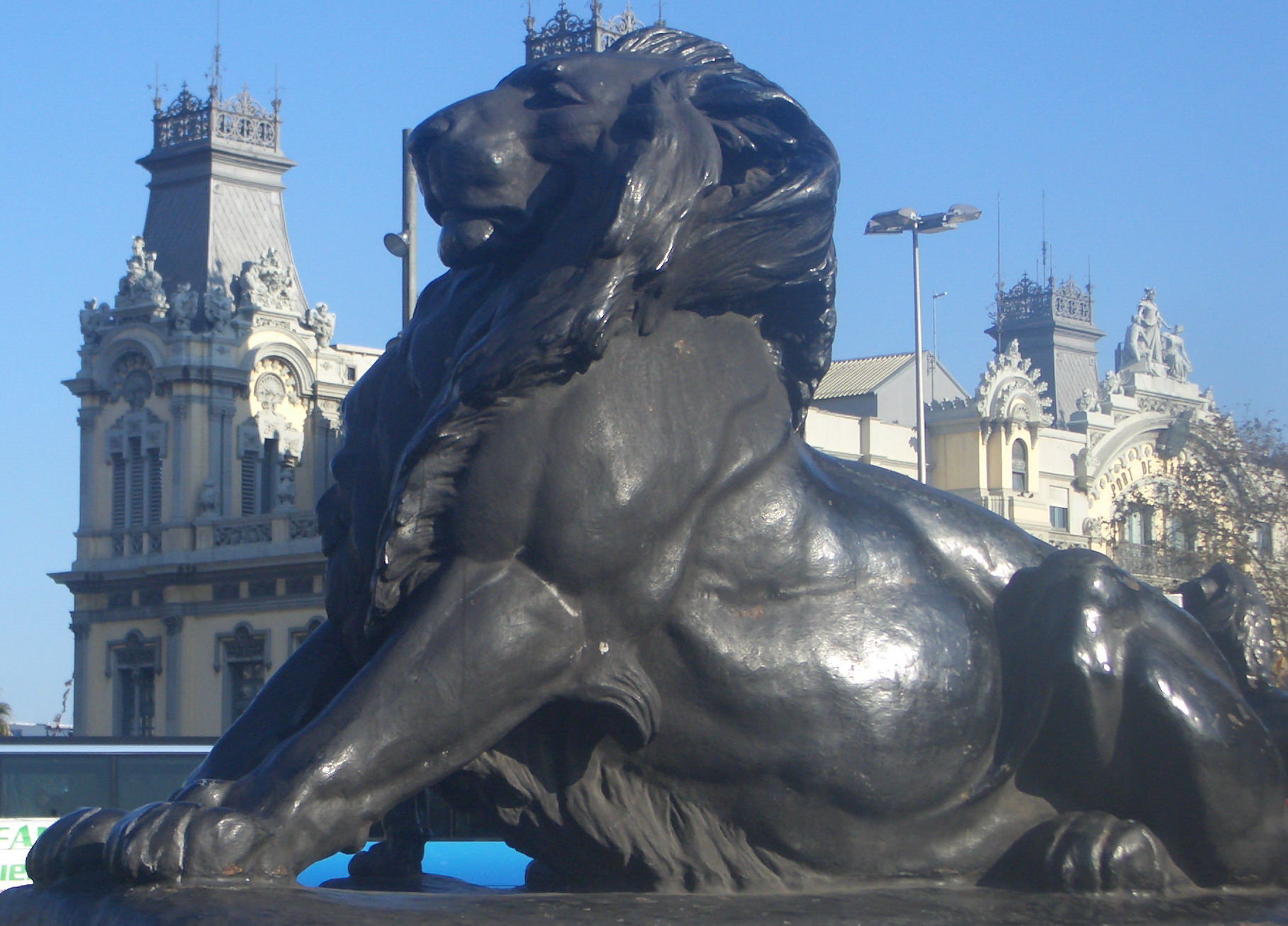
Columbus Monument, Barcelona
Christopher Columbus points south-southeast from the top of his 60-meter column at the foot of La Rambla. He is not pointing toward the Americas. He is pointing, roughly, toward Constantine, Algeria. To aim at his birthplace of Genoa, the 7.2-meter bronze statue would need to face east-northeast up the coast. The most charitable explanation is that sculptor Rafael Atche simply wanted Columbus gesturing toward the open sea, underscoring the achievement of a man who sailed into the unknown. The less charitable explanation is that nobody checked. Either way, Barcelona's most prominent navigational monument has been pointing the wrong direction since 1888.
A Catalan Project
The idea for the monument came in 1856 from Antoni Fages i Ferrer, who proposed that it be built entirely by Catalans. He spent sixteen fruitless years promoting the plan before winning the support of Barcelona's mayor, Francesc Rius i Taulet, in 1872. The city passed a resolution to build in 1881 and held a competition restricted to Spanish artists. The winner was Gaietà Buigas i Monravà, a Catalan architect who designed the Corinthian column, octagonal pedestal, and circular base that together rise to the height of a twenty-story building. Most of the funding came from private Spanish sources; only twelve percent was public money. Construction began in 1882 and finished in 1888, in time for Barcelona's Universal Exposition. Every piece of labor and material was Catalan. The monument to the Genoese explorer who sailed for the Castilian crown is, in its bones, a thoroughly Catalan achievement.
Stories in Bronze
The monument is dense with narrative. Eight bronze bas-relief panels on the plinth depict scenes from Columbus's first voyage: begging for food at the La Rabida Monastery with his young son, persuading the monks of his plan, meeting Ferdinand and Isabella in Cordoba, leaving port from Palos de la Frontera on 3 August 1492, arriving in the New World, and finally greeting the monarchs upon his return to Barcelona. Four seated figures represent the realms of Spain at the time: the Principality of Catalonia and the kingdoms of Leon, Aragon, and Castile. Portrait medallions show the Pinzon brothers, the Catholic Monarchs, and the friars who supported Columbus's venture. At the base, four additional statues include Father Bernat de Boil preaching to a kneeling Native American, a detail that speaks plainly about the colonial enterprise the monument celebrates.
Lions, Griffins, and an Elevator
Eight lions flank the four staircases at the base, their bronze bodies worn smooth by generations of tourists climbing up to touch them. Above them, the octagonal pedestal sprouts four winged victories, or Phemes, launching toward the four corners of the world, paired with griffins in a design that owes more to classical mythology than to 15th-century navigation. The 40-meter Corinthian column is hung with an anchor device, and inside it, an elevator carries visitors to a viewing platform just below Columbus's feet. From that platform, the view sweeps from Montjuic to the Sagrada Familia, from the Gothic Quarter to the Mediterranean, the entire city Columbus saw when he returned from his first voyage laid out in every direction. The word "Tierra" -- land -- is inscribed on the socle beneath the statue, the first cry from the crow's nest that changed the world.
Standing, Still
In 2020, amid global protests over monuments to colonial figures, 250 people marched to demand the statue's removal. Mayor Ada Colau rejected the calls. The pro-independence party CUP had tried to get it removed in 2016, 2018, and 2020, each time unsuccessfully. The monument endures, not because Barcelona is uncritical of Columbus or colonialism, but because the city has chosen a different approach: contextualizing rather than erasing. Slavery tours now depart from the monument's base, reframing the statue as a starting point for confronting Barcelona's participation in the colonial economy. Copies of the monument stand in L'Arboc, Maspalomas, a theme park in Japan, and the Mini-Europe park in Brussels, each one reproducing the same directional error. Columbus points toward Africa from all of them. The original stands where La Rambla meets the sea, pointing confidently in the wrong direction, which may be the most honest tribute to the man who thought he had found Asia.
From the Air
The Columbus Monument (41.376°N, 2.178°E) stands at the junction of La Rambla and the port, a 60m column visible as a vertical landmark at Barcelona's waterfront. Barcelona-El Prat (LEBL) is 12km southwest. The monument marks the transition between the Gothic Quarter and Port Vell. From the air, La Rambla runs as a tree-lined boulevard from Placa Catalunya to the monument, which sits at the port's edge near the Drassanes medieval shipyard.