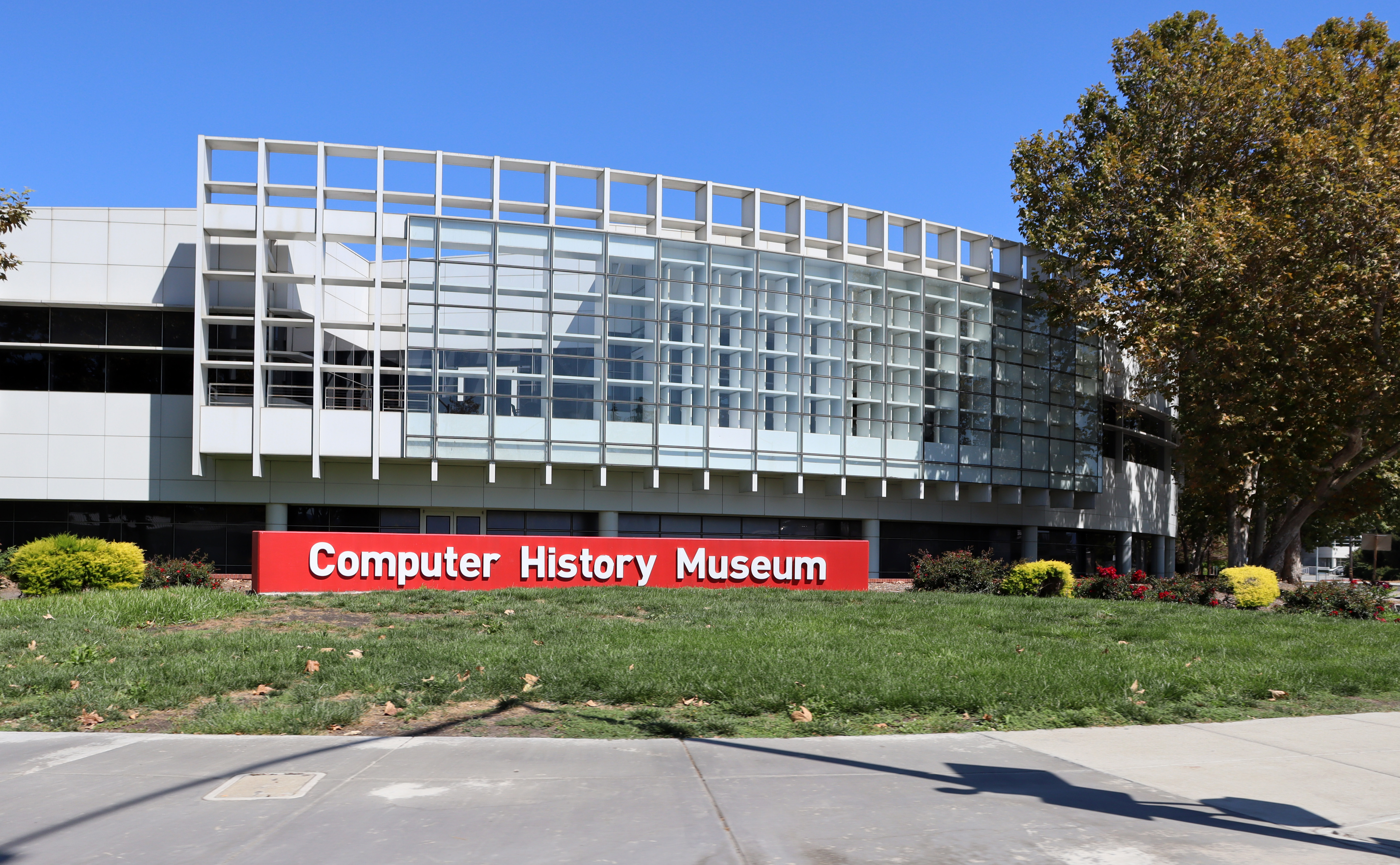
Computer History Museum
The collection started in a coat closet. In 1975, what would become the Computer History Museum held its first exhibit in a converted closet in a Digital Equipment Corporation lobby. That modest beginning has grown into nearly 90,000 objects, including a working Babbage difference engine, the Utah teapot that launched 3D graphics, and a Neiman Marcus Kitchen Computer that sold for $10,000 in 1969 and found no buyers.
From Coat Closet to Campus
The museum traces its origins to 1968, when computer pioneer Gordon Bell began collecting historical machines with an eye toward preservation. Others were simultaneously working to save the Whirlwind, an early MIT computer that pioneered real-time computing. These efforts merged into the Museum Project, which found its first home in that DEC lobby coat closet in 1975. By 1978, the growing collection had moved to a larger DEC lobby in Marlborough, Massachusetts, opening to the public in September 1979 as The Digital Computer Museum. The collection eventually migrated west to Mountain View, California, settling into its current home after a two-year, $19 million renovation that reopened in January 2011.
Artifacts of the Digital Age
The museum's collection reads like a catalog of computing's greatest hits and strangest curiosities. Three generations of Cray supercomputers stand alongside an Apple I, hand-built by Steve Wozniak. The Utah teapot, a simple 3D model that became the standard test object for computer graphics, sits in proximity to an actual teapot. Google donated racks from their first generation of custom web servers. The 1969 Neiman Marcus Kitchen Computer, offered as a luxury holiday gift for $10,600, was marketed as a recipe storage device but required extensive training to operate and never sold a single unit. Over 1,000 oral history interviews capture firsthand accounts from computing pioneers including Donald Knuth, Dame Stephanie Shirley, and the teams behind the IBM PC and the hard disk drive.
Babbage's Dream Made Real
For eight years, the museum displayed a working difference engine based on Charles Babbage's 1840s designs. This was not a replica but a fully functional calculating machine constructed by the Science Museum of London. Babbage never completed his mechanical computer during his lifetime, thwarted by manufacturing limitations and funding troubles. The modern construction proved his designs were sound. The engine, owned by former Microsoft executive Nathan Myhrvold, operated as intended, cranking out mathematical tables through an intricate dance of gears and levers. Visitors could watch nineteenth-century mechanical computing in action until the machine left the museum in January 2016.
Preserving the Code
Beyond hardware, the museum has become a repository for source code that shaped the digital world. Apple donated MacPaint 1.3 in 2010, revealing the assembly language and Pascal code behind the first graphical paint program. Adobe contributed Photoshop 1.0.1 source code in 2013 and PostScript in 2022. Microsoft released early MS-DOS source code and Word for Windows 1.1a. The Xerox Alto operating system, which pioneered the graphical user interface that would eventually inspire both Macintosh and Windows, had its source code released in 2014. In 2023, Apple made the Lisa source code public. Software curator Al Kossow, hired in 2006, oversees preservation and also maintains Bitsavers, a massive online archive of historical computer manuals and firmware.
Silicon Valley's Living Memory
The museum hosts regular public programs featuring technology leaders past and present. Bill Gates, Mark Zuckerberg, Elon Musk, and Eric Schmidt have all appeared. Special events mark computing milestones: the 40th anniversary of the Apple Macintosh, the 50th anniversary of Ethernet. The CHM Fellows program, launched in 1987 with Rear Admiral Grace Hopper as its first inductee, has grown to 100 members who represent the pioneers whose work transformed daily life. The exhibit "Revolution: The First 2000 Years of Computing" spans 20 galleries, tracing the arc from the abacus through the internet, while hands-on exhibits let visitors explore coding. In a building on North Shoreline Boulevard, surrounded by the tech campuses of modern Silicon Valley, the museum preserves the machines and memories of the digital revolution.
From the Air
Located at 37.414N, 122.077W in Mountain View, California. The museum sits along North Shoreline Boulevard near the Shoreline Amphitheatre and Google campus. The distinctive building is visible from above, set against the south San Francisco Bay salt ponds. Nearby airports include Moffett Federal Airfield (KNUQ) 2nm northeast, Palo Alto Airport (KPAO) 4nm south, and San Jose International (KSJC) 8nm southeast. Low-altitude flight restrictions may apply near Moffett.